
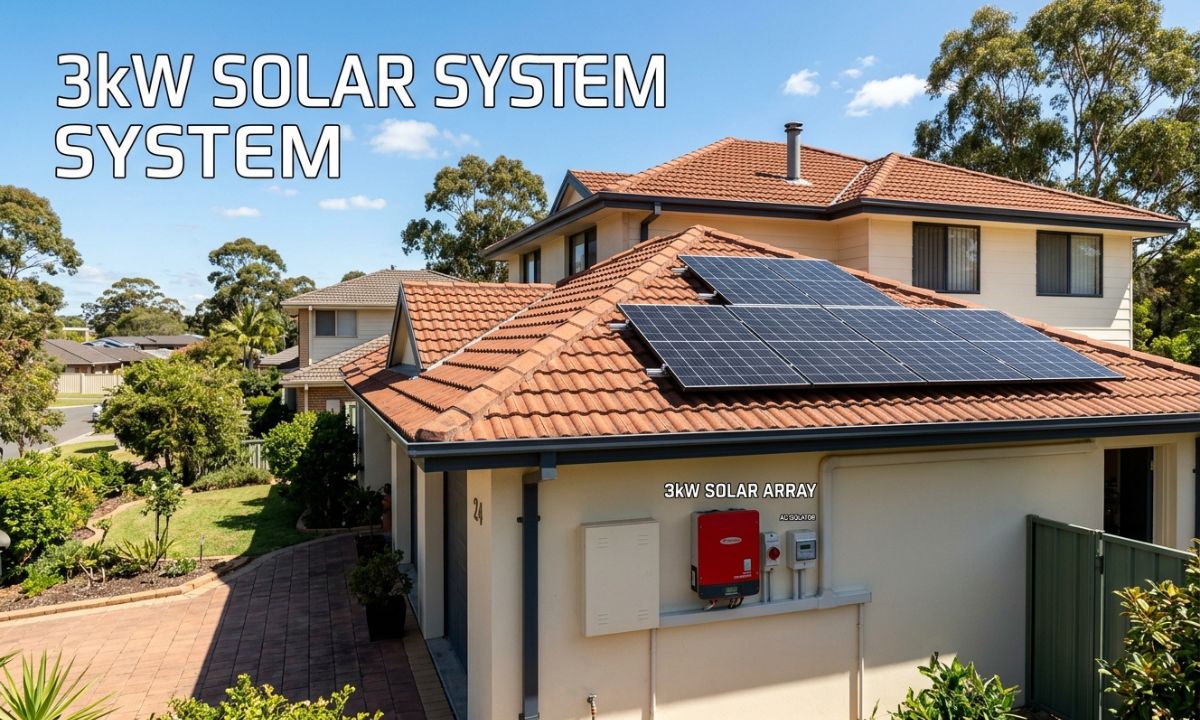
A 3kW solar system is a smart choice for small and medium homes in Pakistan. In 2026, the price for an on-grid setup starts at around PKR 350,000. If you add a battery for backup power, the cost goes up to PKR 600,000 or more. Your final price depends on the panel brand, inverter type, and battery size you pick.
This system works well for homes using 300 to 400 units of electricity every month. It can run your fans, lights, fridge, and even a small AC. Many families choose this size because it fits their budget and their roof space. With net metering, you can also send extra power back to the grid and earn credit on your bill.
Choosing between a hybrid and an on-grid system makes a big difference in price. A hybrid system with a lithium battery costs more, but it keeps your lights on during load shedding.
An on-grid system is cheaper, but it stops working when the power goes out. In this guide, I’ll break down every cost so you can pick the right system for your home.
Estimated System Price
PKR 480,000 – 580,000
Monthly Generation
360 – 400 Units
Annual Generation
4,500+ Units
Estimated Monthly Savings
PKR 22,000+
3kW Solar System Price in Pakistan 2026: At a Glance
I have installed and priced out dozens of 3kW solar systems across Punjab this year. So let me give you the short answer first, then we will go deep into every detail.
In 2026, a basic on-grid 3kW solar system in Pakistan costs between PKR 320,000 and PKR 450,000. If you want a hybrid system with a lithium battery, expect to pay PKR 550,000 to PKR 900,000, depending on the battery size you choose. ‘
Your final bill depends on the panel brand, inverter quality, battery capacity, and your city.
Here is a quick summary table before we break everything down:
| System Type | Price Range (PKR) | Backup During Loadshedding |
| On-grid (no battery) | 320,000 – 450,000 | No |
| Hybrid (no battery, battery-ready) | 390,000 – 450,000 | No |
| Hybrid with lead-acid battery | 450,000 – 600,000 | Limited |
| Hybrid with 5kWh lithium battery | 600,000 – 900,000 | Yes, several hours |
A 3kW system suits homes using 300 to 400 units of electricity every month. It is the most common starting size for small and medium houses in Pakistan. Now let’s understand why the price tag moves around so much.
Why Two 3kW Quotations Can Differ by Several Lakhs
I get this question every week. Two customers show me quotes for the “same” 3kW system, and one is PKR 350,000 while the other is PKR 750,000. Both quotes are honest. They are just for different things.
Here is what actually changes the price:
- Panel brand and grade – Tier-1 panels like Jinko, JA Solar, or Canadian Solar cost more than unbranded or B-grade panels.
- Inverter type – An on-grid inverter is cheaper than a hybrid inverter, and a hybrid inverter is cheaper than one with a large battery bank attached.
- Battery presence and size – This is the biggest price swing. No battery keeps the cost low. A 5kWh lithium battery alone can add PKR 200,000 to 300,000.
- Installation quality – Proper earthing, cable size, and a trained technician cost more than a rushed job, but they protect your system for years.
- Net metering or net billing application – This paperwork and equipment can add PKR 15,000 to 80,000, depending on your installer and DISCO.
- City and transport – Karachi, Lahore, and Islamabad usually get better rates than smaller towns because of competition and lower delivery costs.
Pro tip from my own site visits: Always ask your installer to write down the exact panel wattage, inverter model, and battery brand on the invoice.
A vague quote like “3kW system – all included” is a red flag. I have seen customers pay full price for undersized wiring and thin, low-grade cables that failed within a year.
What is Included in a Complete 3kW Solar System?
A full 3kW solar system is not just panels on your roof. It is a set of parts working together. A complete package should include:
- Solar panels – Usually 5 to 6 panels, depending on wattage.
- Solar inverter – Converts DC power from panels into AC power for your home.
- Mounting structure – The metal frame that holds panels on your roof.
- DC cables and AC cables – Carry electricity safely between parts.
- DC protection box – Fuses and breakers that protect against short circuits.
- Earthing kit – Protects your home and equipment from lightning and faults.
- Battery (optional) – Only needed for hybrid or off-grid setups.
- Net metering equipment – A bi-directional meter, if you plan to export extra power to the grid.
If any of these items are missing from your quote, ask why. A missing earthing kit or thin DC cable might save you a few thousand rupees today, but it can damage your inverter later.
How Many Solar Panels are Needed for a 3kW System?
This depends on the wattage of each panel. Panels sold in Pakistan today are usually rated between 550W and 610W. Here is a simple table to explain it:
| Panel Wattage | Panels Needed for 3kW | Approx. Roof Space Needed |
| 550W | 6 panels | 130–140 sq. ft |
| 580W | 5–6 panels | 120–135 sq. ft |
| 600W | 5 panels | 115–125 sq. ft |
Real installer tip: I always tell my customers to leave a small buffer. If your roof allows one extra panel, add it. Panels lose some output on very hot days and cloudy days. A slightly oversized panel array helps your system perform closer to its rated output all year, not just in perfect weather.
Which Solar Panel is Best for a 3kW System?
For a home-sized 3kW system, I usually recommend monocrystalline panels. They cost a little more than polycrystalline panels, but they give more power in less roof space and last longer.
Popular and trusted panel brands in the Pakistani market right now include:
- Jinko Solar
- JA Solar
- Canadian Solar
- LONGi
- Trina Solar
What to check before buying:
- Tier-1 certification – This means the manufacturer is financially strong and likely to honor warranty claims.
- 25-year performance warranty – Standard for good-quality panels.
- Efficiency rating – Look for panels above 21% efficiency for the best output in limited roof space.
Pro tip: Fake or refurbished panels are common in the local market, especially with well-known brand names printed on them.
Always buy from an authorized dealer and ask for a serial number you can verify with the manufacturer’s app or website.
How Much Electricity Does a 3kW Solar System Produce?
On a sunny day in Pakistan, a properly installed 3kW solar system produces around 12 to 15 units of electricity. Over a full month, that adds up to about 360 to 420 units.
This output changes with the season:
- Summer months – Higher output due to longer daylight hours, though extreme heat slightly reduces panel efficiency.
- Winter months – Shorter days mean lower daily output, often around 8 to 11 units per day.
- Monsoon and cloudy days – Output can drop by 30% to 50% on heavily overcast days.
Pro tip: Panel direction and tilt matter a lot. In most of Pakistan, panels facing south at a tilt close to your city’s latitude angle give the best year-round output.
A wrongly angled panel can lose 10% to 15% of its potential output every single day, for 25 years.
How Many Appliances can run on a 3kW Solar System?
A 3kW system is built for daytime household loads, not for running your entire home at full capacity around the clock. It works best when you run your heavier appliances during sunlight hours.
With good sunlight, a 3kW system can comfortably run:
- Fans, LED lights, and a router
- A refrigerator
- A television
- A washing machine (during the day)
- Mobile and laptop charging
- One small inverter AC, used carefully
Typical Appliance Power in a Pakistani Home
| Appliance | Approx. Power (Watts) |
| LED bulb | 10–15W |
| Ceiling fan | 60–80W |
| LED TV (32–43 inch) | 60–120W |
| Wi-Fi router | 10W |
| Refrigerator (running) | 100–200W |
| Washing machine | 300–500W |
| Iron | 1000W |
| Water motor (0.5–1 HP) | 375–750W |
| 1-Ton inverter AC (running) | 900–1200W |
| 1.5-Ton inverter AC (running) | 1400–1800W |
Pro tip: Add up your daytime loads before buying a system. If your total daytime load is close to 3000W, you are at the edge of what a 3kW system can handle comfortably.
Leave some room, especially if you plan to add more appliances later.
3kW Solar System with Battery Price 2026
Adding a battery changes both your price and your comfort level during loadshedding. Here is what current 2026 market pricing looks like for a 3kW hybrid system:
| Battery Type | Storage Size | Added Cost (PKR) | Backup Hours (basic load) |
| Lead-acid (tubular) | 2 batteries (~4–5kWh) | 80,000 – 150,000 | 2–4 hours |
| Lithium (LiFePO4) | 5kWh | 200,000 – 300,000 | 4–6 hours |
| Lithium (LiFePO4) | 10kWh | 400,000 – 550,000 | 8–10 hours |
Lead-acid batteries are cheaper upfront but need replacement every 2 to 3 years and take up more space.
Lithium batteries cost more today, but many now come with 6-year to 7-year replacement warranties and last far longer, which usually makes them the better long-term investment.
A Comfortable Daytime Load without AC
If you skip the AC and just run fans, lights, a fridge, TV, and a washing machine, a 3kW system without a battery handles this easily during the day. This is the cheapest and simplest setup, and it is what I recommend for most small families who mainly want to cut their electricity bill.
A Managed Daytime Load with One Inverter AC
If you want to run one small inverter AC during the day along with your usual appliances, you need to be more careful. Run the AC on a low or “eco” mode, avoid running the washing machine and AC together, and keep an eye on cloudy-day performance.
This setup works, but it needs some daily discipline from your side.
Can a 3kW Solar Panel System run an AC?
Yes, but with limits. A 3kW system can usually run one 1-Ton inverter AC comfortably during strong sunlight hours. Running a 1.5-Ton AC is possible but tighter, especially if other appliances are also switched on at the same time.
What you should NOT expect:
- Running two ACs at once
- Running an AC all night without a large battery
- Running an AC on a heavily cloudy day at full cooling power
Pro tip: Inverter ACs are much friendlier to solar systems than old-style non-inverter ACs, because they draw less power once the room is cool. If AC comfort is your main goal, consider stepping up to a 5kW system instead, which we compare later in this guide.
Battery Options for a 3kW Solar System
You have three main battery paths for a 3kW system:
- No battery (pure on-grid) – Cheapest option. You use solar power during the day and grid power at night. No backup during outages.
- Lead-acid battery bank – Lower upfront cost, shorter lifespan, needs regular water top-up and ventilation space.
- Lithium (LiFePO4) battery – Higher upfront cost, but compact, low-maintenance, and built for thousands of charge cycles.
Popular lithium battery options in the Pakistani market today include local and international brands with 5kWh, 10kWh, and larger modular units that can be stacked together as your needs grow.
What can a 5kWh Lithium Battery Run?
A 5kWh lithium battery is one of the most common sizes for a 3kW home system. On a single full charge, it can typically run:
- Fans, lights, router, and TV for a full evening
- A fridge running through the night
- Mobile charging and a few small devices
It is usually not enough to run a full-size AC through the night. Think of a 5kWh battery as your evening comfort and essential-load backup, not a way to run your whole house through a 6-hour loadshedding period at full power.
On-grid, Hybrid, or Off-grid: Which 3kW System is Right?
| Type | Battery | Works During Loadshedding | Best For |
| On-grid | No | No | Lowest cost, pure bill reduction |
| Hybrid | Optional/Yes | Yes, if battery installed | Most Pakistani homes |
| Off-grid | Yes (required) | Yes, fully independent | Remote areas with no grid access |
For most homes I visit in Punjab, I recommend a hybrid system. It gives you the option to add a battery now or later, works with net billing, and gives backup power when you need it most.
Pure off-grid systems only make sense if you have no reliable grid connection at all, since they need a bigger battery bank to cover every single load.
How the 2026 Prosumer Rules Affect Savings
This is important, and many customers still don’t know about it. In February 2026, NEPRA replaced the old net metering system with a new net billing system under the Prosumer Regulations 2026.
Here is what changed in simple words:
- Old system (net metering): One unit exported to the grid equaled one unit imported later. Your meter simply ran backward.
- New system (net billing): Exported units are now bought back at a much lower rate, close to PKR 10 to 15 per unit, while imported grid units are still charged at the full consumer tariff, which can be PKR 37 to 55 per unit.
What this means for your 3kW system:
- Sending extra power back to the grid is now worth much less than before.
- Using your own solar power directly, as you generate it, is now far more valuable than exporting it.
- A well-sized system that matches your daytime usage, possibly with a battery to store extra power for the evening, now makes more financial sense than an oversized, export-heavy system.
Pro tip: If you are installing solar in 2026, size your system to your own daytime and evening needs first.
Do not oversize it hoping to earn money from exports. That strategy worked well under the old rules, but it does not pay off the same way anymore.
3kW Solar System Benefits and ROI in Pakistan
Even with the new billing rules, solar still makes strong financial sense in Pakistan, because grid electricity is expensive and rising. Here are the main benefits:
- Lower monthly electricity bills, often by 60% to 90% for daytime-heavy households.
- Protection from future tariff hikes, since your solar power cost stays fixed once installed.
- Backup power during loadshedding, if you choose a hybrid system with a battery.
- A working system for 25+ years, since quality panels are built to last that long.
Simple On-grid ROI Example
Let’s walk through a simple example, using rounded numbers:
- System cost: PKR 400,000 (on-grid, no battery)
- Average monthly bill before solar: PKR 15,000
- Average monthly bill after solar: PKR 3,000
- Monthly savings: PKR 12,000
- Payback period: 400,000 ÷ 12,000 ≈ 33 months, or just under 3 years
After that payback period, your solar electricity is essentially free for the rest of the panel’s life, aside from occasional maintenance.
Use this ROI Formula with your own Bill
You can work out your own payback period with this simple formula:
Payback Period (months) = System Cost ÷ Monthly Savings
To use it:
- Get 2 to 3 quotes for your exact system size.
- Check your last 3 months of electricity bills and find your average.
- Estimate your new bill after solar (your installer should help with this).
- Subtract the new bill from the old bill to get your monthly savings.
- Divide your system cost by your monthly savings.
Pro tip: Be honest with your usage estimate. I have seen customers get disappointed because their installer promised a “zero bill” without checking their actual night-time and cloudy-day consumption. A realistic ROI estimate protects you from false promises.
3kW versus 3.5kVA Solar System
This causes a lot of confusion, so let me clear it up simply. 3kW usually refers to the total wattage of your solar panels. 3.5kVA usually refers to the size rating of your inverter.
Many installers pair a 3kW panel array with a 3.5kVA inverter on purpose. This gives the inverter a little extra headroom, so it is not working at its absolute maximum limit all the time. This can improve performance on bright days and slightly extend the inverter’s working life.
| Term | What it Measures | Typical Pairing |
| 3kW | Solar panel capacity (DC) | Paired with a 3.5kVA or similar inverter |
| 3.5kVA | Inverter output capacity (AC) | Can accept slightly more panel wattage than 3kW |
Pro tip: When comparing quotes, always check both numbers. A “3.5kVA system” with only 2.5kW of panels will underperform a true 3kW panel array, even though the inverter sounds bigger.
3kW versus 5kW Solar System Price in Pakistan
Many families ask me whether to go for a 3kW or 5kW system. Here is a straight comparison:
| Feature | 3kW System | 5kW System |
| On-grid price (PKR) | 320,000 – 450,000 | 500,000 – 700,000 |
| Hybrid + battery price (PKR) | 600,000 – 900,000 | 850,000 – 1,300,000 |
| Monthly units produced | 360–420 | 600–700 |
| Best-suited monthly bill | 300–400 units usage | 500–700 units usage |
| Can run a 1.5-ton AC comfortably | Tight | Yes |
My honest advice: If your monthly electricity usage is consistently above 500 units, or you want to comfortably run an AC and a few other heavy appliances together, the 5kW system is usually worth the extra cost.
If your usage sits closer to 300–400 units, a 3kW system gives you a faster payback and avoids paying for capacity you will not use.
Solar Price in Pakistan on Installment
Not everyone can pay the full price upfront, and that is completely normal. Several routes exist in Pakistan for buying solar on installments:
- Bank solar financing schemes, offered by several commercial banks with a markup rate.
- Vendor-based installment plans, offered directly by some solar retailers and marketplaces for specific package sizes, including 3kW packages.
- Solar leasing or “pay-as-you-save” models, where a company installs the system, and you pay a fixed monthly amount, sometimes lower than your old electricity bill.
Pro tip: Before signing any installment plan, ask for the total repayment amount, not just the monthly figure.
A low monthly payment can hide a much higher total cost once markup is added over 2 to 3 years. Compare this total against simply saving up and buying the system outright.
Should you Buy a 3kW Solar System from OLX?
I get asked this often, since OLX has plenty of solar listings. My honest answer: buy carefully, not blindly.
Reasonable things to buy used:
- Mounting structures and stands, if in good physical condition
- Cables, as long as you check for damage or wear
Riskier things to buy used:
- Panels – Hard to verify true output without proper testing equipment. Hidden micro-cracks reduce performance over time.
- Inverters – Often sold used because they are already showing problems.
- Batteries – The riskiest. A used battery’s remaining life is very hard to judge just by looking at it.
Pro tip: If you do buy used equipment, ask the seller to demonstrate it running under load before you pay, and avoid used lithium batteries unless you can check their cycle count and health report.
For Solar panels and inverters especially, buying new from an authorized dealer with a warranty is almost always worth the extra cost in the long run.
Where Luminey Fits in a 3kW Home Solar Plan
Luminey is a Pakistan-focused solar brand offering both hybrid inverters and LiFePO4 lithium batteries, with power ranges covering small home systems like 3kW right up to large commercial setups.
For a 3kW home system, Luminey’s smaller hybrid inverters and modular battery units, such as their 5kWh wall-mounted lithium batteries, are a practical fit. These batteries are designed to stack, so you can start with one 5kWh unit and add more later if your needs grow, without replacing your whole battery bank.
What stands out with this kind of setup:
- Modular batteries that expand as your budget allows
- Long replacement warranties on several lithium models, which reduces long-term risk
- Local service support, which matters a lot when something needs a warranty claim in Pakistan
Pro tip: Whichever battery brand you choose, ask specifically about the warranty terms for capacity loss, not just outright failure. A battery that still “works” but only holds 60% of its original charge after 3 years is a real problem many buyers do not think to ask about upfront.
How to Choose the Best 3kW Solar System with Battery
After years of doing this, here is my simple checklist for picking a solid 3kW system:
- Match the system to your daytime load first, not just your total monthly bill.
- Choose Tier-1 panels from a brand you can verify.
- Pick a hybrid inverter, even if you skip the battery for now, so you can add one later.
- Decide between lead-acid and lithium based on your budget and how often you face long loadshedding.
- Get the exact brand, model, and wattage written on your invoice, not vague descriptions.
- Ask about warranty terms in detail, including battery capacity loss over time.
- Confirm net billing paperwork and costs are included, so there are no surprise charges later.
- Get at least 2 to 3 quotes before deciding, and compare them item by item, not just by the final price.
Final words
A 3kW solar system remains one of the smartest investments for a small Pakistani household in 2026. It cuts your electricity bill, protects you from future tariff hikes, and pays for itself within a few years under normal daytime usage.
The market has more options today than ever before, from budget on-grid setups to fully-loaded hybrid systems with lithium battery backup. The right choice depends on your actual electricity usage, your budget, and how much backup power you need during loadshedding.
Take your time, compare real quotes with exact specifications, and don’t rush into buying just because a price looks attractive. A well-planned 3kW system, installed properly, will keep your home running comfortably and your bills low for the next 25 years.
“FAQs”
What can a 3kW solar system run?
A 3kW system runs your fans, lights, fridge, TV, and washing machine during the day. It can also handle one small inverter AC if you use it carefully.
How many ACs can run on 3kW?
A 3kW system can run one 1-Ton inverter AC comfortably. Running two ACs together is not realistic at this size.
Can a 3kW solar system run an AC?
Yes, a 3kW system can run one small inverter AC during strong sunlight hours. At night, you will need a battery for the AC to keep running.
How many solar panels are needed for 3kW?
You need 5 to 6 solar panels for a 3kW system, depending on the wattage. Most installers use 550W to 600W panels today.
How many batteries are required for a 3kW solar system?
Most homes use one 5kWh lithium battery or two tubular batteries for a 3kW system. This gives a few hours of backup for basic loads.
Can I run a 1.5 Ton AC on a 3kW solar system?
Running a 1.5-Ton AC on a 3kW system is possible but tight, especially with other appliances on. For comfortable AC use, a 5kW system works better.
How long will a 3kWh battery last?
A 3kWh battery can run basic loads like fans, lights, and a fridge for around 2 to 3 hours. It is not enough to run an AC for long.
Is 3kW enough for a house?
A 3kW system is enough for small homes using 300 to 400 units of electricity monthly. For bigger homes with more appliances, a 5kW system fits better.

I AM CH SAMI ULLAH, THE TOP SOLAR PANEL SELLER AND INSTALLER IN PAKISTAN, WITH CHEAPEST RATES, OF TOP QUALITY. GET THE LATEST RATES ON SOLAR PANELS, FANS, ACs, TUBE WELLS, SOLAR FRIDGES, AND SOLAR ATTA CHAKKIS. WHATSAPP (03461320821)