
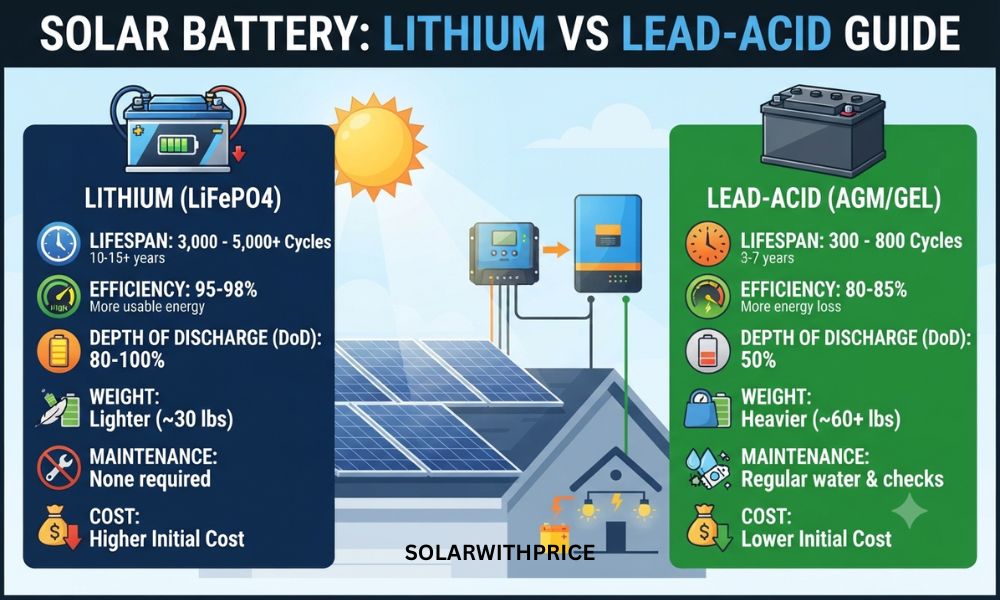
Solar battery prices in Pakistan have changed a lot in 2026, with lithium finally becoming affordable for everyday homes instead of just commercial projects nowadays. If you are comparing lithium and lead-acid batteries before buying, this guide breaks down real PKR pricing, lifespan, and which option actually saves you money in 2026.
The latest solar battery price today is only 50,000 to 80,000 for lead-acid and 150,000 to 250,000 rupees for lithium or dry battery in Pakistan in 2026. The Solar Battery Price depends on size, capacity, AH, and number of plates, as well as the latest technology.
It is very informative news that Most Pakistani households still default to tubular batteries because the upfront cost looks smaller in 2026. But once you factor in usable capacity, replacement cycles, and maintenance, the actual price picture looks very different once you calculate it over several years.
In this guide, we compare lithium (LiFePO4) and lead-acid tubular battery prices side by side, look at top brands like Pylontech, Phoenix, and Osaka, and help you figure out exactly what battery size and budget fits your home in 2026.
Lithium-Ion vs Lead-Acid Battery 2026: The Core Comparison
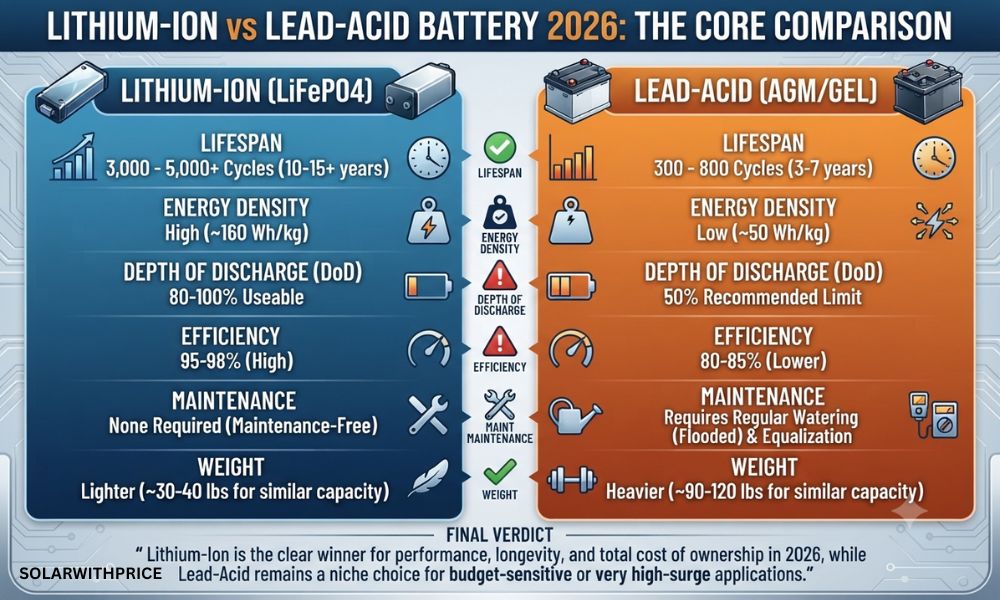
Before picking a brand, you need to understand the two technologies themselves. Here is a side-by-side look at how lithium and lead-acid batteries perform in real Pakistani homes.
| Feature | Lithium (LiFePO4) | Lead-Acid (Tubular) |
| Usable capacity (Depth of Discharge) | 90-100% | 50% |
| Cycle life | 4,000-8,000 cycles | 800-1,200 cycles |
| Expected lifespan (daily use) | 10-16+ years | 2-4 years |
| Maintenance | None | Monthly water top-up |
| Weight | Light (15-20 kg for 5kWh) | Heavy (40-60 kg per battery) |
| Charging speed | Fast | Slower |
| Safety | No fire risk, stable chemistry | Produces hydrogen gas, needs ventilation |
| Upfront cost | High | Low |
| Space needed | Compact, wall-mountable | Bulky, needs battery room |
| Warranty (typical) | 5-10 years | 6-12 months |
My personal experience: The biggest number to notice here is depth of discharge. A lead-acid battery is only rated for 50% usable capacity, meaning a 200Ah battery really only gives you about 100Ah of safe, usable power before it starts to damage the plates.
My pro tip: A lithium battery of the same rated size gives you nearly all of it. This single fact is why lithium batteries can be smaller in rated capacity and still outperform much larger lead-acid banks.
Lithium Iron Phosphate (LiFePO4)
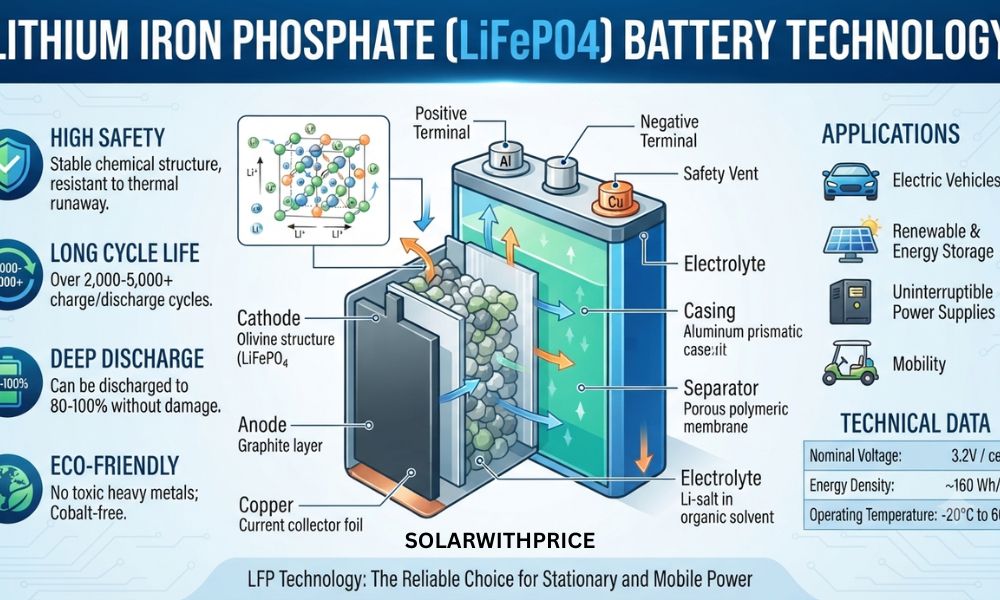
My personal experience: LiFePO4 is the lithium chemistry used in almost every solar battery sold in Pakistan today, from Pylontech to BYD to local brands like Dyness and Crown.
It is different from the lithium-ion cells used in phones and laptops. LiFePO4 is far more thermally stable, does not catch fire even under stress, and holds its capacity for thousands of charge cycles.
Key advantages of LiFePO4 for Pakistani homes:
- High usable capacity — you can safely use 95-100% of the rated kWh
- Long cycle life — most models are rated for 6,000+ cycles at 80% capacity retention
- Zero maintenance — no water refilling, no acid, no float checks
- Fast charging — recovers quickly during short sunny windows, useful in cloudy or hazy weather
- Modular and expandable — you can add more battery units later without replacing the whole system
- Built-in BMS (Battery Management System) — automatically protects against overcharging, short circuits, and overheating
My pro tip: The only real downside is the upfront price, which is still 2-3 times higher per kWh than a comparable lead-acid setup.
Lead-Acid (Tubular)
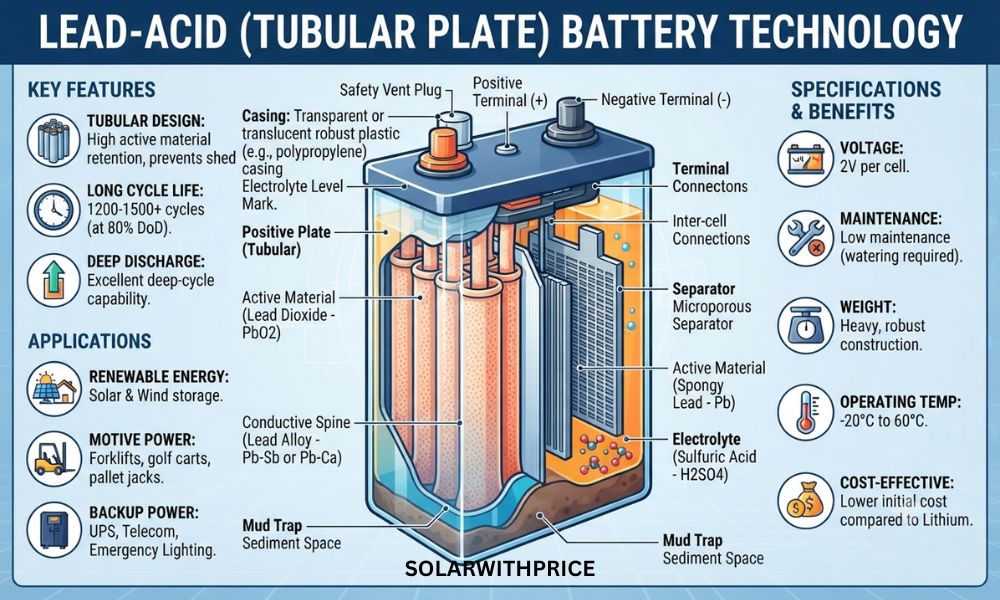
Tubular batteries have been the backbone of Pakistan’s UPS and solar market for over two decades. These batteries are charged by solar panels power at daytime and used at night.
Brands like Phoenix, Osaka, AGS, and Exide dominate this space, and for good reason — tubular technology is well understood, repairable, and widely available even in small towns.
Key characteristics of tubular batteries:
- Lower upfront cost — a major reason they remain popular for tight budgets
- Widely available — every electrician and battery shop in Pakistan can service or replace them
- Deep-cycle design — built to handle repeated charge-discharge cycles better than a plain lead-acid battery
- Requires monthly maintenance — water levels must be checked and topped up with distilled water
- Shorter lifespan — most tubular batteries need replacement every 3-4 years with regular solar use
- Heavier and bulkier — needs a dedicated, ventilated space due to gas venting
My pro tip: For someone who wants the lowest possible entry cost and doesn’t mind occasional maintenance, tubular batteries still make sense in specific situations, which we cover further down.
Lifetime Cost: Where Lithium Wins
This is the section most people skip, and it is the most important one. Comparing sticker price alone is misleading. What actually matters is cost per kWh delivered over the life of the battery.
| Cost Factor | Lithium (LiFePO4) | Lead-Acid (Tubular) |
| Approx. upfront cost per kWh | PKR 30,000-45,000 | PKR 15,000-22,000 |
| Usable capacity | ~95-100% | ~50% |
| Replacements needed in 12 years | 0-1 | 3-4 |
| Total cost over 12 years (per kWh, approx.) | Roughly 1x (single purchase) | Roughly 2.5x-3x (repeated replacement) |
| Maintenance cost over 12 years | Minimal | Distilled water, labour, occasional plate damage repairs |
A quality lithium battery bought once in 2026 can realistically outlast three to four tubular battery replacements over the same period.
Once you factor in the 50% usable capacity of lead-acid versus the near-100% usable capacity of lithium, the real cost per usable kWh tilts heavily in lithium’s favour — even though the upfront number looks scarier.
My pro tip: The break-even point usually appears somewhere between year 4 and year 6, right around the time a tubular battery bank needs its first full replacement.
After that point, lithium keeps running while lead-acid users are back at the shop buying new batteries.
Latest Lithium Battery Prices in Pakistan 2026
| Battery (Brand & Model) | Voltage / Capacity | Price Range (PKR) | Best For |
|---|---|---|---|
| Inverex 12V 100Ah | 12V / 100Ah | ~80,000 | Small UPS/backup loads |
| MaxPower 12.8V 100Ah | 12.8V / 100Ah | ~60,000 | Entry-level home backup |
| Crown 25.6V 100Ah | 25.6V / 100Ah | ~123,000 | Mid-size inverter setups |
| Knox 51.2V 100Ah (5kWh) | 48V/51.2V / 100Ah | 227,000 – 250,000 | Standard home solar (1–2 AC) |
| Fronus 48V 100Ah (5kWh) | 48V / 100Ah | ~185,000 | Standard hybrid inverter systems |
| Dyness 5.12kWh (DL5.0) | 51.2V / 100Ah | 252,000 – 370,000 | Premium home solar, IP55, 6,000+ cycles |
| Pylontech UF5000 | 48V / 5kWh | ~310,000 | High-reliability solar storage |
| Crown 51.2V 230Ah | 51.2V / 230Ah | ~557,000 | Large homes / commercial backup |
| Fronus 48V 300Ah | 48V / 300Ah | ~530,000 | High-capacity commercial use |
| 14–16kWh systems (various brands) | 48V/51.2V | 420,000 – 780,000+ | Full off-grid / overnight independence |
Latest Lead-Acid Battery Prices in Pakistan 2026
| Battery (Brand & Model) | Type / Capacity | Price Range (PKR) | Best For |
|---|---|---|---|
| Phoenix XP145 (110Ah) | Standard lead-acid | ~9,000 | Small home UPS (fans, lights) |
| Osaka small solar battery | Lead-acid | ~5,699 | Budget/entry backup |
| Phoenix UGS 135/190 | Dry lead-acid | 11,000 – 18,000 | 2–4 fans, lights, TV backup |
| Exide TR-1800 | Tubular (185Ah) | ~45,700 | Medium home solar/UPS |
| Osaka TA-1800 / HT-1800 (185Ah) | Tubular | ~41,890 | Fast-charging, frequent short outages |
| Phoenix TX-1800 | Tall tubular | 43,000 – 59,000 | Best backup time, solar-paired systems |
| Phoenix XP230/TX-2500 (190–230Ah) | Tubular | 22,000 – 60,000 | Larger homes, longer backup |
| Osaka HT-2000/2500 (200–230Ah) | Tubular | 45,000 – 55,000 | 5kW solar systems |
| Exide TR-3000/TR-3500 | Heavy tubular (280Ah+) | 60,000 – 73,200 | High-load homes, commercial |
| Osaka Tubular HT-3500 (280Ah) | Tubular | ~69,030 | Heavy-duty backup |
Battery Sizing for Pakistani Homes
Battery sizing depends on what loads you want to run and for how many hours during load shedding. Here is a simple sizing table based on common Pakistani household setups.
| Home Type | Typical Load | Backup Needed | Recommended Battery Size |
| Small apartment / 1-2 rooms | Fans, lights, WiFi, TV | 4-6 hours | 3-5 kWh |
| Medium home (3-4 rooms) | Fans, lights, fridge, WiFi | 6-8 hours | 5-10 kWh |
| Large home with 1 AC | Above + 1 inverter AC overnight | 8+ hours | 10-15 kWh |
| Large home with 2+ ACs | Above + additional AC units | Full night | 15-20+ kWh |
A rough formula that installers use: take your running load in watts, multiply by the number of backup hours you want, then add 20% extra for system losses and BMS overhead.
My personal experience: For example, an 800-watt load running for 6 hours needs roughly 4.8 kWh of usable capacity, so you would round up to a 5kWh lithium battery or a larger lead-acid bank to account for its 50% usable limit.
Top Solar Battery Brands in Pakistan (2026)
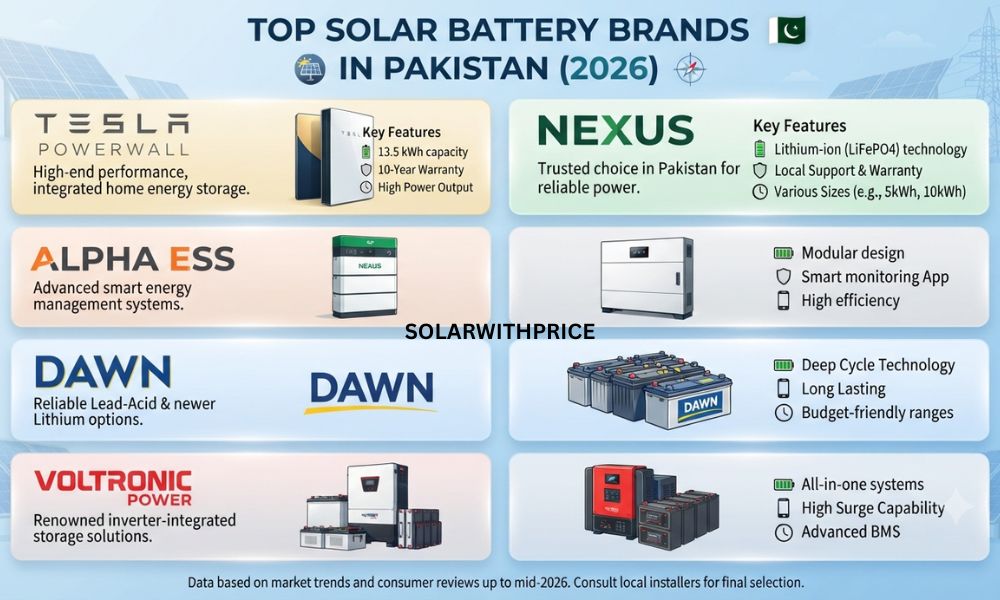
Pylontech (US2000 / US3000 / US5000)
Pylontech is the most widely installed lithium battery brand in Pakistan’s solar market in 2026. It uses a stackable 48V architecture compatible with almost every hybrid inverter sold here, including Growatt, Deye, Sungrow, and GoodWe.
Standard models like the US3000 (3.5kWh) and US5000 (4.8kWh) can be stacked up to 8 units in parallel, giving households a clear upgrade path without replacing the inverter.
My personal experience: Most Pylontech models carry a 10-year warranty with 6,000+ cycle ratings, and current market pricing sits around PKR 40,000-45,000 per kWh depending on the model and dealer.
BYD (B-Box Series)
BYD’s B-Box series is a premium LiFePO4 option known for solid build quality and strong compatibility with major hybrid inverters.
It is less common than Pylontech in the local market but is trusted by installers who want an alternative premium brand with similarly long cycle life and warranty coverage.
MaxPower
MaxPower is a budget-friendly lithium option gaining traction among installers who want to offer LiFePO4 backup at a lower entry price than Pylontech or BYD.
My personal experience: Build quality and after-sales support vary more by dealer, so buyers should confirm warranty terms directly with their supplier before purchase.
Tesla Powerwall
Tesla Powerwall is not officially distributed in Pakistan, and any unit found locally is typically grey-imported without factory warranty support or authorized servicing.
For most Pakistani buyers, Pylontech or BYD deliver comparable performance with proper local warranty backing, making them the more practical choice.
Phoenix / Osaka (Lead-Acid Tubular)
Phoenix and Osaka remain the two biggest names in tubular batteries in Pakistan, and they are essentially twin rivals in performance.
Phoenix tends to hold slightly better resale value and handles deep discharge a bit better, while Osaka charges faster, which helps in areas with short, frequent outages rather than long ones.
My personal experience: A popular 200Ah tubular battery from either brand currently costs roughly PKR 25,000-30,000, with typical warranties of 6-12 months and an expected lifespan of 3-4 years under regular solar use.
When You Need a Battery (And When You Do Not)
Not every solar system needs a battery. This is one of the most misunderstood parts of going solar in Pakistan.
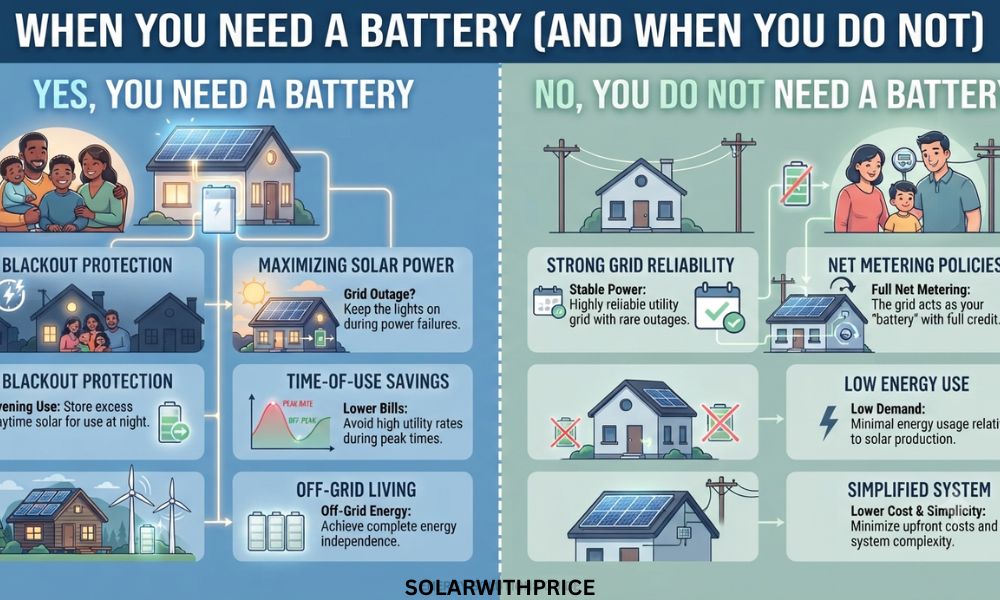
A battery makes sense if:
- You experience regular load shedding and need power after sunset
- You want to run essential loads (fans, lights, WiFi, fridge) during outages
- You want to avoid depending on the grid entirely during peak tariff hours
- You have net metering but still face frequent unscheduled outages
- You run sensitive equipment (medical devices, home office, servers) that cannot lose power
A battery may not be necessary if:
- Your area has stable, near-zero load shedding
- You are on net metering and mainly want to reduce your electricity bill during the day
- Your budget only covers solar panels and an inverter for now, with battery added later
- You can tolerate short outages without backup, especially in cooler months
My personal experience: Many households in Pakistan start with a battery-less, grid-tied solar system to cut their bill, then add a lithium battery bank a year or two later once budget allows.
Because lithium systems are modular, this phased approach works well without wasting money on oversized equipment upfront.
How Solar Citizen Designs Battery Systems
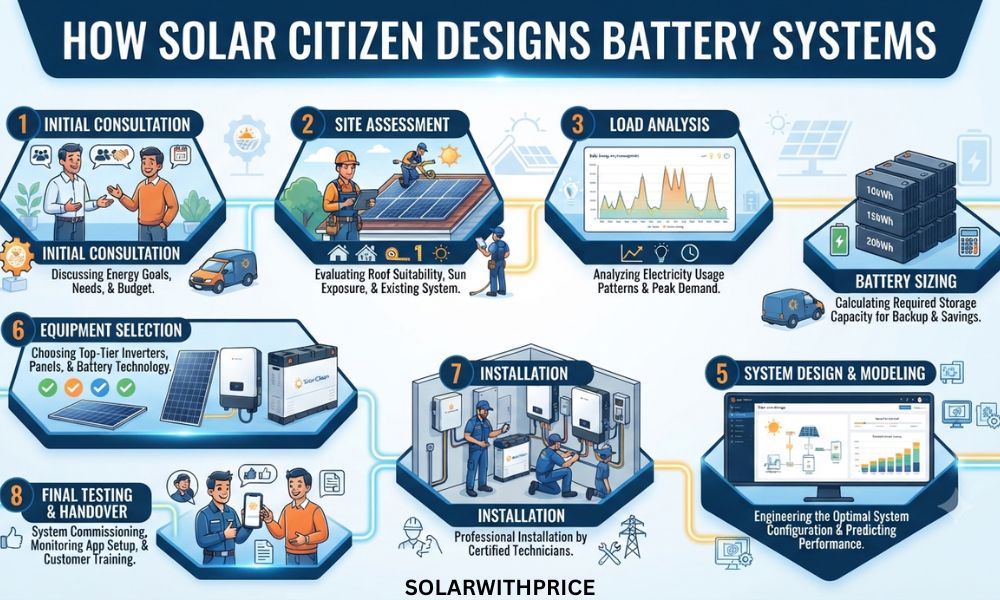
- At Solar Citizen, battery sizing always starts with your actual load, not a generic package. We ask what you want to run during an outage, for how long, and whether you are planning to add an AC or other heavy appliance later.
- From there, we recommend either a lithium bank sized for your real usage or, if budget is the priority, a tubular setup that still gets you through the load shedding hours reliably.
- We favour Pylontech as our default lithium recommendation because of its proven track record across hundreds of installations, wide inverter compatibility, and strong 10-year warranty support in Pakistan.
My personal experience: For lower-budget projects, we still install and service Phoenix and Osaka tubular batteries, with clear guidance on maintenance so customers get the full rated lifespan out of them.
My personal experience: Every system we design leaves room for future expansion, so you are never locked into today’s capacity if your power needs grow.
Final words
At the end of the day, solar battery prices in Pakistan will keep shifting with currency rates and demand, but the value comparison between lithium and lead-acid stays the same. Lithium costs more upfront, yet it delivers far more usable power over a much longer lifespan, making it the smarter buy for most homes in 2026.
If your budget is tight and you only need basic backup for fans and lights, a Phoenix or Osaka tubular battery still gets the job done at a lower entry price. But if you want a battery that lasts a decade with zero maintenance, lithium options like Pylontech are worth the extra rupees.
My pro tip: Whatever you choose, always confirm today’s PKR pricing with your dealer before buying, since rates move with exchange fluctuations. Get your load and backup needs sorted first, and the right battery size and budget will fall into place naturally.
Frequently Asked Questions
10kW Solar Battery Price in Pakistan 2026
A battery bank for a 10kW solar system usually needs 10-15kWh of storage. Lithium options cost roughly PKR 400,000 to 650,000, while tubular banks of similar backup cost around PKR 250,000 to 350,000 but need frequent replacement.
12 Volt Solar Battery Price in Pakistan 2026
A standard 12V solar battery in Pakistan ranges from around PKR 15,000 to PKR 45,000, depending on brand and Ah rating. Tubular and deep-cycle 12V models sit at the higher end, while basic dry batteries are cheaper.
15kW Solar Battery Price in Pakistan 2026
For a 15kW system, you typically need 15-20kWh of battery storage. Lithium setups cost roughly PKR 600,000 to 900,000, while an equivalent tubular bank costs less upfront but needs replacing every 3-4 years.
5kW Solar Battery Price in Pakistan 2026
A 5kW system usually pairs with a 5-8kWh battery bank. Lithium options like Pylontech cost around PKR 200,000 to 320,000, while tubular battery banks of similar backup run roughly PKR 100,000 to 150,000.
6kW Solar Battery Price in Pakistan 2026
For a 6kW system, most homes install 8-10kWh of storage. Lithium banks cost approximately PKR 320,000 to 400,000, while tubular alternatives cost less initially but wear out faster under regular deep cycling.
Exide Solar Battery Price in Pakistan 2026
Exide solar batteries in Pakistan range from around PKR 7,000 for small models to PKR 73,000 for heavy-duty tubular units like the TR-3500. Exide is known for a wide dealer network and longer warranty support.
Osaka Solar Battery Price in Pakistan 2026
Osaka solar and tubular batteries typically range from PKR 35,000 to 75,000 depending on Ah rating and model. Popular options like the Osaka TA-1800 and HT-2000 are widely used with 3kW to 6kW solar systems.
Phoenix Solar Battery Price in Pakistan 2026
Phoenix solar batteries in Pakistan range from around PKR 8,000 for small units to PKR 78,500 for heavy-duty tubular models like the TX series. Phoenix TX-1800 remains one of the most popular choices for solar backup.

I AM CH SAMI ULLAH, THE TOP SOLAR PANEL SELLER AND INSTALLER IN PAKISTAN, WITH CHEAPEST RATES, OF TOP QUALITY. GET THE LATEST RATES ON SOLAR PANELS, FANS, ACs, TUBE WELLS, SOLAR FRIDGES, AND SOLAR ATTA CHAKKIS. WHATSAPP (03461320821)
3 thoughts on “Solar Battery Price in Pakistan 2026: Lithium vs Lead-Acid Guide”