
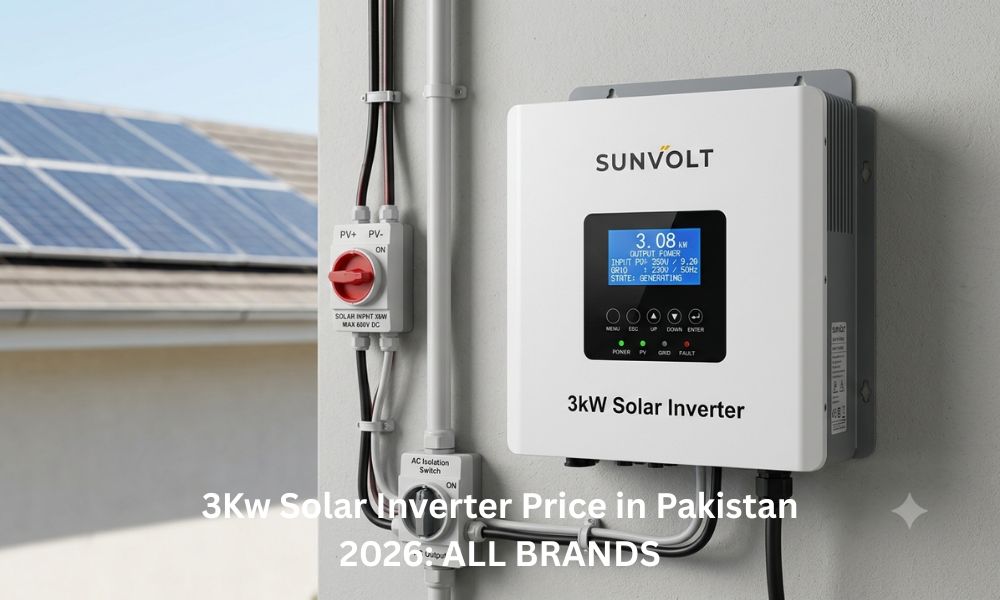
A 3kW solar inverter is a good choice for small homes in Pakistan. It can easily run one AC, some lights, and fans without any problem. In 2026, prices for a 3kW inverter range from Rs. 75,000 for basic models to over Rs. 230,000 for top hybrid brands like Inverex, Knox, Crown, and SolarMax.
Electricity bills are going up every month, and load shedding makes life hard in summer. A 3kW solar inverter is a smart and affordable way to cut your bills and stay free from power cuts. In this guide, I will share the latest 3kW inverter prices in Pakistan, brand by brand, so you can pick the best one for your home.
With the right system size and good quality parts, most homes recover their full cost within 2.5 to 5 years through lower electricity bills. After that, you enjoy many years of low-cost power from the sun.
Who Is a 3kW System For
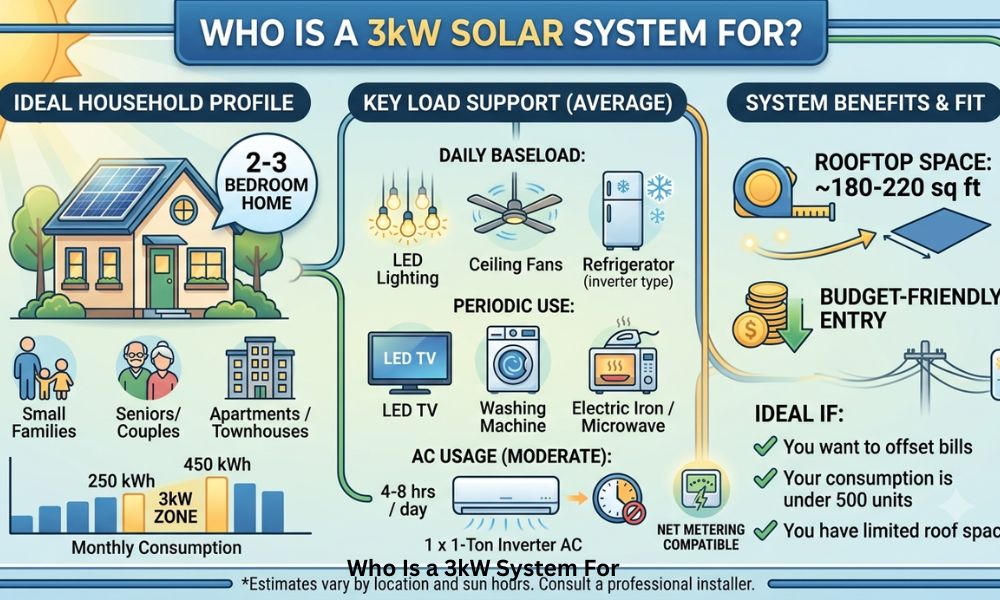
A 3kW solar system is best for small and medium homes with simple daily electricity needs. It is not too big and not too small, which makes it a good starting point for many families.
This system size works well if your home matches these points:
- Your monthly electricity bill is normally between Rs. 15,000 and Rs. 30,000
- Your monthly unit usage is around 250 to 450 units
- You run fans, lights, a fridge, a TV, and one small AC
- You have a small house, portion, or apartment with limited roof space
- You want to lower your bill without spending too much money at once
If your home uses more power, like two ACs, a water pump, and heavy machines, then a 3kW system will not be enough.
MY PRO TIP: In that case, a 5kW or bigger system is a better choice. But for a small family with normal daily use, 3kW is often the perfect fit.
Ideal Roof Space for 3kW System
A 3kW solar system needs around 200 to 300 square feet of open roof space. This space should get good sunlight for most of the day, without shade from trees, water tanks, or walls.
Appliances a 3kW System Can Run
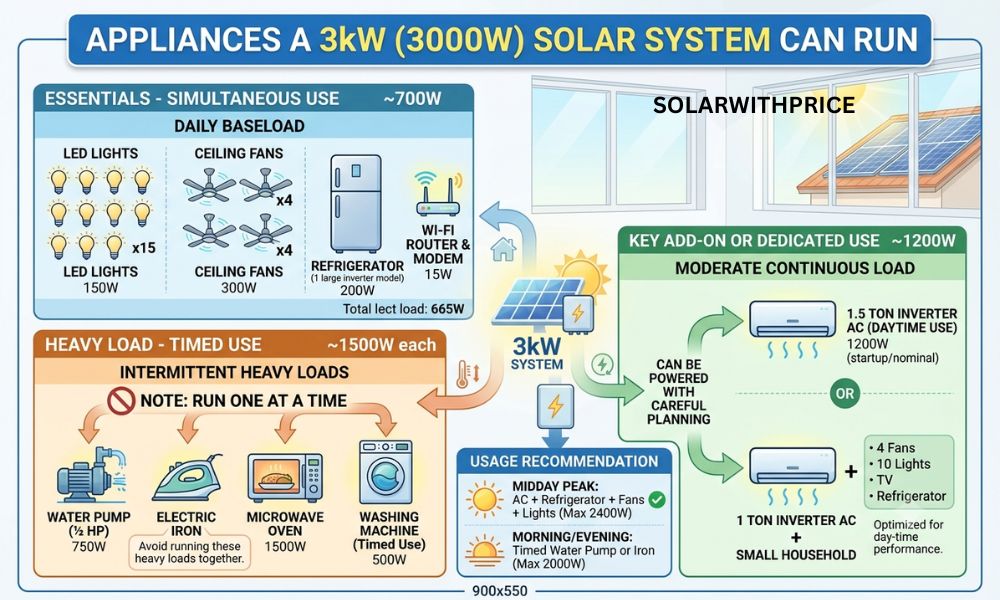
Many readers ask me what they can actually run on a 3kW system. Here is a simple list of common appliances this system size can handle at the same time:
- 4 to 6 ceiling fans
- 8 to 10 LED bulbs or tube lights
- 1 LED TV
- 1 refrigerator
- 1 small inverter AC (used during sunny hours)
- Wi-Fi router and small chargers
- Washing machine (used occasionally, not with AC running at the same time)
MY PRO TIP: If you try to run two ACs, a water pump, and heavy machines together on a 3kW system, it will get overloaded. In that case, you should move up to a 5kW or bigger system.
3kW vs 5kW: Which One Should You Choose
Some readers get confused between 3kW and 5kW systems. The table below makes the choice simple:
| Point | 3kW System | 5kW System |
| Best For | Small homes, 250–450 units/month | Medium homes, 450–700 units/month |
| Can Run 1 AC | Yes | Yes, plus more appliances |
| Roof Space Needed | 200–300 sq ft | 350–450 sq ft |
| Starting Price | Rs. 280,000 | Rs. 600,000 |
| Ideal For | Small family, portion, small house | Full house with more appliances |
If your monthly bill is under Rs. 25,000, a 3kW system is usually enough. If your bill is regularly above Rs. 35,000, you may need a bigger system.
What Is Included in a 3kW Solar System
Many people think a 3kW system is just solar panels. In reality, it has many parts working together. Each part has its own job, and the quality of each part affects your final price.
Here is what a standard 3kW solar system includes:
- Solar Panels: Usually 6 panels of around 500 to 585 watts each, placed on the roof to catch sunlight
- Solar Inverter: Converts the DC power from panels into AC power your home can use
- Mounting Structure: Metal frame that holds the panels safely on your roof
- Batteries (optional): Store extra power for use at night or during outages
- Cables and Wiring: Connect all parts of the system safely
- Circuit Breakers and Fuses: Protect the system from electrical faults
- Installation and Labor: The physical work of setting up the full system on your roof
MY PRO TIP: If you choose a hybrid system with batteries, your price will be higher because batteries are one of the most expensive parts of the setup. An on-grid system without batteries is cheaper but gives you no backup during a power cut.
Component-Wise Price Breakdown (Approximate)
To help you understand where your money goes, here is a rough breakdown of a standard 3kW hybrid system:
| Component | Approximate Share of Total Cost |
| Solar Panels (6 x 500–585W) | 30% – 35% |
| Solar Inverter | 20% – 25% |
| Battery (if included) | 20% – 30% |
| Mounting Structure & Cables | 10% – 15% |
| Installation & Labor | 8% – 12% |
This breakdown can shift depending on your brand choices, but it gives you a fair idea of how the total price is divided among the main parts.
On-Grid vs Hybrid vs Off-Grid: Quick Comparison
| Type | Works With Batteries | Backup During Outage | Net Metering Support |
| On-Grid | No | No | Yes |
| Hybrid | Yes | Yes | Yes |
| Off-Grid | Yes | Yes | No |
3kW Solar System Price Range in Pakistan 2026
The 3kW solar system price in Pakistan changes based on panel brand, inverter brand, battery type, and whether you choose on-grid or hybrid. Prices also shift with the dollar rate, since panels and inverters are mostly imported.
Based on current 2026 market rates, here is what you can expect to pay:
| System Type | Estimated Price Range (PKR) |
| On-Grid 3kW (no battery) | Rs. 280,000 – Rs. 450,000 |
| Hybrid 3kW (no battery) | Rs. 390,000 – Rs. 450,000 |
| Hybrid 3kW (with lead-acid battery) | Rs. 450,000 – Rs. 550,000 |
| Hybrid 3kW (with lithium battery) | Rs. 550,000 – Rs. 850,000 |
MY PRO TIP: These prices normally include panels, inverter, mounting structure, wiring, and basic installation.
Net metering application charges may cost an extra Rs. 60,000 to Rs. 80,000, so always ask your vendor for a complete, all-in quote before you pay anything.
What Changes the Price
Several small choices can raise or lower your final bill. Keep these points in mind while comparing quotes:
- Panel Brand: Tier-1 brands like Jinko, LONGi, and Canadian Solar cost more than local or lesser-known brands
- Inverter Brand: Premium brands like Huawei and Sungrow cost more than budget brands like Knox or Crown
- Battery Type: Lithium batteries cost more than lead-acid batteries, but they last longer
- City and Vendor: Prices can be slightly different in Lahore, Karachi, Islamabad, and smaller cities
- Net Metering: Adding net metering increases your upfront cost but helps you save more later
Brand-Wise Inverter Price Guide for 3kW Systems
The inverter is one of the most important parts of your system, and its brand has a big effect on the total price. Here is a general guide for popular brands used in 3kW setups:
| Inverter Brand | Type | Approximate Price (PKR) |
| Knox / Crown | Budget Hybrid | Rs. 75,000 – Rs. 95,000 |
| Inverex | Mid-Range Hybrid | Rs. 110,000 – Rs. 135,000 |
| Growatt / Solis | Mid-Range Hybrid | Rs. 100,000 – Rs. 150,000 |
| Huawei / Sungrow | Premium Hybrid | Rs. 150,000 and above |
Budget brands are a good option if you want to save money upfront. Premium brands cost more but usually offer better efficiency, longer warranty, and smoother performance over many years.
Does Price Change by City
The 3kW solar system price in Pakistan is fairly similar across major cities like Lahore, Karachi, Islamabad, Multan, and Faisalabad, since most panels and inverters come from the same importers. However, small differences can appear because of:
- Local transport and delivery charges
- Number of installers available in your city
- Local labor rates for installation
- Demand and competition among vendors in your area
MY PRO TIP: It is always a good idea to get quotes from at least two or three vendors in your own city before making a final decision.
Monthly Generation and Savings
A 3kW solar system does not run at full power all day. It depends on sunlight hours, weather, and the direction your panels face. On a normal sunny day in Pakistan, a 3kW system gets around 4 to 5 peak sun hours.
Here is what this means in real numbers:
| Measure | Estimated Value |
| Daily Generation | 10 to 15 units (kWh) |
| Monthly Generation | 300 to 450 units (kWh) |
| Monthly Bill Savings | Rs. 12,000 – Rs. 22,000 (approx.) |
Your actual savings depend on your local electricity rate and how much power you use during the day versus at night.
MY PERSONAL EXPERIENCE: If your home uses most of its electricity during daylight hours, your savings will be higher because you use solar power directly instead of buying it from WAPDA.
Simple Way to Estimate Your Own Savings
You do not need special tools to get a rough idea of your savings. Just follow these three simple steps:
- Take your current monthly electricity bill and divide it by your per-unit rate to find your monthly units used
- Multiply your expected daily solar generation (10 to 15 units) by 30 to get your monthly solar generation
- Multiply your monthly solar generation by your per-unit rate to estimate your monthly savings
This gives you a fair idea of how much a 3kW system can reduce your bill each month.
Payback Period of a 3kW Solar System
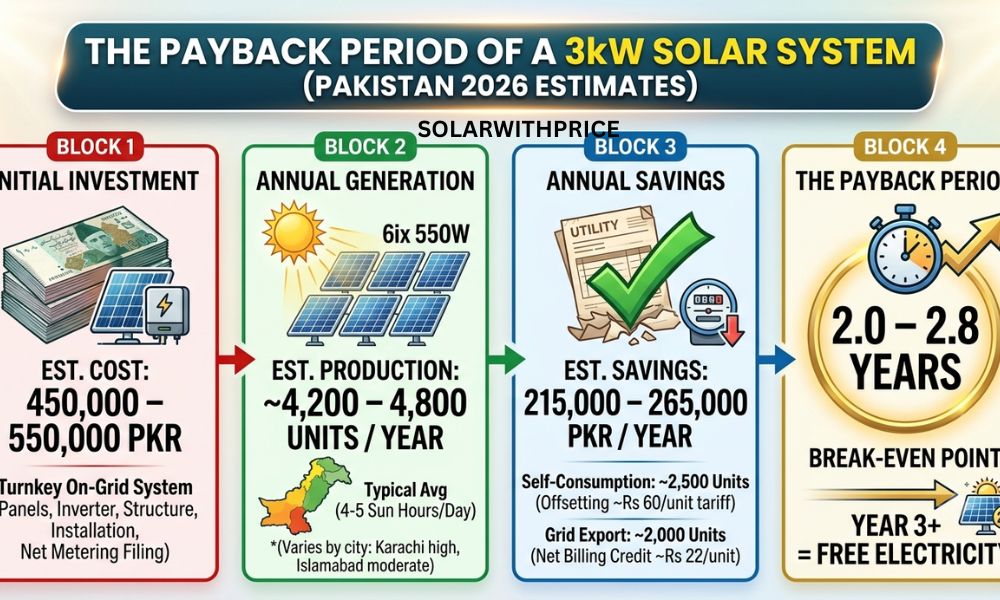
The payback period is the time it takes for your monthly savings to cover the full cost of your solar system. After that, the electricity from your panels is almost free for many more years.
For a 3kW system in Pakistan, the payback period is usually:
- On-grid system with net metering: 2.5 to 4 years
- Hybrid system with battery: 3.5 to 5 years
A shorter payback period usually means your system is well-sized for your actual electricity use, and you are getting good savings from net metering. A longer payback period often happens when the system is bigger than what your home actually needs, or when battery costs push up the total price.
MY PRO TIP: Once the payback period ends, your solar system keeps generating electricity for another 20 to 25 years with very little cost. This makes solar a smart long-term investment, even though the starting cost feels high.
A Simple Payback Example
Let us look at one easy example to understand payback period in real numbers:
- System cost: Rs. 450,000 (on-grid, no battery)
- Monthly savings: Rs. 15,000
- Yearly savings: Rs. 180,000
- Payback period: Rs. 450,000 ÷ Rs. 180,000 = 2.5 years
This is just an example. Your own payback period will depend on your system cost, your electricity rate, and how much power you actually use during sunny hours.
Net Metering and Net Billing Impact
Under NEPRA’s latest prosumer rules, extra solar units you send back to the grid are credited under net metering or net billing, depending on your DISCO and connection type.
This credit lowers your bill further and helps your system pay for itself faster. Since buyback rates can change over time, always ask your vendor for the current rate before calculating your expected savings.
What to Consider Before Installing a 3kW System
Before you spend your money, it helps to check a few important points. This can save you from picking the wrong system size or a poor-quality installer.
- Check Your Real Electricity Usage: Look at your last 6 months of bills to know your true average unit consumption
- Confirm Your Roof Space and Direction: South-facing roofs with no shade give the best results
- Compare On-Grid vs Hybrid: Choose hybrid only if you face long load shedding hours
- Ask About Warranty: Good panels come with a 10 to 25-year warranty, and inverters usually have 5 to 10 years
- Get Multiple Quotes: Prices can differ a lot between vendors for the same system size
- Check Net Metering Support: Confirm if the vendor will handle your DISCO application and paperwork
- Avoid Very Cheap Deals: Extremely low prices often mean low-quality panels or inverters that fail early
Taking a little time to check these points before installation can save you from costly mistakes later.
Pros and Cons of a 3kW Solar System
Every system size has its strengths and limits. Here is an honest look at both sides for a 3kW setup.
Pros:
- Lower upfront cost compared to bigger systems
- Enough for small homes with normal daily usage
- Faster payback period with net metering
- Free electricity for 20 to 25 years after payback
- Reduces your dependence on WAPDA and rising tariffs
Cons:
- Not enough for homes with two ACs or heavy machines
- Battery backup adds a high extra cost
- Savings depend heavily on sunlight hours and season
- Performance drops slightly during cloudy or rainy months
Financing Options for a 3kW System
If you do not want to pay the full amount at once, many banks and solar companies now offer installment plans for solar systems in Pakistan. Common options include:
- Bank financing plans of up to 5 to 7 years
- Vendor-based installment plans with monthly payments
- Government-backed schemes available through some provincial programs
For a system costing around Rs. 450,000, a 5-year installment plan usually comes out to roughly Rs. 9,500 to Rs. 12,000 per month, depending on the bank and interest terms. This can make solar more affordable if you do not want to pay the full price upfront.
Maintenance Tips for Long-Term Performance
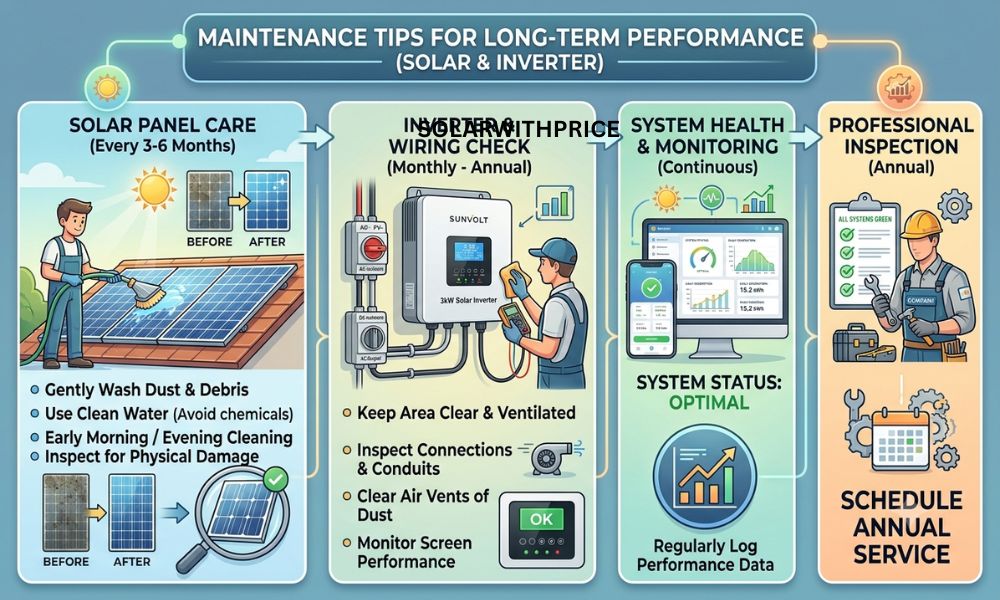
- Clean the panels regularly: Dust and bird droppings reduce output, so wipe panels every 2 to 3 weeks with a soft cloth or brush
- Check wiring and connections: Have a technician check cables and connections once a year
- Watch the inverter display: Most inverters show daily generation, so you can notice quickly if output drops
- Trim nearby trees: Keep branches away from your panels so shade does not block sunlight
- Service batteries on schedule: If you have lead-acid batteries, check water levels every few months
- Keep the area around panels dry: Standing water or heavy dust buildup can affect long-term performance
Following these small steps can help your system perform close to its full rated output for 25 years or more.
3kW Solar Inverter Price in Pakistan: Current Market Rate
A 3kW inverter is the most popular size for small homes in Pakistan. It can run fans, lights, a fridge, and one small AC on a good sunny day.
Right now, a new 3kW hybrid inverter costs between Rs. 84,000 and Rs. 160,000, depending on the brand and features. Off-grid basic models are cheaper, and premium brands with wifi monitoring cost more.
Here is a simple price table for new 3kW inverters this year:
| Type | Price Range (PKR) |
| Basic off-grid 3kW | Rs. 75,000 – Rs. 85,000 |
| Standard hybrid 3kW | Rs. 85,000 – Rs. 120,000 |
| Premium hybrid 3kW (wifi, dual MPPT) | Rs. 120,000 – Rs. 160,000 |
A few things that change this price:
- Brand name (local vs foreign)
- Hybrid or off-grid type
- Warranty period (1 year vs 5 years)
- Dollar rate, because most parts are imported
- IP65 waterproof body vs normal body
3kW Solar Inverter Price in Pakistan OLX Lahore
Many people in Lahore ask me about OLX because they want to save money on a used or slightly used inverter. I always tell my customers the truth about this.
On OLX Lahore, 3kW inverter listings usually fall in these ranges:
| Condition | Price Range (PKR) |
| Brand new (box pack, OLX seller) | Rs. 80,000 – Rs. 140,000 |
| Used, 1 year old | Rs. 55,000 – Rs. 85,000 |
| Used, 2-3 years old | Rs. 35,000 – Rs. 60,000 |
Before you buy from OLX Lahore, please check these points:
- Ask the seller for the original purchase receipt
- Check if the warranty card is still valid
- Turn on the inverter in front of you before paying
- Ask why they are selling it (upgrade or fault)
- Meet in a safe public place, not an empty house
Used inverters on OLX can save you 30% to 40% on the price, but only buy from a seller who lets you test the unit first.
Crown 3kW Solar Inverter Price in Pakistan
Crown Micro is a local brand, and it is very famous for being budget-friendly. I install Crown inverters for many of my clients who have a tight budget.
The Crown 3kW inverter price in Pakistan currently sits at:
| Crown 3kW Model | Price Range (PKR) |
| Crown Xavier PV3000 (hybrid) | Rs. 84,000 |
| Crown Xavier IP21 series | Rs. 90,000 – Rs. 110,000 |
| Crown Xavier IP65 (waterproof) | Rs. 120,000 – Rs. 160,000 |
Why do people in Punjab like Crown?
- Price is 20% to 30% lower than Inverex or Growatt
- Spare parts are easy to find in local markets
- Service centers are available in most big cities
- 4 to 6-year warranty on many models
- Works well with both lead-acid and lithium batteries
5kW Solar Inverter Price in Pakistan
If your home has 2 or more ACs, a fridge, and a washing machine, then 3kW is not enough. I always suggest 5kW for medium-sized families.
The 5kW solar inverter price in Pakistan this year is:
| Brand/Type | Price Range (PKR) |
| Crown 5kW hybrid | Rs. 150,000 – Rs. 230,000 |
| Inverex Nitrox 5kW | Rs. 240,000 – Rs. 365,000 |
| Solis 5kW on-grid | Rs. 170,000 – Rs. 210,000 |
| Growatt 5kW hybrid | Rs. 180,000 – Rs. 250,000 |
A 5kW inverter can run:
- 2 inverter ACs (1.5 ton each)
- 1 fridge
- 1 washing machine
- Fans, lights, and TV for the whole house
- A small water motor
Inverex 5kW Solar Inverter Price in Pakistan
Inverex is known as Pakistan’s most trusted local brand. Many farmers and shopkeepers in my area ask specifically for Inverex because service is easy to find.
The Inverex Nitrox 5kW hybrid inverter price ranges from Rs. 240,000 to Rs. 365,000, depending on the model year and dealer.
Some good points about Inverex 5kW:
- Touchscreen control panel
- Supports up to 6500 watts of solar panels
- Works with generator backup too
- 5-year warranty (2 years product, 3 years service)
- Wide dealer network across Punjab and Sindh
3KW Hybrid Inverter Price in Pakistan
A hybrid inverter is the smartest choice because it works with solar panels, batteries, and WAPDA electricity, all at the same time.
Here is the full hybrid inverter price table for 3kW models:
| Hybrid Inverter Brand | Price Range (PKR) |
| Crown 3kW hybrid | Rs. 120,000 – Rs. 160,000 |
| Knox 3kW hybrid | Rs. 75,000 – Rs. 100,000 |
| Inverex Veyron 3kW | Rs. 110,000 – Rs. 135,000 |
| Growatt 3kW hybrid | Rs. 120,000 – Rs. 165,000 |
Hybrid inverters are best for Pakistan because loadshedding is still common in many cities. When WAPDA goes off, the hybrid inverter switches to battery power in less than a second, and your fans and lights do not even stop.
2kW Solar Inverter Price in Pakistan
Not every home needs a big system. If you only want to run fans, lights, and a fridge, a 2kW inverter is enough, and it saves a lot of money.
Current 2kW inverter prices in Pakistan:
| Type | Price Range (PKR) |
| Basic 2kW off-grid | Rs. 60,000 – Rs. 75,000 |
| Standard 2kW hybrid | Rs. 75,000 – Rs. 93,000 |
A 2kW inverter is a good fit for:
- Small houses (1 to 3 rooms)
- Shops that only need fans and lights
- Rental portions or single-family units
- Rural clinics with basic equipment
Best 3KW Hybrid Solar Inverter Price in Pakistan
People always ask me, “Farooq, which one is the best?” There is no single best brand for everyone, because it depends on your budget. So let me give you my honest ranking.
| Rank | Brand/Model | Price (PKR) | Best For |
| 1 | Crown Xavier 3kW | Rs. 84,000 – Rs. 120,000 | Tight budget homes |
| 2 | Inverex Veyron 3kW | Rs. 110,000 – Rs. 135,000 | Trusted local service |
| 3 | Growatt 3kW hybrid | Rs. 120,000 – Rs. 165,000 | Better build quality |
| 4 | Solis/Huawei 3kW | Rs. 140,000+ | Long-term reliability |
If your budget is under Rs. 100,000, go with Crown. If you want strong after-sales support in small towns, pick Inverex. If you want the best long-term performance and can spend more, Growatt or Solis are worth the extra money.
Is a 3kW System Worth It in 2026
With electricity tariffs continuing to rise and load shedding still common in many areas, a 3kW solar system remains one of the most practical investments for a small Pakistani home.
The upfront cost may look high, but when you compare it to years of rising WAPDA bills, most families recover their investment within a few years and then enjoy low-cost power for two more decades.
If your home matches the usage pattern described in this guide, a 3kW system is very likely worth the investment in 2026.
FINAL WORDS
A 3kW solar system is a smart and affordable choice for small Pakistani homes that want to lower their electricity bills. In 2026, prices for a 3kW system range from around Rs. 280,000 for a basic on-grid setup to over Rs. 800,000 for a full hybrid system with lithium batteries.
Before you install, always check your real electricity usage, compare vendor quotes, and confirm net metering support to get the best value for your money.

I AM CH SAMI ULLAH, THE TOP SOLAR PANEL SELLER AND INSTALLER IN PAKISTAN, WITH CHEAPEST RATES, OF TOP QUALITY. GET THE LATEST RATES ON SOLAR PANELS, FANS, ACs, TUBE WELLS, SOLAR FRIDGES, AND SOLAR ATTA CHAKKIS. WHATSAPP (03461320821)
1 thought on “3Kw Solar Inverter Price in Pakistan 2026: ALL BRANDS”