
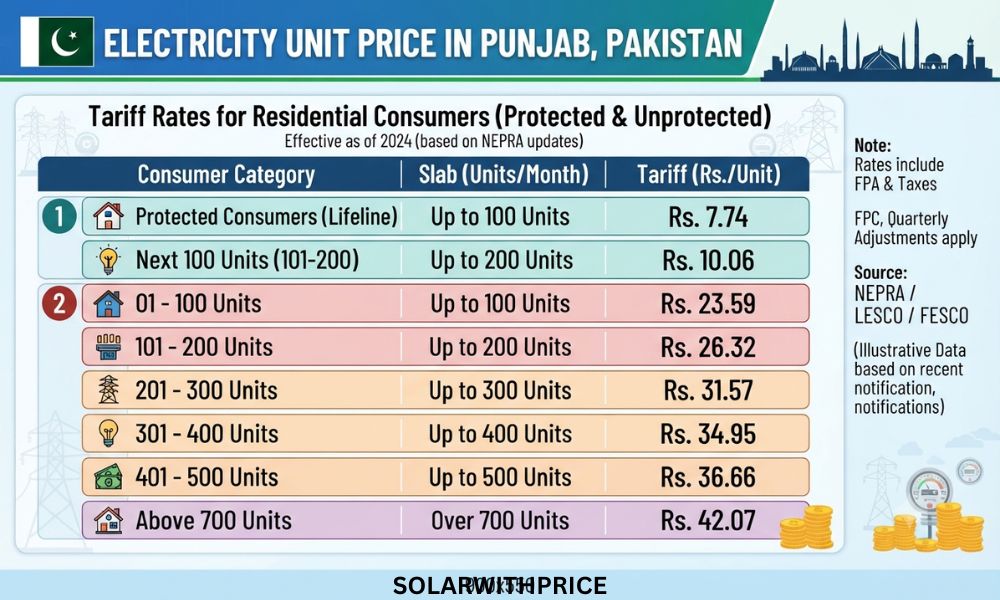
Electricity bills in Punjab keep surprising people every month, and most of the confusion starts with one simple question: what is the actual electricity unit price right now? Whether you’re in Lahore, Faisalabad, Multan, or Gujranwala, the rate you pay follows the same NEPRA-notified structure, just billed under different company names.
In 2026, the unit price in Punjab starts as low as Rs. 3.95 for the smallest lifeline users and climbs past Rs. 47 per unit once your monthly usage crosses 700 units. Add fuel charges, taxes, and quarterly adjustments on top, and it’s easy to see why two homes using similar units can end up with very different bills.
To get free electricity and get rid of heavy electricty bills we need to install solar panels at home because they can generate free electricity.
Electricity Unit Price in Punjab 2026
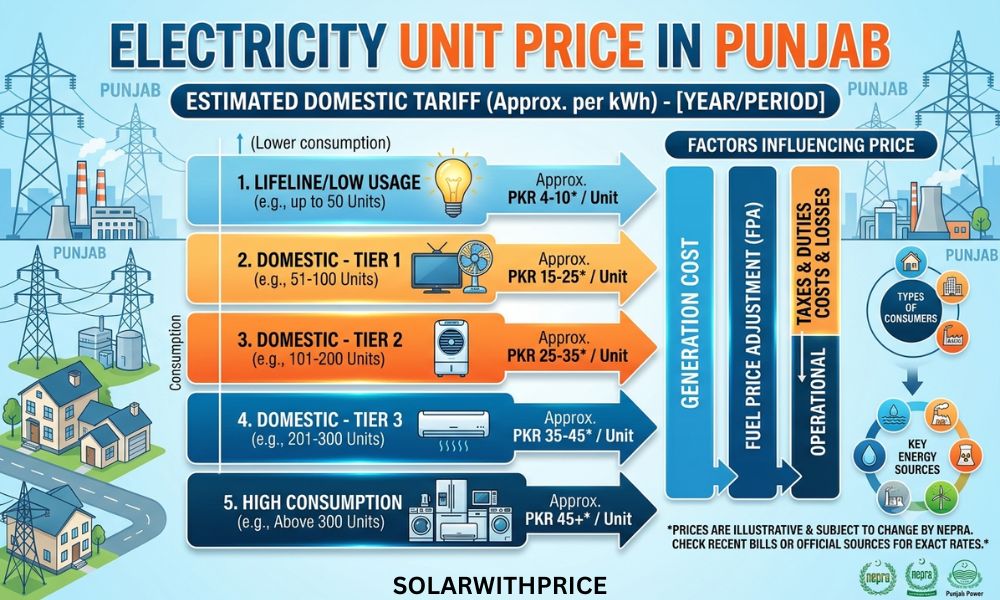
Punjab is served by five distribution companies: LESCO (Lahore), FESCO (Faisalabad), GEPCO (Gujranwala), MEPCO (Multan), and parts of the province also fall under IESCO (Islamabad) coverage for northern districts.
Here is the good news: all of these are “ex-WAPDA” DISCOs, and NEPRA applies a uniform consumer-end tariff across all of them. This means a household in Lahore and a household in Multan pay the same base rate per unit, even though the companies are different.
The only real differences between Punjab’s DISCOs show up in:
- Local fixed monthly charges
- How fast complaints and new connections are processed
- Regional Fuel Charge Adjustment (FCA) timing on your bill
My personal experience: So if you live anywhere in Punjab, the base unit price table below applies to you, no matter which company’s logo is printed on your bill.
Electricity Unit Price in Pakistan (NEPRA Uniform Tariff)
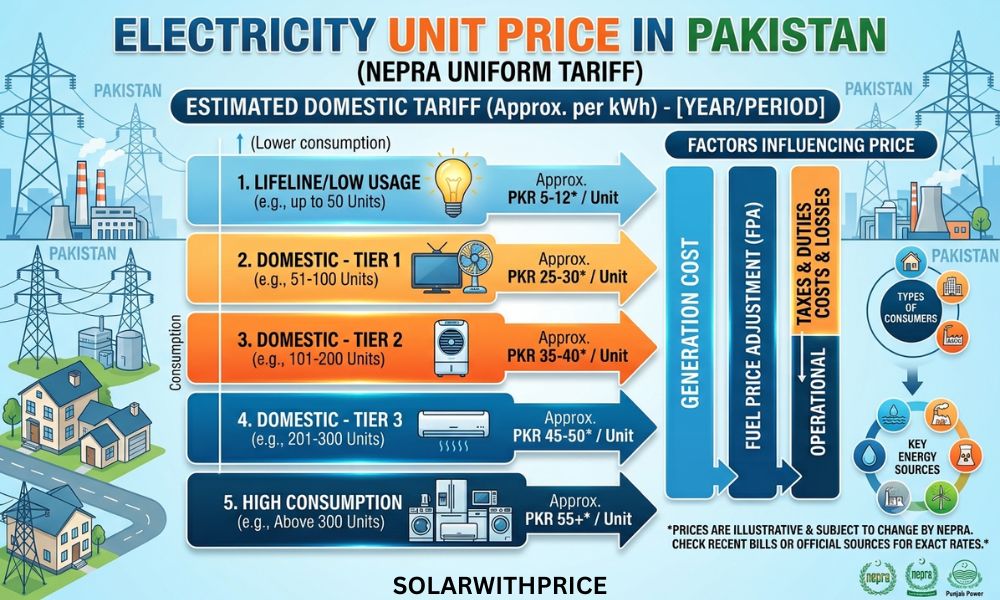
As of the current fiscal year, NEPRA’s average base tariff across all consumer categories sits close to Rs. 31 to Rs. 33 per unit, though this is only an average. Your actual rate depends heavily on your consumption slab.
My personal experience: Here is the domestic (residential) tariff structure that applies uniformly across LESCO, FESCO, MEPCO, GEPCO, IESCO, PESCO, HESCO, QESCO, SEPCO, and TESCO.
Domestic Tariff Slabs (Protected & Unprotected Consumers)
| Monthly Units Consumed | Approx. Rate Per Unit (PKR) | Consumer Category |
|---|---|---|
| Up to 50 units (Lifeline) | Rs. 3.95 | Lifeline |
| 51–100 units | Rs. 7.74 | Lifeline/Protected |
| First 100 units (Protected) | Rs. 10.54 | Protected |
| 101–200 units | Rs. 13.01 | Protected |
| 201–300 units | Rs. 22–26 | Unprotected |
| 301–400 units | Rs. 33–36 | Unprotected |
| 401–500 units | Rs. 37–39 | Unprotected |
| 501–600 units | Rs. 39–41 | Unprotected |
| 601–700 units | Rs. 41–42 | Unprotected |
| Above 700 units | Rs. 47–47.7 | Unprotected |
My pro tip: A quick note on “protected” status: if your household has stayed within 200 units for the last six consecutive months, you keep the subsidised protected rate.
The moment your usage crosses 200 units even once, you fall into the unprotected category, and every unit going forward is billed at the higher rate.
What is Included in Our Electricity Bill in Pakistan 2026
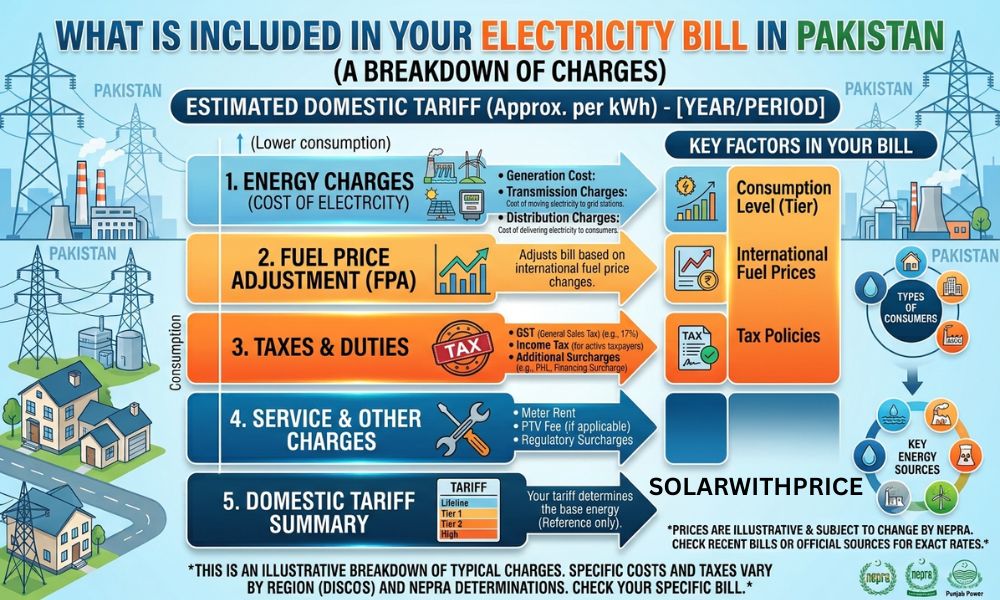
- Fuel Charge Adjustment (FCA) – changes almost every month
- Quarterly Tariff Adjustment (QTA)
- 18% General Sales Tax (GST)
- Electricity Duty
- PTV Fee (Rs. 35 flat)
- Income tax, if applicable and your bill crosses a certain threshold
Since fuel costs are tied closely to the dollar rate and international oil and LNG prices, these adjustment charges can swing your bill up or down even if your unit consumption stays the same.
IESCO (Islamabad Electric Supply Company) Per Unit Price
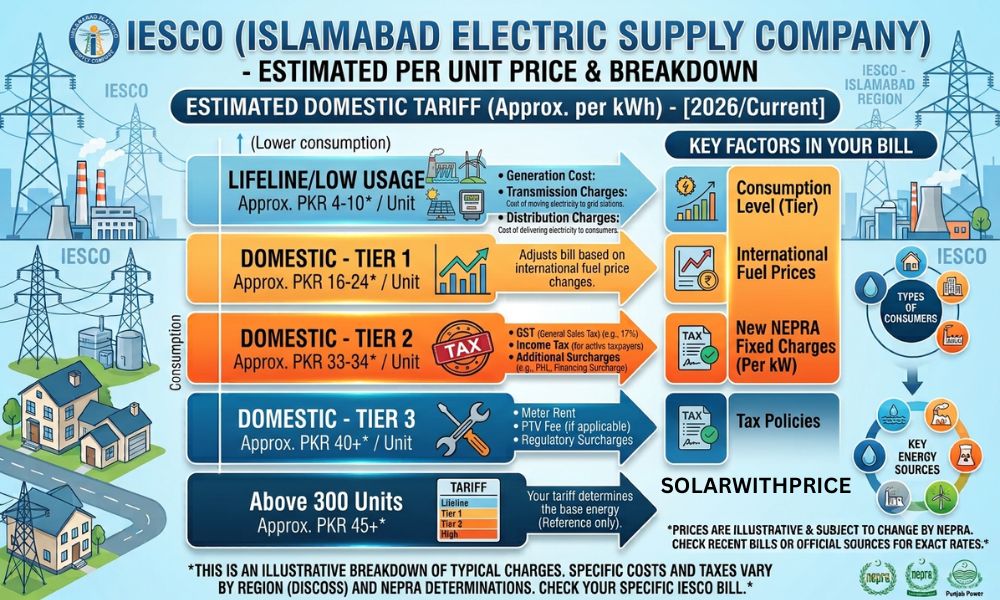
IESCO covers Islamabad, Rawalpindi, Attock, Jhelum, Chakwal, and Gujar Khan. Since IESCO follows the same NEPRA uniform tariff, domestic consumers here pay the identical slab-wise rates shown in the table.
It starts from Rs. 3.95 for lifeline users and goes up to roughly Rs. 47 per unit for consumption above 700 units.
Commercial consumers under IESCO are billed at a flat base rate of around Rs. 45 per unit, while general service connections (small shops, offices) fall closer to Rs. 43 per unit, before taxes and adjustments.
Electricity Price Per Unit in Pakistan: K-Electric Per Unit Rate
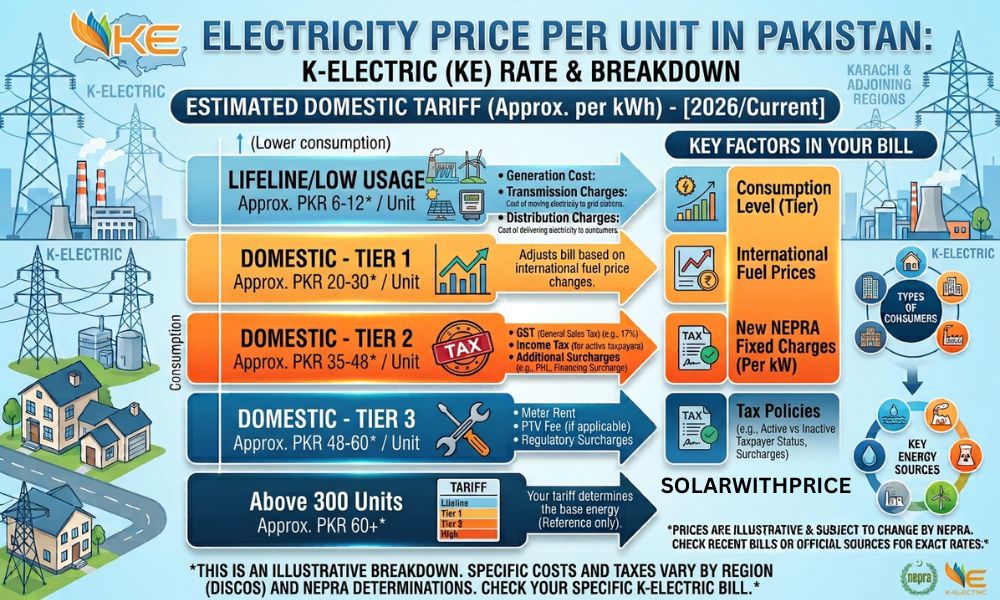
Karachi is the one major exception to the uniform tariff rule. K-Electric is a privately owned utility, and while its base slab structure closely mirrors the NEPRA national tariff, its fixed charges and fuel adjustment components are calculated separately.
K-Electric Domestic Slab Rates
| Monthly Units | Rate Per Unit (PKR) | Fixed Charge |
|---|---|---|
| Up to 50 units (Lifeline) | Rs. 3.95 | None |
| 51–100 units | Rs. 7.74 | None |
| 01–100 (Protected) | Rs. 10.54 | Rs. 200 |
| 101–200 (Protected) | Rs. 13.01 | Rs. 300 |
| 301–400 | Rs. 36.46 | Rs. 400 |
| 401–500 | Rs. 38.95 | Rs. 500 |
| 601–700 | Rs. 41.85 | Rs. 500–600 |
| Above 700 | Rs. 47.20 | Rs. 600 |
My personal experience: Once you add K-Electric’s Fuel Cost Adjustment (which has ranged between Rs. 2.8 and Rs. 5 per unit recently) plus GST and other surcharges, many Karachi households report their effective per-unit cost landing anywhere between Rs. 45 and Rs. 60.
It is also important to note that even higher for heavy summer usage. This is one big reason solar adoption has picked up so quickly across Karachi over the last year.
LESCO (Lahore Electric Supply Company) Per Unit Price
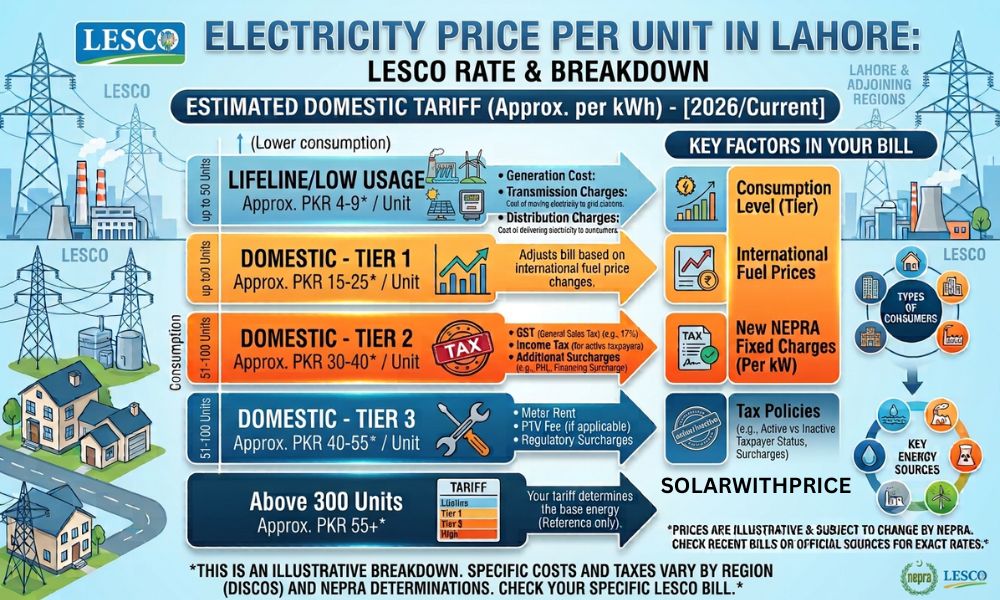
LESCO serves Lahore, Kasur, Sheikhupura, Okara, and Nankana Sahib. As part of the uniform tariff structure, LESCO’s domestic rates match the national table exactly: Rs. 3.95 for lifeline consumers up to Rs. 47+ per unit for the highest slab.
LESCO adds these fixed charges on top of the energy rate:
- Single-phase connections: Rs. 75 per month
- Three-phase connections: Rs. 150 per month
- Commercial (higher load) three-phase: up to Rs. 350 per month
My personal experience: LESCO consumers can also opt for a Time-of-Use (TOU) meter if their sanctioned load is below 5 kW, which charges a lower rate during off-peak night hours and a higher rate during evening peak hours.
MEPCO (Multan Electric Power Company) Per Unit Price
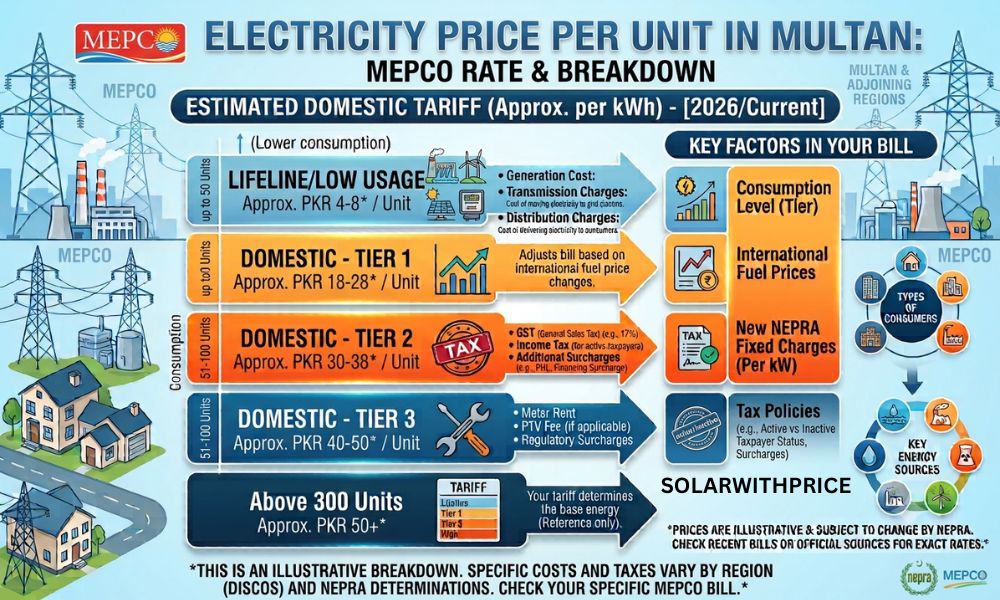
MEPCO covers Multan, Bahawalpur, Vehari, Sahiwal, and much of Southern Punjab, an area with a huge number of agricultural tube-well connections. Domestic rates again follow the same uniform NEPRA slabs.
For Tariff A-1 domestic consumers, MEPCO applies:
- Single-phase minimum monthly charge: Rs. 75
- Three-phase minimum monthly charge: higher, based on load
MEPCO’s agricultural tariff is particularly important for this region since so many farmers rely on tube wells for irrigation.
My personal experience: Agricultural connections get separate seasonal rates, and consumers can switch between seasonal and regular tariff once a year.
FESCO (Faisalabad Electric Supply Company) Per Unit Price
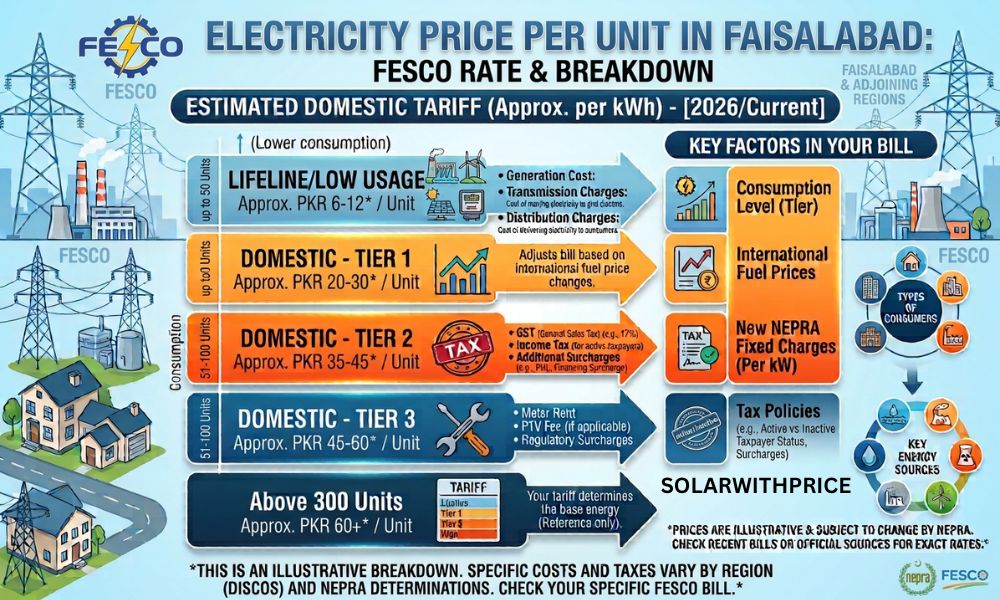
FESCO serves Faisalabad, Jhang, Toba Tek Singh, and Chiniot, a region with heavy textile industry demand alongside residential consumers. Domestic per-unit pricing again mirrors the national NEPRA table.
Where FESCO stands out is on the industrial side.
Following the government’s industrial relief package earlier this year, small industrial (B1) consumers using up to 25 kW now pay around Rs. 26.23 per unit, down from over Rs. 30 previously, with peak-hour rates around Rs. 35.74 and off-peak rates closer to Rs. 25.48 per unit.
PESCO (Peshawar Electric Supply Company) Per Unit Price
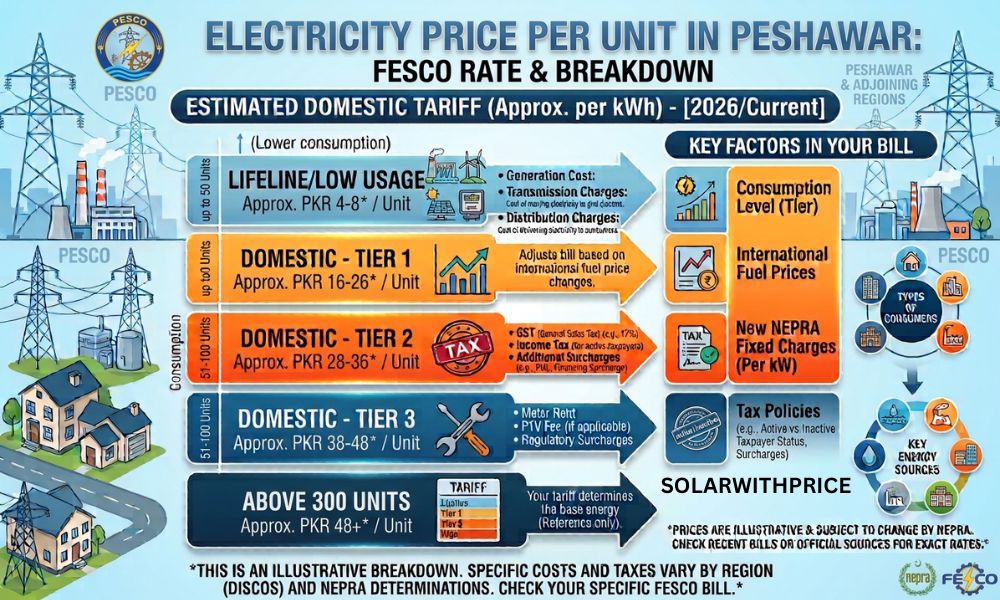
PESCO covers Peshawar, Mardan, Swat, and most of Khyber Pakhtunkhwa. Domestic residential rates follow the same uniform slabs as every other ex-WAPDA DISCO.
My personal experience: One thing worth knowing: PESCO’s service territory includes a large number of tribal and merged districts where billing and recovery arrangements differ from settled areas, but the notified per-unit tariff itself remains uniform with the rest of the country for standard domestic and commercial consumers.
GEPCO (Gujranwala Electric Power Company) Per Unit Price
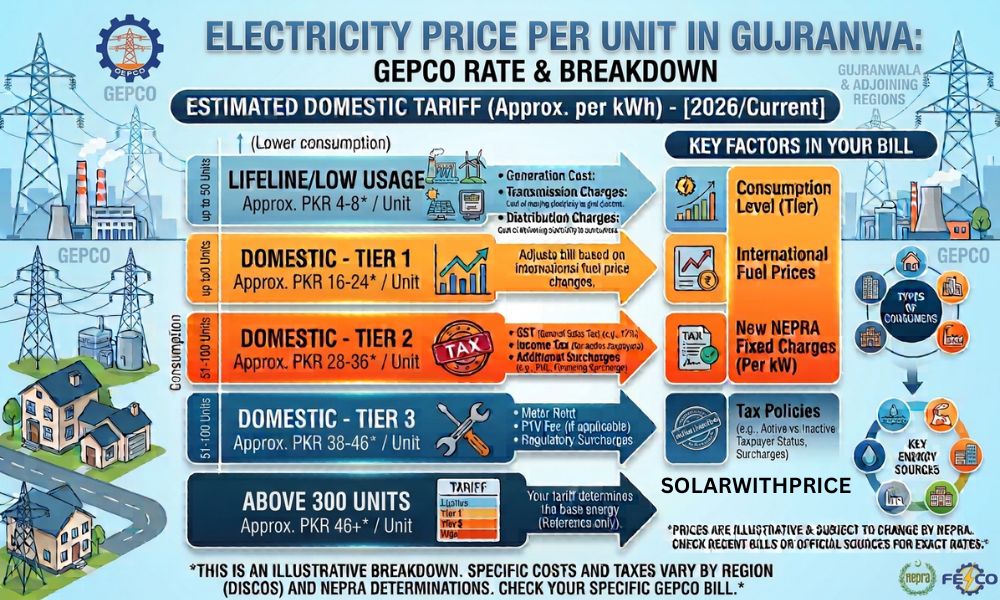
GEPCO serves Gujranwala, Sialkot, Gujrat, Hafizabad, and Narowal in Upper Punjab. As with LESCO and FESCO, GEPCO’s domestic and commercial per-unit rates follow the exact national NEPRA slab structure.
GEPCO consumers can check their complete billing breakdown online, including meter reading history, arrears, and applicable taxes, which is a good habit if you want to catch billing errors early and confirm you’re sitting in the correct slab.
HESCO (Hyderabad Electric Supply Company) Per Unit Price
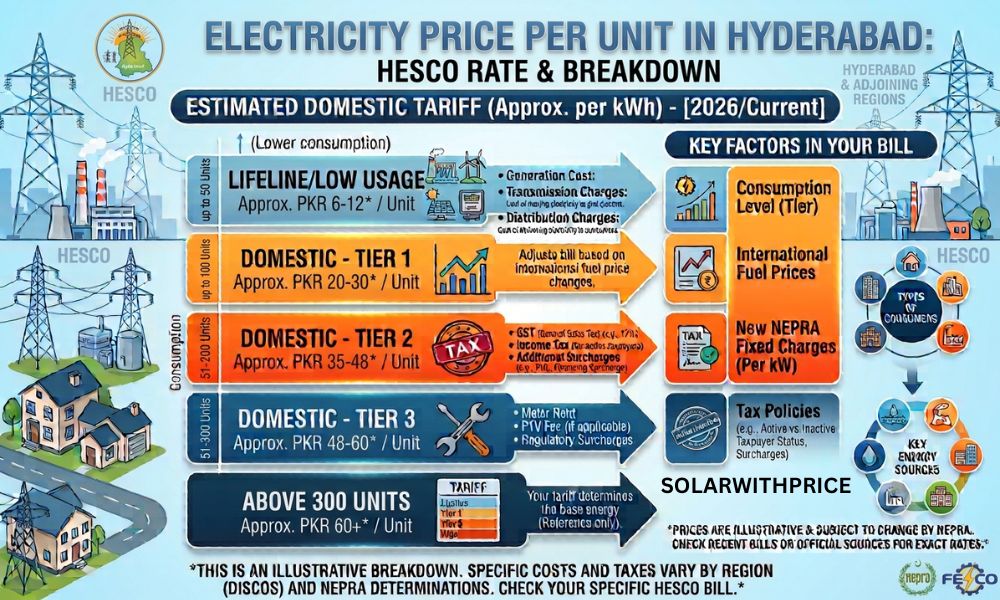
HESCO covers Hyderabad, Mirpurkhas, and several districts of Sindh outside K-Electric’s Karachi territory. Since HESCO is an ex-WAPDA company, its domestic tariff also follows the uniform national structure, from Rs. 3.95 per unit at the lifeline level up to the highest unprotected slab near Rs. 47 per unit.
My personal experience: Agricultural tube-well consumers form a significant share of HESCO’s customer base, and these connections follow separate agricultural tariff tables with their own seasonal adjustments.
QESCO (Quetta Electric Supply Company) Per Unit Rate
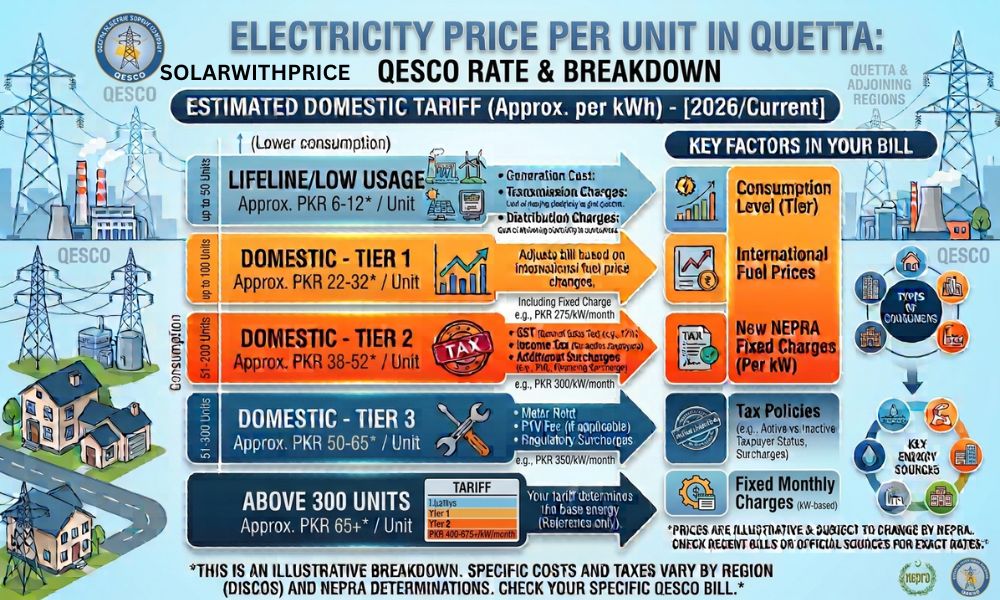
QESCO serves the whole of Balochistan, the largest but least densely populated service area of any DISCO in the country. Despite covering such a vast region, QESCO’s domestic per-unit rate follows the same NEPRA uniform tariff as the rest of Pakistan.
QESCO has historically faced higher line losses and recovery challenges due to the sheer distances involved in the province, but this does not change the notified per-unit price a compliant, billed consumer pays.
SEPCO Per Unit Price
SEPCO (Sukkur Electric Power Company) covers Sukkur, Larkana, Jacobabad, Shikarpur, and Northern Sindh. Like the other ex-WAPDA companies, SEPCO applies the identical national tariff slabs for domestic, commercial, and agricultural consumers.
My personal experience: Because SEPCO’s territory includes a large concentration of agricultural tube wells, many of its consumers fall under the agricultural tariff category rather than standard domestic slabs, which use a different seasonal rate structure.
How Can You Calculate Your Electricity Bill?
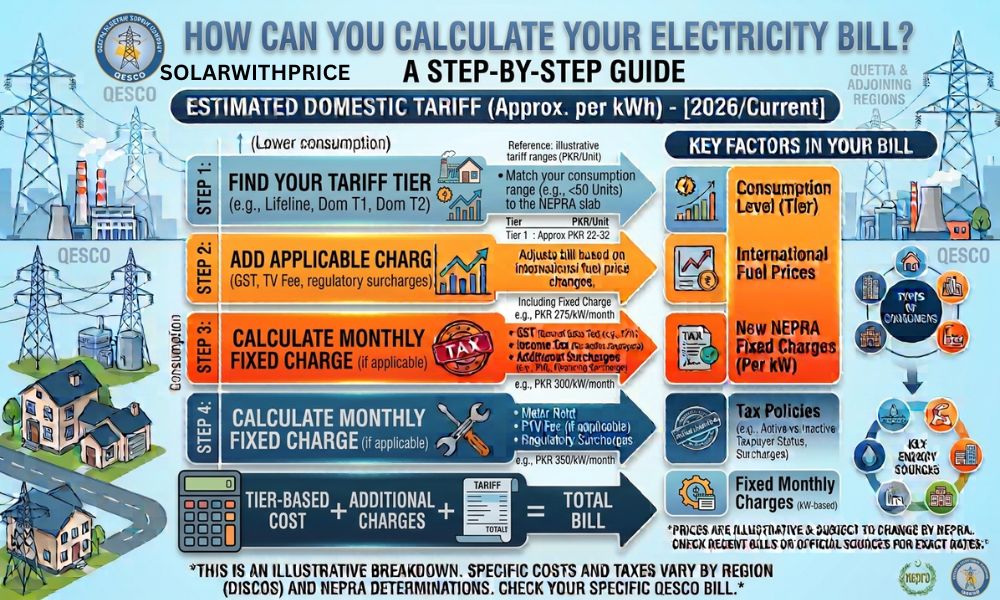
- Find your consumed units. Subtract your previous meter reading from your current reading, or check the units mentioned on your latest bill.
- Identify your consumer category. Are you protected (under 200 units for the last six months) or unprotected? Domestic, commercial, or agricultural?
- Apply the slab rates progressively. If you used 350 units, you do not pay the 301–400 rate on all 350 units. Instead, the first 100 units are charged at slab one, the next 100 at slab two, and so on, all the way up.
- Add your fixed monthly charge. This ranges roughly from Rs. 75 to Rs. 500 depending on connection type and load.
- Add the Fuel Charge Adjustment (FCA). This changes monthly and can add anywhere from Rs. 1 to Rs. 5 per unit.
- Add taxes. This typically includes 18% GST, a small Electricity Duty percentage, and the Rs. 35 PTV fee.
- Sum everything up. Energy charges + fixed charges + FCA + taxes = your total bill.
Quick Example
Say you consumed 350 units in a month as an unprotected domestic consumer:
- First 100 units at Rs. 10.54 = Rs. 1,054
- Next 100 units at Rs. 13.01 = Rs. 1,301
- Next 150 units at approximately Rs. 24 = Rs. 3,600
- Fixed charge: Rs. 200
- FCA (approx.): Rs. 600
- Subtotal: Rs. 6,755
- GST (18%): Rs. 1,216
- PTV Fee: Rs. 35
- Estimated Total: Rs. 8,000 approximately
Your actual figure may vary slightly depending on the exact FCA and QTA notified for that particular month, since these are tied to fluctuating fuel costs and the dollar exchange rate.
What Can You Do to Control Your Electricity Bill?
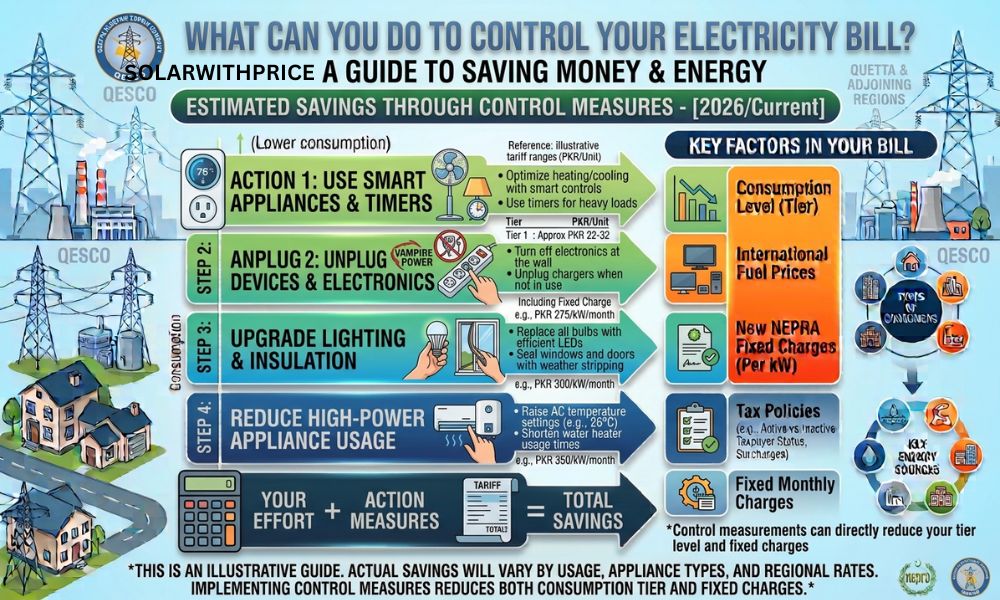
- Stay under 200 units if possible. Crossing into the unprotected category even once can raise your rate for the whole month.
- Shift heavy appliance use to off-peak hours. If you have a Time-of-Use meter, running your washing machine, iron, and water pump at night can cut costs noticeably.
- Switch to LED lighting everywhere. LEDs use 60 to 80% less power than older bulbs for the same brightness.
- Set your AC to 24–26°C instead of running it colder. Every degree lower adds real cost to your bill.
- Get your appliances serviced regularly. A poorly maintained AC or refrigerator draws noticeably more power than a well-serviced one.
- Check your bill category every month. Billing errors happen. Confirm you are placed in the correct protected or unprotected slab.
- Consider a solar system. With unit prices climbing steadily and FCA charges adding unpredictable costs, many households now find solar pays for itself within three to five years, especially under the current net billing framework.
Electricity Unit Price in Punjab Today (2026)
Punjab consumers fall under LESCO, FESCO, MEPCO, or GEPCO, and all four follow the same NEPRA-notified rate. There is no separate “Punjab rate.” The number below applies whether you’re in Lahore, Faisalabad, Multan, or Gujranwala.
| Monthly Units | Per Unit Rate (PKR) | Category |
|---|---|---|
| 1–50 | Rs. 3.95 | Lifeline |
| 51–100 | Rs. 7.74 | Lifeline |
| 1–100 | Rs. 10.54 | Protected |
| 101–200 | Rs. 13.01 | Protected |
| 201–300 | Rs. 22–26 | Unprotected |
| 301–400 | Rs. 33–36 | Unprotected |
| 401–700 | Rs. 37–42 | Unprotected |
| Above 700 | Rs. 47–47.7 | Unprotected |
My pro tip: Remember, these are base energy rates. Your final Punjab bill also adds Fuel Charge Adjustment (FCA), GST, and the PTV fee on top.
Electricity Unit Price in Pakistan Today (2026)
Across the whole country, the story is almost identical. Every ex-WAPDA distribution company- LESCO, FESCO, MEPCO, GEPCO, IESCO, PESCO, HESCO, QESCO, and SEPCO- bills domestic consumers using the same national slab structure shown above. Only K-Electric in Karachi runs a slightly separate fixed-charge and FCA structure.
Quick summary of today’s rate range:
- Lowest rate: Rs. 3.95 per unit (lifeline, up to 50 units)
- Average national rate: Roughly Rs. 31 to Rs. 33 per unit
- Highest domestic rate: Rs. 47 to Rs. 47.7 per unit (above 700 units)
- Commercial base rate: Around Rs. 45 per unit
- Industrial rate (B1, small load): Around Rs. 26 per unit after recent relief
Electricity 1 Unit Price in Pakistan Today (Commercial)
Commercial connections, shops, offices, mall units, are billed very differently from homes. There is no lifeline or protected slab here. You pay a flat, higher base rate from the very first unit.
| Consumer Type | Approx. Rate Per Unit (PKR) |
|---|---|
| Commercial (general, uniform tariff) | Rs. 45.43 |
| General Service (small shops, offices) | Rs. 43.17 |
| Commercial peak-hour (ToU) | Rs. 40–48 |
| Commercial off-peak (ToU) | Rs. 25–30 |
On top of this, commercial consumers with a sanctioned load above 5 kW also pay a fixed monthly charge that can go up to Rs. 1,250 per kW.
That is why even a small shop with a few fans, lights, and a fridge can end up with a bill much higher per unit than a house using the same number of units.
Electricity Unit Price in Pakistan Today in Urdu
A lot of people search this in Urdu because they want the same information, just in their own language. The good news: the rate itself does not change based on the language you search in.
Whether you check it in English or Urdu, the number is the same, from Rs. 3.95 per unit at the lowest slab, up to Rs. 47+ per unit at the top domestic slab, and around Rs. 45 per unit for commercial use.
My pro tip: If your bill or app shows the tariff in Urdu, just match your consumer category (protected or unprotected) and your unit count with the tables above, and you’ll get the identical figure.
100 Unit Electricity Bill in Pakistan 2026
A consumer using 100 units per month usually stays in the protected, lifeline-friendly slabs.
| Item | Amount (PKR) |
|---|---|
| 1–50 units @ Rs. 3.95 | Rs. 198 |
| 51–100 units @ Rs. 7.74 | Rs. 387 |
| Fixed charge | Rs. 75 |
| FCA (approx.) | Rs. 150–200 |
| GST (18%) | Rs. 130–140 |
| PTV Fee | Rs. 35 |
| Estimated Total | Rs. 950 – 1,100 |
200 Unit Electricity Bill in Pakistan 2026
At 200 units, you’re still comfortably in the protected category, as long as your last six months have stayed under this limit.
| Item | Amount (PKR) |
|---|---|
| 1–100 units @ Rs. 10.54 | Rs. 1,054 |
| 101–200 units @ Rs. 13.01 | Rs. 1,301 |
| Fixed charge | Rs. 100–200 |
| FCA (approx.) | Rs. 300–400 |
| GST (18%) | Rs. 500–530 |
| PTV Fee | Rs. 35 |
| Estimated Total | Rs. 3,400 – 3,600 |
300 Unit Electricity Bill in Pakistan 2026
Once you cross 200 units, you move into the unprotected slabs, and the rate for units beyond 200 jumps noticeably.
| Item | Amount (PKR) |
|---|---|
| 1–100 units @ Rs. 10.54 | Rs. 1,054 |
| 101–200 units @ Rs. 13.01 | Rs. 1,301 |
| 201–300 units @ ~Rs. 24 | Rs. 2,400 |
| Fixed charge | Rs. 200 |
| FCA (approx.) | Rs. 600 |
| GST (18%) | Rs. 1,000 |
| PTV Fee | Rs. 35 |
| Estimated Total | Rs. 6,500 – 6,700 |
400 Unit Electricity Bill in Pakistan 2026
At 400 units, you’re firmly in unprotected territory, and the fourth slab pushes your average per-unit cost up sharply.
| Item | Amount (PKR) |
|---|---|
| 1–100 units @ Rs. 10.54 | Rs. 1,054 |
| 101–200 units @ Rs. 13.01 | Rs. 1,301 |
| 201–300 units @ ~Rs. 24 | Rs. 2,400 |
| 301–400 units @ ~Rs. 34.5 | Rs. 3,450 |
| Fixed charge | Rs. 300 |
| FCA (approx.) | Rs. 800 |
| GST (18%) | Rs. 1,675 |
| PTV Fee | Rs. 35 |
| Estimated Total | Rs. 11,000 – 11,300 |
Bill Comparison: 100 vs 200 vs 300 vs 400 Units
Seeing all four side by side makes it easy to understand why your bill jumps so fast once you cross 200 units.
| Units Used | Estimated Total Bill (PKR) | Avg. Cost Per Unit |
|---|---|---|
| 100 | Rs. 950 – 1,100 | ~Rs. 10.5 |
| 200 | Rs. 3,400 – 3,600 | ~Rs. 17.5 |
| 300 | Rs. 6,500 – 6,700 | ~Rs. 22 |
| 400 | Rs. 11,000 – 11,300 | ~Rs. 28 |
My personal experience: Notice how the average per-unit cost almost triples between 100 and 400 units. This is exactly why staying under 200 units, or shifting extra load to solar, makes such a big financial difference.
Why Your Per Unit Price Keeps Changing
A few real reasons your rate is never fixed month to month:
- Fuel Charge Adjustment (FCA): Changes almost every month based on actual fuel cost.
- Dollar rate movement: Fuel is imported and paid for in dollars, so a weaker rupee pushes FCA up.
- Quarterly Tariff Adjustment (QTA): Applied every three months for cost differences.
- Consumer category shift: Crossing 200 units even once removes your protected status.
- Seasonal demand: Summer months push more consumers into higher slabs due to AC usage.
Final words
At the end of the day, the electricity unit price in Punjab is not one fixed number; it changes based on your consumption slab, your protected or unprotected status, and the monthly fuel adjustment added on top. Knowing where you fall in this structure is the first real step toward understanding your bill instead of just paying it.
Whether you’re in Lahore, Faisalabad, Multan, or Gujranwala, the base rate stays the same, but small habits like staying under 200 units, shifting heavy appliance use to off-peak hours, and checking your slab every month can genuinely lower what you pay. These are simple changes, but they add up fast over a full year.
Electricity prices in Punjab will likely keep adjusting as fuel costs and government policy shift, so it’s worth revisiting your bill category from time to time. Staying informed today means fewer surprises on your meter reading tomorrow.
Frequently Asked Questions
What is the electricity unit price in Punjab right now?
It starts at Rs. 3.95 per unit for lifeline users and goes up to around Rs. 47 per unit for unprotected consumers using more than 700 units. Your exact rate depends on your monthly slab.
Is the electricity rate different for LESCO, FESCO, MEPCO, and GEPCO?
No, all four follow the same NEPRA uniform tariff. Only the company name on your bill changes, not the actual per-unit rate.
What does “protected consumer” mean in Punjab?
It means your household used 200 units or less for the last six consecutive months. Protected consumers pay lower, subsidised slab rates.
What happens if I cross 200 units in Punjab?
You lose protected status and move into the unprotected category. Every unit beyond 200 is billed at a noticeably higher rate.
Why does my Punjab electricity bill change even with the same units used?
This usually happens because of the Fuel Charge Adjustment (FCA), which changes almost every month based on fuel costs and the dollar rate.
What is the highest electricity unit price in Punjab in 2026?
The top slab, for consumption above 700 units, sits at roughly Rs. 47 to Rs. 47.7 per unit before taxes are added.
Do commercial consumers in Punjab pay the same rate as domestic users?
No, commercial consumers pay a flat, higher base rate from the first unit, with no lifeline or protected slab available.
How much tax is added to my Punjab electricity bill?
Typically 18% GST plus a small Electricity Duty percentage and a flat Rs. 35 PTV fee are added on top of your energy charges.
Does the electricity unit price change based on the season?
The base rate stays the same, but summer bills are usually higher because consumption rises with AC and appliance use.
How can I lower my electricity unit cost in Punjab?
Stay under 200 units where possible, shift heavy appliance use to off-peak hours, and get your appliances serviced regularly to reduce consumption.

I AM CH SAMI ULLAH, THE TOP SOLAR PANEL SELLER AND INSTALLER IN PAKISTAN, WITH CHEAPEST RATES, OF TOP QUALITY. GET THE LATEST RATES ON SOLAR PANELS, FANS, ACs, TUBE WELLS, SOLAR FRIDGES, AND SOLAR ATTA CHAKKIS. WHATSAPP (03461320821)
6 thoughts on “Electricity Unit Price in Punjab, Pakistan, Today 2026”