
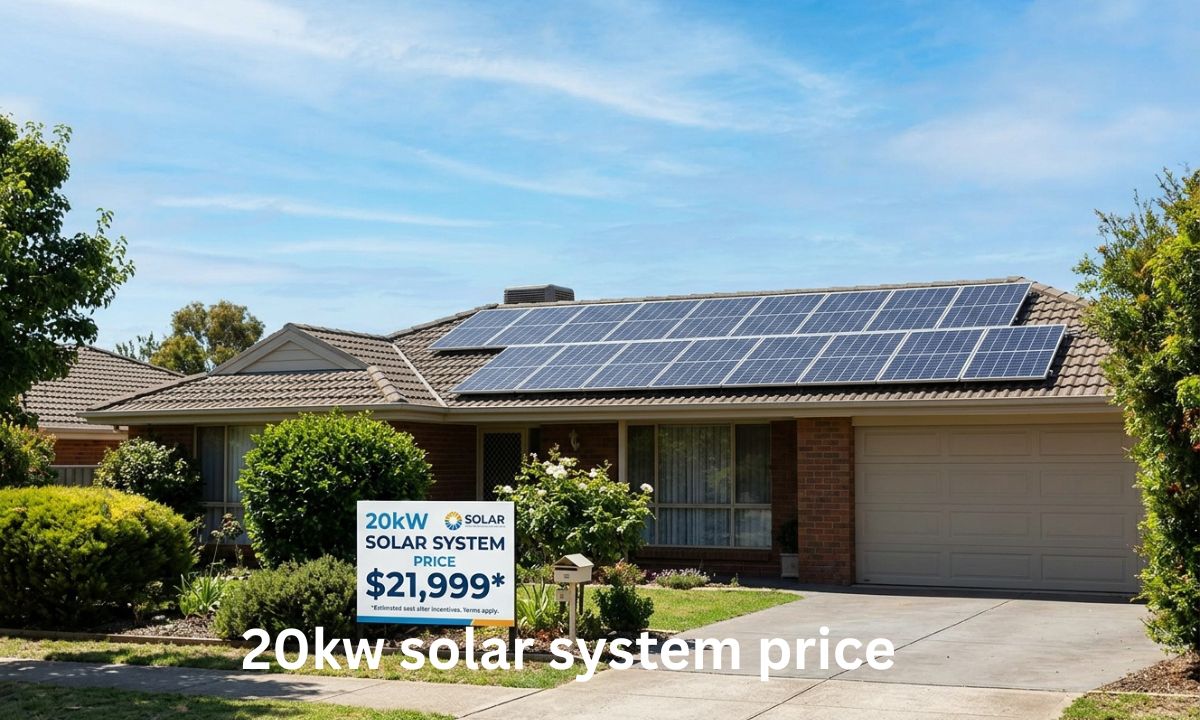
Are you looking for the 20kW solar system price in Pakistan? You are in the right place, my friend. A 20kW system is a big solar system. It is perfect for large homes, shops, and small businesses. Many people with high electricity bills choose this size.
In 2026, the 20kW solar system price can be different for different systems. An on-grid system is the cheapest option. It works with WAPDA and net metering. A hybrid system costs more, but it gives you backup power during load shedding. I will explain both in simple words.
In this guide, I will share the latest prices for on-grid and hybrid 20kW systems. I will also show you a price table in PKR. You will learn about panels, inverters, and monthly savings. Stay with me, and I will help you pick the best option for your home or business.
What Is a 20kW Solar System?
A 20kW solar system is a large solar power setup. It can produce 20,000 watts of electricity when the sun is at its best. This size is not for a small house. It is made for big homes, shops, schools, and small factories.
Think of it like this. A normal 5kW system can run a few fans, lights, and one AC. A 20kW system is four times bigger. It can run many air conditioners, motors, freezers, and machines at the same time.
I have installed many 20kW systems in Punjab. Most of my clients are big families with high bills or shop owners who run heavy equipment all day. If your monthly bill is above Rs. 80,000, this system size usually makes sense.
A 20kW system has three main parts. These are solar panels, an inverter, and a mounting structure. Some systems also add batteries for backup power. We will explain each part below.
20kW Solar System Total Price in Pakistan 2026
The 20kW solar system price changes based on the type you pick. There are three main types: on-grid, hybrid, and off-grid.
An on-grid system connects only to the WAPDA line. It has no batteries. This is the cheapest option. A hybrid system connects to WAPDA and also has batteries. It costs more but gives backup during load shedding. An off-grid system works fully on batteries and solar power. It does not need WAPDA at all.
Here is a simple price table based on current 2026 market rates:
| System Type | Price Range (PKR) | Batteries Included |
| On-Grid (Net Metering) | 1,575,000 – 2,200,000 | No |
| Hybrid (Without Battery) | 1,920,000 – 2,400,000 | No |
| Hybrid (With Battery) | 3,200,000 – 4,600,000 | Yes |
| Off-Grid (Full Backup) | 3,600,000 – 4,800,000 | Yes |
Pro tip: Prices move up and down with the dollar rate. Solar panels and inverters are imported items. Always ask your dealer for today’s rate, not last month’s rate.
The price also depends on your city. Karachi, Lahore, and Islamabad usually have more dealers, so prices can be a little lower there. Smaller cities may charge extra for transport and installation travel.
Component-Wise Cost Breakdown
A 20kW system is not just panels. Many parts work together. Knowing the cost of each part helps you spot a fair quote versus an overpriced quote.
1. Solar Panels: Panels are the highest cost. A 20kW system needs about 28 to 34 panels, depending on panel wattage. Panel prices in 2026 range from Rs. 24 to Rs. 35 per watt.
2. Solar Inverter: The inverter turns sunlight power into usable electricity. A good 20kW inverter costs between Rs. 250,000 and Rs. 500,000, depending on the brand.
3. Mounting Structure: This is the metal frame that holds your panels. For 20kW, the structure cost is usually Rs. 150,000 to Rs. 250,000.
4. Wiring and Cables: Cables carry electricity safely from panels to the inverter. Budget Rs. 40,000 to Rs. 80,000 for good quality DC and AC cables.
5. Net Metering and Documentation: Your DISCO (electric company) charges a fee for the net meter. This is usually Rs. 20,000 to Rs. 40,000, plus paperwork time.
6. Labor and Installation: Skilled labor for a 20kW system costs around Rs. 100,000 to Rs. 200,000, depending on roof height and site difficulty.
Here is a simple breakdown table:
| Component | Approximate Cost (PKR) |
| Solar Panels (28–34 pcs) | 700,000 – 1,100,000 |
| Inverter | 250,000 – 500,000 |
| Structure | 150,000 – 250,000 |
| Wiring & Accessories | 40,000 – 80,000 |
| Net Metering Fee | 20,000 – 40,000 |
| Installation Labor | 100,000 – 200,000 |
Real talk from the field: I always tell my clients not to save money on wiring and structure. Cheap cables can burn. Weak structure can break in strong wind. Save money on the brand of panel, not on safety parts.
How Much Power Does a 20kW Solar System Produce
This is the most common question I get. A 20kW solar system produces power based on sunlight hours, not just its size.
On a good sunny day in Pakistan, a 20kW system produces about 80 to 100 units of electricity. This is called daily production.
Over one full month, this adds up to about 2,400 to 2,800 units. That is enough for a very heavy household or a mid-size shop.
Production also depends on your city. Cities in Sindh and South Punjab get more sun hours. Cities near hills or with more cloud cover get slightly less.
| City | Average Daily Units | Average Monthly Units |
| Lahore | 85 – 95 | 2,500 – 2,700 |
| Karachi | 90 – 100 | 2,600 – 2,800 |
| Islamabad | 80 – 90 | 2,400 – 2,600 |
| Multan | 90 – 100 | 2,600 – 2,800 |
| Peshawar | 80 – 90 | 2,400 – 2,600 |
Pro tip: Winter months give less power because the sun stays low. Always design your system for average yearly output, not just summer output.
20kW Solar System Cost With Batteries
Adding batteries changes the price a lot. Batteries are the most expensive single part of a solar system after the panels.
A 20kW system with lead-acid batteries costs around Rs. 3,200,000 to Rs. 3,800,000. Lead-acid batteries are cheaper but need more maintenance and last fewer years.
A 20kW system with lithium batteries costs more, around Rs. 3,800,000 to Rs. 4,800,000. Lithium batteries last longer, charge faster, and need almost no maintenance.
Here is a comparison:
| Battery Type | Extra Cost (PKR) | Life Span | Maintenance |
| Lead-Acid / Tubular | 1,600,000 – 2,200,000 | 3–5 years | Regular water top-up |
| Lithium (LiFePO4) | 2,200,000 – 3,000,000 | 8–12 years | Almost none |
My honest advice: If your budget allows, go for lithium batteries. Yes, they cost more today. But you will not replace them every few years like tubular batteries. In the long run, lithium usually saves money.
How Many Batteries for a 20kW Solar System
This depends on how many hours of backup you want.
As a simple rule, a 20kW load needs about 20 batteries if you want full backup using standard 12V tubular batteries. This gives a good backup window during load shedding.
If you use lithium batteries, you need far fewer units. A lithium battery bank of 15kWh to 20kWh can often replace 20 tubular batteries, because lithium stores energy more efficiently.
Here is a simple guide:
- 2–3 hours backup: 8 to 10 tubular batteries, or one lithium unit (10kWh)
- 5–6 hours backup: 16 to 20 tubular batteries, or two lithium units (20kWh)
- Full-day backup: 24+ tubular batteries, or three lithium units (30kWh)
Pro tip: Do not just buy batteries based on price. Match the battery bank to your inverter’s charging capacity. A mismatched setup will never charge fully, and your batteries will die early.
20kW Inverter Options
The inverter is the “brain” of your solar system. For a 20kW system, you have a few good choices in the Pakistani market.
On-Grid Inverters: These only work with WAPDA. Popular brands include Solis, Growatt, and Sungrow. Prices range from Rs. 250,000 to Rs. 350,000 for 20kW capacity.
Hybrid Inverters: These work with WAPDA and batteries. Popular choices include Huawei SUN2000, Growatt SPH series, and Solis Hybrid. Prices range from Rs. 350,000 to Rs. 500,000.
Three-Phase vs Two-Phase: Homes usually use two-phase or single-phase setups. Factories, motors, and tube wells need three-phase inverters. Three-phase inverters cost more but are needed for heavy machines.
| Inverter Type | Best For | Price Range (PKR) |
| On-Grid (2-Phase) | Homes, shops | 250,000 – 320,000 |
| Hybrid (2-Phase) | Homes with backup need | 350,000 – 420,000 |
| Hybrid (3-Phase) | Factories, tube wells | 420,000 – 550,000 |
Field tip from Farooq: Always buy an inverter with at least five years warranty. I have seen cheap, no-name inverters fail within one year. A good inverter brand saves you many headaches later.
Who Needs a 20kW System?
A 20kW system is not for every home. It fits specific needs. Let us look at who really benefits from this size.
Small Factories & Workshops
Small factories and workshops use motors, welding machines, and compressors. These machines pull heavy power all day. A 20kW system can cover most daytime factory loads and cut diesel generator use.
Shopping Plazas & Malls
Shopping plazas run many lights, ACs, and shop fridges together. A 20kW system helps spread solar power across multiple shops. It works very well with net metering, since shops use power mostly during the day.
Schools & Hospitals
Schools and small hospitals need steady power for fans, lights, computer labs, and medical equipment. A 20kW hybrid system with batteries is a smart choice here, because power cuts can affect patient care or classes.
Large Residential (2+ Kanal Homes)
Big houses on 2 Kanal or more land usually have many rooms, ACs, and outdoor lights. If your bill crosses Rs. 80,000 to Rs. 100,000 a month, a 20kW system fits your usage well.
Simple check: If your last three electricity bills averaged more than Rs. 80,000, a 20kW system is likely the right size for you.
Monthly Savings & Payback Period
This is the number every client asks about first: “When will I get my money back?”
At Pakistan’s current blended tariff of around Rs. 55 to Rs. 60 per unit, a 20kW system can save you between Rs. 130,000 and Rs. 160,000 every month. Over one year, that is roughly Rs. 1.5 million to Rs. 1.9 million in savings.
The payback period — the time it takes for your savings to equal your system cost — is usually 3 to 5 years for an on-grid system. Hybrid systems with batteries take a bit longer to pay back, because the upfront cost is higher.
| System Type | Monthly Savings (PKR) | Estimated Payback Period |
| On-Grid | 130,000 – 160,000 | 3 – 4 years |
| Hybrid (No Battery) | 130,000 – 160,000 | 4 – 5 years |
| Hybrid (With Battery) | 130,000 – 160,000 | 6 – 8 years |
Pro tip: After payback, your solar system keeps saving you money for another 15 to 20 years, almost free. This is why I tell clients to think of solar as an investment, not just a bill.
Solar Unit Production: Daily and Monthly Numbers
We touched on this earlier, but let’s go deeper, because many readers search for exact daily numbers.
On average, 1kW of solar panels produces about 4 to 5 units per day in Pakistan’s climate. For a 20kW system, this means:
- Daily production: 80 to 100 units
- Weekly production: 560 to 700 units
- Monthly production: 2,400 to 2,800 units
- Yearly production: roughly 29,000 to 33,000 units
These numbers change with the season. Summer months, with longer and stronger sunlight, can push daily output closer to 100+ units. Winter months, with shorter days and more cloud cover, may drop output to 60 to 70 units per day.
Real example from my installs: A client in Sahiwal with a 20kW on-grid system tracked his output for one year. His summer average was 95 units per day, and his winter average dropped to 65 units per day. His yearly total still crossed 30,000 units, which fully covered his large household load.
How Many AC Can Run on a 20kW Solar System?
This is a very practical question, so let’s break it down simply.
A standard 1.5-ton inverter AC uses about 1,200 to 1,500 watts when running normally, though it can spike higher at startup. A 1-ton AC uses less, around 900 to 1,100 watts.
With 20kW (20,000 watts) of solar capacity, you can theoretically run:
- 10 to 12 units of 1.5-ton inverter ACs at the same time
- 14 to 16 units of 1-ton inverter ACs at the same time
But in real life, you never run only ACs. You also have fridges, lights, motors, and other appliances pulling power together. So a more realistic number is:
- 6 to 8 ACs (1.5-ton) running alongside normal household or shop appliances
Pro tip: Non-inverter ACs pull much more power at startup than inverter ACs. If you plan to run many ACs on solar, always choose inverter-type ACs. They are kinder to your solar inverter and battery bank.
20kW Solar System Load Capacity
Load capacity means the total amount of electrical load your system can safely handle at one time.
A 20kW system can safely support a combined running load of about 16,000 to 18,000 watts, keeping some buffer for safety and startup surges. This buffer matters because motors, ACs, and pumps often draw extra power for a few seconds when they first switch on.
Here is a rough load capacity guide for a 20kW system:
| Appliance | Typical Load (Watts) | Approx. Quantity Supported |
| Inverter AC (1.5 Ton) | 1,300 | 8 – 10 units |
| Refrigerator | 200 | 4 – 5 units |
| LED Lights | 15 | 100+ units |
| Ceiling Fans | 70 | 20+ units |
| Washing Machine | 500 | 2 – 3 units (not always together) |
| Water Motor (1 HP) | 750 | 3 – 4 units |
Important note: Never load your system beyond its safe capacity. Overloading can trip your inverter or shorten its life. Always leave at least 15 to 20% buffer for safety.
20kW Solar System Area Required
Roof space is a real concern for many buyers, so let’s cover it clearly.
A standard solar panel today is rated at 550W to 585W and takes up roughly 28 to 30 square feet of roof area, including the space needed between rows for cleaning and airflow.
For a 20kW system, you generally need:
- 28 to 34 panels, depending on the panel wattage you choose
- 1,300 to 1,600 square feet of clear, unshaded roof space
| Panel Wattage | Panels Needed | Approx. Area Required |
| 550W | 36 – 37 panels | 1,500 – 1,600 sq ft |
| 585W | 34 – 35 panels | 1,400 – 1,500 sq ft |
| 610W+ | 32 – 33 panels | 1,300 – 1,400 sq ft |
South-facing roofs work best in Pakistan, since they catch the most direct sunlight through the day. East-west split installs are possible too, but they usually reduce total output by 8 to 12 percent.
Pro tip: Before buying a 20kW system, measure your usable roof area first. I have seen many clients fall in love with a system size their roof simply cannot fit. Always confirm space before confirming the order.
Final words
A 20kW solar system is a serious investment, but it is one of the smartest moves you can make if your electricity bill is high. It gives you the power to run big appliances, support a factory, or keep a school or hospital running without heavy dependence on WAPDA.
The right choice between on-grid, hybrid, and battery-backed systems depends on your budget and how often your area faces load shedding. On-grid saves the most money upfront, while hybrid gives you peace of mind during outages.
Before you install, always check your roof space, your monthly bill pattern, and get quotes from more than one trusted installer. A well-planned 20kW system can pay for itself in a few years and then keep saving you money for two decades or more.
“FAQs”
What is the cost of a 20kW solar system?
A 20kW on-grid solar system in Pakistan costs around Rs. 1,575,000 to Rs. 2,200,000. A hybrid version with batteries can go up to Rs. 3,200,000 to Rs. 4,600,000.
What is the price of a 20 kW solar system in Pakistan?
The 20kW solar system price ranges from about Rs. 1,575,000 to Rs. 2,400,000 for on-grid or hybrid without batteries. Prices change with the dollar rate and panel brand.
Can a 20kW solar system power my whole house?
Yes, a 20kW system can easily power a large house, including several ACs, fridges, and motors. It suits homes with monthly bills above Rs. 80,000.
How many solar panels for 25 kW?
A 25kW system needs about 40 to 44 panels, using 580W to 630W Tier-1 panels. Fewer, higher-wattage panels can also reach 25kW with less roof space.
How many solar panels are in a 20 kW system?
A 20kW system usually needs 28 to 34 panels, depending on panel wattage. Higher-wattage panels (600W+) mean fewer panels are required.
What is the price of a 20 kW inverter?
A 20kW on-grid inverter costs around Rs. 250,000 to Rs. 350,000. A hybrid 20kW inverter costs more, around Rs. 350,000 to Rs. 500,000.
How much electricity can a 25 kW solar system generate per day?
A 25kW solar system generates about 100 to 120 units per day in good sunlight. This adds up to roughly 3,000 to 3,400 units per month.
How much is 20 kW of power?
20 kW means 20,000 watts of power output at any moment. It is enough to run many appliances together, like several ACs, fridges, and lights at once.

I AM CH SAMI ULLAH, THE TOP SOLAR PANEL SELLER AND INSTALLER IN PAKISTAN, WITH CHEAPEST RATES, OF TOP QUALITY. GET THE LATEST RATES ON SOLAR PANELS, FANS, ACs, TUBE WELLS, SOLAR FRIDGES, AND SOLAR ATTA CHAKKIS. WHATSAPP (03461320821)