
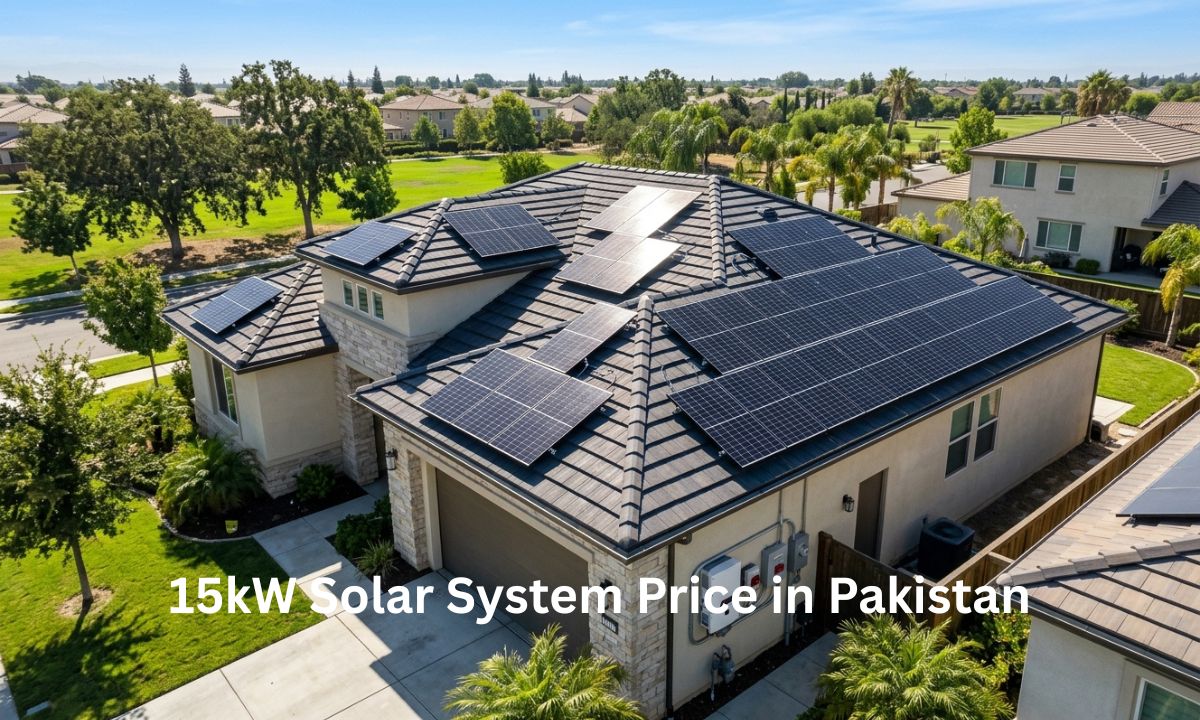
A 15kW solar system is a popular choice for large homes and small businesses in Pakistan. It can power multiple air conditioners, refrigerators, and other heavy appliances with ease. In 2026, more people are choosing solar because electricity bills keep rising every year. This size system offers a strong balance between power output and installation cost.
The price of a 15kW solar system depends on many things. These include the type of panels, the inverter brand, and whether you choose an on-grid or hybrid setup. On-grid systems are cheaper and connect directly to WAPDA through net metering. Hybrid systems cost more but give you backup power during load shedding.
In 2026, a 15kW on-grid system in Pakistan costs roughly PKR 1.2 million to 1.8 million. A hybrid system with battery backup can cost between PKR 2.2 million and 3 million. Prices change based on your city, the brand you pick, and current exchange rates. This guide gives you updated rates to help you plan your solar investment.
What Is a 15kW Solar System? kW vs. KVA
A 15kW solar system is a large solar setup that can produce 15 kilowatts of real power at any given moment. This size is popular with big homes, small factories, schools, and clinics that use a lot of electricity every day.
Many buyers get confused between kW and kVA, and this mistake can cost you money. Here is the simple difference:
- kW (kilowatt) measures real power — the actual energy that does work, like running your fan or fridge.
- kVA (kilovolt-ampere) measures apparent power, which includes extra load from motors and compressors.
Pro tip: Some sellers advertise a “15 KVA system” that only delivers around 12kW of real power. Always ask your installer for the kW rating, not the KVA rating, before you sign any deal. This one question alone can save you from buying an undersized system.
In real installations, a 15kW inverter is usually paired with 26 to 28 solar panels, depending on the panel wattage used. Bigger panels mean fewer panels, but the total power stays close to 15kW either way.
15kW Solar System Price Summary | 2026 Pakistan
Prices change often because of exchange rates, import duties, and panel technology. Based on real market data from 2026, here is a simple price summary:
| System Type | Price Range (PKR) | Backup During Outages |
| On-Grid (No Battery) | 1,220,000 – 1,800,000 | No |
| Hybrid (No Battery) | 1,750,000 – 2,100,000 | Partial (only when sun is out) |
| Hybrid with Lithium Battery | 2,200,000 – 3,000,000 | Yes, full backup |
On-grid systems are the cheapest because they only work when connected to WAPDA. They send extra power back to the grid through net metering, but they shut down during a power outage for safety reasons.
Hybrid systems cost more but keep your lights on during load shedding. This is why most Pakistani homes now prefer hybrid over simple on-grid setups, even with the higher price tag.
From my own experience talking to installers in Lahore and Karachi, prices in Karachi are often slightly higher than Lahore because of extra transport and labor costs. If you live in a smaller city, always ask for three separate quotes before choosing an installer.
What’s Included vs. Excluded in a Solar Installation Quote
This is where most buyers get surprised later. A cheap quote often looks great on paper, but it may be missing important parts.
Usually included in a standard quote:
- Solar panels
- Inverter (on-grid or hybrid)
- Mounting structure
- DC and AC cables
- Basic protection devices (breakers, fuses)
Often excluded, so always ask:
- Net metering application fee (Rs. 60,000 – 80,000 in many cases)
- Elevated structure if your roof needs extra height
- Earthing kit and lightning protection
- Long cable runs if your inverter is far from the panels
- Transport charges for far-off locations
Pro tip: Always ask the seller to write “complete installed price, no hidden charges” on your invoice. This one line protects you from surprise bills after the work starts. A good installer will never hesitate to put this in writing.
How to Confirm a 15kW System Matches Your Load?
Buying the wrong size system is one of the most common mistakes in Pakistan. Some people buy too small and don’t get enough power. Others buy too big and waste money.
Follow these simple steps to check if 15kW is right for you:
- Check your monthly bill. If your electricity bill is between Rs. 60,000 and 80,000, a 15kW system usually fits well.
- List your heavy appliances. Count your air conditioners, washing machines, water motors, and refrigerators.
- Add up the load. Most 15kW systems can run 5 or more inverter ACs along with normal household items.
- Think about future needs. If you plan to add more rooms or a small business setup, size a little higher than your current need.
Real-life tip: A family I know in Islamabad had a 1-kanal house with 6 split ACs, a water pump, and two refrigerators. Their old 10kW system kept tripping during summer. After switching to 15kW, everything ran smoothly, even on the hottest days. This shows why matching the system to your actual load matters more than just picking a popular size.
15kW Solar System Components & Cost Breakdown
A complete 15kW system has several parts, and each one affects your final cost. Here is a simple breakdown:
| Component | Approximate Share of Total Cost |
| Solar Panels | 35% – 45% |
| Inverter | 20% – 25% |
| Mounting Structure | 8% – 10% |
| Wiring, Earthing & Protection | 8% – 10% |
| Labor & Installation | 8% – 12% |
| Net Metering & Paperwork | 5% – 7% |
Panels usually cost between PKR 24,000 and 35,000 each, depending on the wattage and technology used. N-type panels cost more but produce more power and last longer.
Inverters for a 15kW system come in single-phase or three-phase versions. Three-phase inverters are needed for many commercial connections and cost more than single-phase units.
Mounting structure matters more than people think. A cheap, thin structure may rust or bend during storms. Always choose a galvanized structure built to handle Pakistan’s heat and dust.
ROI, Payback Period, and 25-Year Cost of Ownership
Solar is not just an expense — it is an investment that pays you back over time. Here is what real numbers look like for a 15kW system.
- Monthly savings: Roughly PKR 75,000 to 120,000, depending on your tariff and usage.
- Payback period: Usually 1.5 to 3 years for on-grid systems.
- 25-year outlook: After the panels pay for themselves, you get free electricity for the rest of their lifespan, minus small maintenance costs.
Simple example: If your system costs PKR 1.5 million and saves you PKR 90,000 per month, you recover your full cost in about 17 months. After that, every unit of power is pure savings.
Pro tip: Keep a simple record of your monthly savings in a notebook or spreadsheet. This helps you track your actual payback period, which is often faster than the estimate once electricity rates rise again.
Over 25 years, expect small costs for inverter replacement (usually once, around year 10-12) and panel cleaning. These costs are tiny compared to the total savings you gain from not paying full WAPDA bills.
Panel Performance & Degradation Forecast
Solar panels do not stop working after a few years, but their output slowly drops. This is called degradation, and it is completely normal.
- Year 1: Panels usually perform at 97% to 98% of their rated output.
- Years 2–25: Most Tier-1 panels lose about 0.4% to 0.6% per year.
- After 25 years: Panels still produce around 80% to 87% of their original power.
This means your 15kW system will still act like a strong 12kW to 13kW system even after 25 years of daily use. This is why buying Tier-1 panels with a proper manufacturer warranty is so important.
Pro tip: Always ask for the performance warranty document, not just a sales brochure. A real warranty tells you exactly how much output is guaranteed at year 10, year 20, and year 25.
Solar Anti-Islanding Protection
This is a safety feature that many buyers never ask about, but it is very important.
Anti-islanding protection automatically shuts down your solar system when the main grid power goes off. This prevents your system from sending electricity back into the grid lines while WAPDA staff might be repairing them.
Without this feature, a working solar system could seriously injure a lineman working on what they think is a dead wire. This is why net metering approval in Pakistan requires certified inverters with built-in anti-islanding protection.
Pro tip: Never buy an inverter without this feature, even if it is cheaper. It is not just about following rules — it is about protecting real people’s lives, including your own family and neighbors.
15kW Solar System Load Capacity
A 15kW system is built for serious daily power needs. Here is what it can typically handle at the same time:
- 5 to 6 inverter air conditioners (1.5 ton each)
- 2 to 3 refrigerators
- Water motor or pump
- Washing machine and iron
- Full home lighting and fans
- Small office equipment like computers and printers
This makes 15kW ideal for 1 to 2 kanal homes, small clinics, schools, and retail shops that run multiple devices throughout the day. If your building has three-phase electricity, a 15kW three-phase inverter will balance the load evenly across all phases.
15kW Solar System Daily Output
On a normal sunny day in Pakistan, a 15kW system generates between 60 and 75 units (kWh) of electricity. Over a full month, this adds up to roughly 1,700 to 2,200 units.
Daily output changes with the seasons:
- Summer (May–August): Higher output due to longer daylight hours, often near the top of the range.
- Winter (December–February): Lower output due to shorter days and more cloud cover, sometimes dropping to 40–50 units per day.
- Monsoon season: Output can dip further on heavy cloud or rainy days.
Pro tip: Clean your panels once every 2 to 3 weeks during dusty months. Dust buildup alone can reduce your daily output by 5% to 15%, which adds up to real money lost over a full year.
Cost of 15kW Solar System Installed
The word “installed” matters a lot here. A fully installed 15kW system includes everything needed to make it work on day one, not just the raw equipment.
| Installation Type | Fully Installed Price (PKR) |
| Basic On-Grid | 1,220,000 – 1,600,000 |
| Standard Hybrid (No Battery) | 1,750,000 – 2,100,000 |
| Hybrid with 10kWh Battery | 2,400,000 – 2,800,000 |
| Full Backup (20kWh Battery) | 3,000,000 – 3,800,000 |
These installed prices already include panels, inverter, structure, wiring, and basic labor. Always double-check whether net metering filing is part of the package or charged separately, since this can add another Rs. 60,000 to 80,000 to your final bill.
Inverter Brand Comparison: Huawei vs Growatt vs Sungrow vs GoodWe (15kW)
Choosing the right inverter brand affects your system’s efficiency, monitoring quality, and long-term reliability. Here is an honest, simple comparison for 15kW setups in Pakistan:
| Brand | Efficiency | Best For | Price Level |
| Huawei | Up to 98.6% | Large homes, commercial, tech-savvy users who want smart app monitoring | Premium |
| Sungrow | Up to 98.4% | Homes and businesses needing stable performance in voltage-fluctuation areas | Premium |
| GoodWe | 97.5% – 98.2% | Hybrid systems with strong battery backup and load-shedding support | Mid-range |
| Growatt | Around 97.5% | Budget-friendly buyers who still want reliable daily performance | Affordable |
Huawei leads in raw efficiency and offers an excellent app for checking your system’s performance from your phone. It is a great choice if you want detailed monitoring and don’t mind paying a bit more.
Sungrow is close behind Huawei in performance and works well in areas with unstable voltage, which is common in many Pakistani cities.
GoodWe shines in hybrid setups. If backup power during outages is your top priority, GoodWe’s battery management is often smoother than budget brands.
Growatt is the practical choice for buyers who want solid performance without the premium price tag. It has a wide dealer network across Pakistan, so spare parts and service are easy to find.
Pro tip: Don’t only compare brand names — compare the warranty length and the local service center location. A cheaper inverter with no nearby support center can cost you more in downtime than a slightly pricier one with a strong local team.
What Does a 15kW System Actually Produce?
Numbers on paper and real-world results are not always the same. Here is what a genuine 15kW system produces under normal Pakistani weather conditions:
- Daily average: 55–70 units on a typical day across the year
- Monthly average: Around 1,800–2,000 units
- Yearly total: Roughly 20,000–24,000 units
This output is enough to fully cover a high-consumption household or a small commercial building, often eliminating the WAPDA bill almost completely for on-grid users with net metering, since excess units feed back into the grid for credit.
Pro tip: Ask your installer to show you a simple production estimate report based on your roof’s exact direction and shading. A roof facing south with no shade will always outperform a roof with trees or buildings blocking the sun.
15kW Solar System Output by Major Pakistani Cities
Sunlight hours are not the same across Pakistan, so your output will vary slightly depending on where you live.
| City | Approximate Daily Output (Units) |
| Karachi | 62 – 75 |
| Lahore | 58 – 70 |
| Islamabad | 55 – 68 |
| Multan | 65 – 78 |
| Peshawar | 55 – 66 |
| Quetta | 60 – 74 |
Southern cities like Karachi and Multan usually get more direct sunlight, which slightly boosts daily output. Northern cities like Islamabad and Peshawar see a bit less output, especially during winter, because of shorter daylight hours and more cloud cover in certain months.
Pro tip: If you live in a city with more dust storms, like parts of Punjab and Sindh, factor in slightly more frequent panel cleaning into your maintenance routine to keep your output close to these estimates.
Final words
A 15kW solar system is a smart choice for Pakistani households and businesses with high electricity usage. It handles heavy loads like air conditioners, refrigerators, and water pumps without any strain. The updated 2026 prices show that solar is now more affordable than ever. With rising WAPDA tariffs, this investment pays for itself faster each year.
Before you buy, always compare quotes from different installers. Check the panel brand, inverter quality, and warranty terms carefully. Ask for a full price breakdown, including installation and net metering charges. This helps you avoid hidden costs and get the best value for your money.
In the end, a 15kW system offers strong savings and long-term energy independence. It reduces your monthly bills and protects you from future price hikes. With proper maintenance, these systems can last 25 years or more. Making the switch to solar power today is a wise decision for your future.
“FAQs”
What is the price of a 15 kW solar system in Pakistan?
A 15kW on-grid system costs around PKR 1.2 million to 1.8 million in 2026. A hybrid system without a battery costs more, around PKR 1.75 million to 2.1 million. With lithium battery backup, prices can go up to PKR 3 million. The final price depends on your panel brand, inverter type, and city.
How much electricity can a 15 kW solar system generate per day?
A 15kW system generates about 60 to 75 units of electricity per day. This adds up to roughly 1,700 to 2,200 units per month. Actual output depends on sunlight hours, panel quality, and your location. Cities with more sun, like those in southern Punjab or Sindh, may see higher output.
What does a 15 kW solar system cost?
The total cost includes panels, inverter, mounting structure, wiring, and installation. On-grid setups are the cheapest option, starting from about PKR 1.22 million. Hybrid setups with battery backup cost significantly more. Always ask for a full quote that includes net metering fees too.
How much does a 15-kW solar system cost?
This is the same as above — pricing depends on the system type you choose. On-grid systems range from PKR 1.2 million to 1.8 million. Hybrid systems with battery backup can reach PKR 2.4 million to 3 million. Battery capacity and brand choice are the biggest price factors.
How many AC can 10kW run?
A 10kW solar system can typically run 3 to 4 inverter ACs comfortably. It also supports other appliances like refrigerators, fans, and lights at the same time. The exact number depends on the AC tonnage and how many hours they run daily. Inverter ACs use less power, so they allow more units to run together.
Is 15kW enough to power a house?
Yes, a 15kW system is enough for a large 1 to 2 kanal home. It can power 5 or more inverter ACs, along with refrigerators, water pumps, and lighting. This size suits homes with high electricity bills, often between Rs. 60,000 and 80,000 per month. It’s one of the biggest residential system sizes available in Pakistan.
Can I run 2 ACs on a 5kW solar system?
Yes, a 5kW system can usually run 2 inverter ACs without any problem. It also has enough capacity left for basic loads like fans, lights, and a refrigerator. Running non-inverter ACs may reduce this capacity, since they draw more power. A 5kW system is best suited for medium-sized households.
How many batteries do I need for a 15kW solar system?
Most 15kW hybrid setups use 2 to 4 lithium batteries for backup power. Each battery typically holds around 5kWh of storage capacity. The exact number depends on how many backup hours you want during load shedding. Homes wanting full independence may choose a 20kWh battery bank or larger.

I AM CH SAMI ULLAH, THE TOP SOLAR PANEL SELLER AND INSTALLER IN PAKISTAN, WITH CHEAPEST RATES, OF TOP QUALITY. GET THE LATEST RATES ON SOLAR PANELS, FANS, ACs, TUBE WELLS, SOLAR FRIDGES, AND SOLAR ATTA CHAKKIS. WHATSAPP (03461320821)
1 thought on “15kW Solar System Price in Pakistan 2026: Updated Rates”