
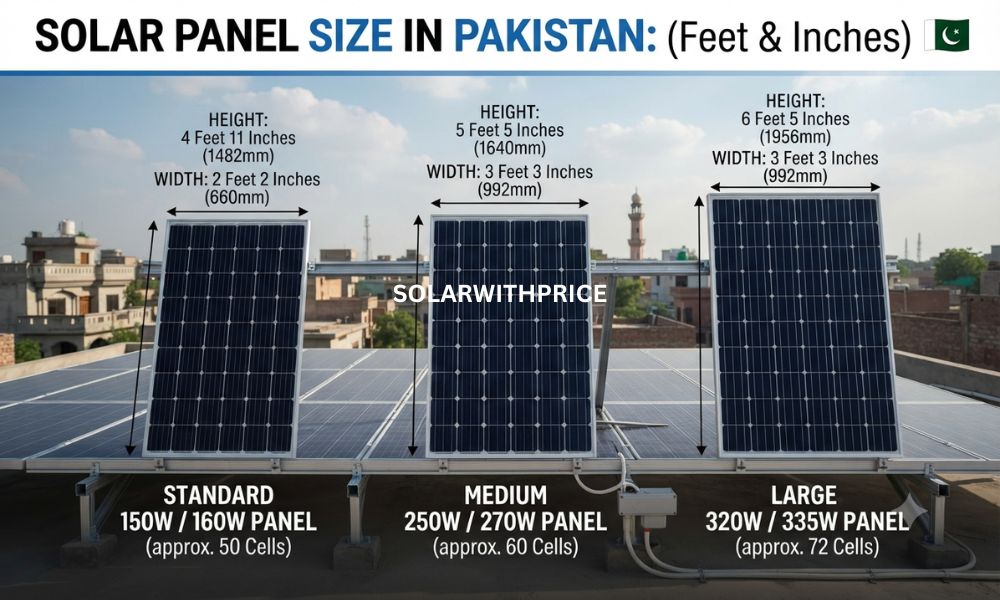
Solar Panel Size depends on the wattage capacity of the solar panels; big Solar panels have a big size, and small panels have a small size in Pakistan in 2026. Solar panel sizes are mostly measured in feet and inches in Pakistan.
Solar panel dimensions in Pakistan vary depending on the type and wattage you choose, and knowing the exact size in feet and inches helps you plan your rooftop space before buying. Most homeowners across Lahore, Karachi, and Islamabad go for standard 60-cell panels, which fit comfortably on small to medium-sized roofs without any structural changes.
If you’re setting up a solar system in 2026, understanding panel size is just as important as checking the price or wattage. A typical residential solar panel in Pakistan measures around 5.4 feet by 3.25 feet, while commercial panels used for shops, factories, and tube wells are slightly bigger and heavier.
What Are the Dimensions of a Solar Panel?
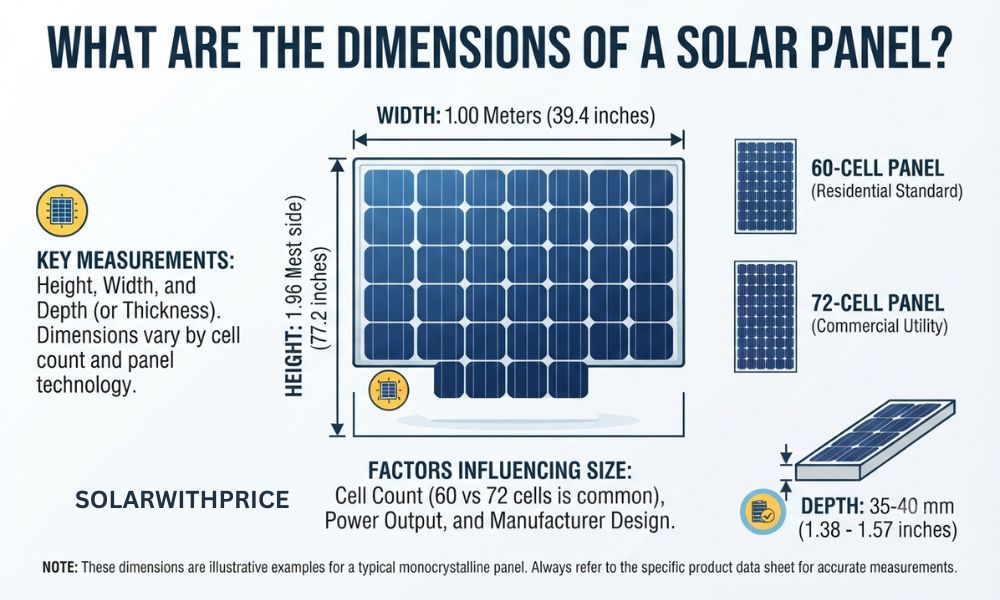
A solar panel’s dimensions refer to its length, width, and thickness — the actual physical size you’ll see on your roof. In Pakistan, most residential solar panels measure around 5.4 feet by 3.25 feet (65 x 39 inches), with a thickness of about 1.4 to 1.8 inches.
These measurements aren’t random. They depend mainly on how many solar cells are packed inside the panel and the wattage it’s built to produce. A higher-wattage panel usually means a slightly bigger frame, though modern technology is helping manufacturers fit more power into smaller sizes.
My personal experience: Whether you’re buying panels for a home in Lahore or a commercial setup in Faisalabad, knowing the exact dimensions in feet and inches helps you plan your roof layout, calculate how many panels will fit, and avoid space issues once installation begins.
Standard Solar Panel Sizes
Most solar panels sold today fall into a few standard categories based on the number of solar cells inside them. The cell count is the biggest driver of a panel’s physical footprint.
| Panel Type | Cell Count | Dimensions | Typical Weight |
| Residential (60-cell) | 60 or 120 half-cut cells | 65″ x 39″ (1.7m x 1m) | 40–46 lbs |
| Commercial (72-cell) | 72 or 144 half-cut cells | 78″ x 40″ (2m x 1m) | 50–55 lbs |
| Large-format commercial | 96-cell | 62.6″ x 41.5″ | 55–60 lbs |
| Portable/small panels | 20–40 cells | 20″ x 20″ up to 40″ | 5–15 lbs |
My pro tip: These numbers are averages. Exact dimensions shift slightly from brand to brand, so it’s always worth checking the datasheet of the specific model you’re buying before finalizing your roof plan.
What Size Are Solar PV Panels in Real Life?
Numbers on a spec sheet only tell half the story. Here’s what these dimensions actually mean once panels are sitting on a rooftop or a commercial building.
Residential PV Panels
Home solar panels are built to be manageable for a two-person installation crew and to fit neatly within standard rooftop dimensions.
A typical residential panel is arranged in a 6×10 grid of cells and measures roughly 5.4 feet by 3.25 feet, with a thickness of around 1.5 to 2 inches.
Weight usually lands between 40 and 50 pounds, which is light enough that most homes don’t need structural reinforcement before installation.
Commercial PV Solar Panels
Commercial installations — think warehouses, factories, schools, and office buildings — generally use larger 72-cell panels. These are arranged in a 6×12 grid and measure close to 6.5 feet by 3.3 feet.
The larger footprint means fewer panels are needed to hit a given power target, which lowers labor, wiring, and racking costs on big projects. Because of their size and weight, these panels typically require two installers to handle safely.
How Big Are Solar PV Panels Overall?
Zooming out, here’s the general range you can expect across the market:
- Length: 60 to 90 inches (1.5m to 2.3m)
- Width: 33 to 44 inches (0.85m to 1.1m)
- Thickness: 1.2 to 1.8 inches (30mm to 45mm)
- Weight: 15kg to 30kg for most residential and commercial models
A single home solar panel typically covers around 17 to 20 square feet of roof space.
What Are the Sizes of Solar Panels in Pakistan 2026?
Solar panels aren’t one-size-fits-all. Manufacturers build different sizes for different use cases, from tiny camping panels to large commercial modules.
1. Small Solar Panels
These range from about 20×20 inches up to 40 inches and are common in the 50W–200W output range. They’re built for off-grid uses — camping, boats, RVs, and small backup lighting systems — not for powering a whole household.
2. Medium Solar Panels (Most Common)
This is the standard 60-cell residential category. Measuring around 65″ x 39″, these panels balance power output, weight, and ease of handling, which is why they dominate home installations worldwide.
3. Large Solar Panels
72-cell and 96-cell panels fall into this group. They’re designed for commercial rooftops and ground-mounted solar farms where maximizing output per panel reduces overall installation costs.
Average Solar Panel Dimensions
| Metric | Residential Average | Commercial Average |
| Length | 65 inches (1.65m) | 78 inches (2m) |
| Width | 39 inches (1m) | 40 inches (1.02m) |
| Thickness | 1.4–1.8 inches (35–45mm) | 1.4–1.8 inches (35–45mm) |
| Weight | 40–46 lbs (18–21kg) | 50–55 lbs (23–25kg) |
| Wattage | 350W–450W | 450W–710W |
7 Factors That Influence Solar Panel Size in Pakistan 2026
Panel dimensions aren’t arbitrary. Several technical and practical factors shape how big or small a panel ends up being.
1. Solar Cell Technology
Monocrystalline, polycrystalline, and thin-film cells all have different efficiency levels. Higher-efficiency monocrystalline cells can generate more power from a smaller surface area, which is why premium panels are sometimes more compact than older polycrystalline designs producing the same wattage.
2. Wattage Capacity
Higher wattage generally means either more cells or larger cells packed into the panel frame. A 585W panel will almost always be physically bigger than a 300W panel, even from the same manufacturer.
3. Number of Cells
This is the single biggest factor. 60-cell, 72-cell, and 96-cell configurations follow fairly predictable grid layouts (6×10, 6×12, and 8×12), and each additional row or column of cells adds measurable inches to the panel’s length or width.
4. Application Type
Panels designed for rooftops, ground mounts, portable use, or specialized surfaces (like van roofs or boats) are engineered with very different size constraints. Portable and flexible panels sacrifice some efficiency for a smaller, lighter, more transportable form factor.
5. Manufacturing Design
Frame thickness, glass type, junction box placement, and edge sealing all add small variations to a panel’s final dimensions, even between two panels with the same cell count and wattage.
How Solar Panel Size Affects Performance 2026
Bigger isn’t automatically better. Size interacts with several other factors to determine how well a solar system actually performs.
Space Utilization
Larger panels reduce the number of units needed to hit a target system size, which can simplify wiring and racking. But if your roof space is limited or irregularly shaped, smaller high-efficiency panels may fit better and waste less usable area.
Energy Output
Panel size alone doesn’t determine wattage — cell efficiency does. Two panels of the same physical dimensions can have noticeably different power ratings depending on the quality of the solar cells inside them.
Installation Design
Panel dimensions directly affect racking layout, row spacing, and the number of mounting points needed. Installers use panel size charts to plan safe, code-compliant layouts before any hardware goes on the roof.
Environmental Conditions
Larger panels catch more wind load, which matters in high-wind regions and needs to be factored into mounting hardware selection. Panel size also affects how much weight is distributed across a roof structure.
Modern Trends in Solar Panel Design
The solar industry keeps pushing panel design forward. Here’s what’s shaping the next generation of panels.
1. High-Efficiency Compact Panels
Manufacturers are packing more power into smaller frames using half-cut cells and improved cell architecture, letting homeowners with limited roof space still hit strong system sizes.
2. Bifacial Technology
Bifacial panels capture sunlight on both the front and back surfaces, boosting output without significantly increasing the panel’s physical footprint.
3. AI-Based Energy Optimization
Smart monitoring and AI-driven optimization tools are increasingly paired with panel arrays to fine-tune output based on shading, weather, and panel positioning — helping systems get more value out of the same physical space.
4. Lightweight Materials
Newer frame materials and thinner glass layers are reducing panel weight without sacrificing durability, making installations easier and safer on a wider range of roof types.
Final words
Choosing the right solar panel size for your home or business in Pakistan comes down to your available roof space, energy needs, and budget. Whether you go for a standard 5.4 x 3.25 feet residential panel or a larger commercial-size panel, checking the exact dimensions beforehand ensures a smooth installation without last-minute surprises.
As solar adoption continues to grow across Punjab, Sindh, and other regions in 2026, manufacturers are offering more panel size options to fit different rooftop shapes and system requirements. Always confirm the panel’s length, width, and weight with your installer, especially if you’re working with limited roof space or an older structure.
At the end of the day, the right panel size isn’t just about fitting more panels on your roof — it’s about getting reliable power output that matches your household or business electricity needs. Take your time comparing dimensions, wattage, and pricing before making your final decision, and consult a trusted local installer to get accurate measurements for your specific setup.
Frequently Asked Questions
12V Solar Panel Dimensions in Pakistan
A standard 12V solar panel in Pakistan typically ranges from 100W to 200W, measuring around 42 x 20 inches for a 100W panel and 5 feet x 2 feet for a 200W panel. These are commonly used for small home backup, DC fans, and battery charging setups.
Solar Panel Dimensions in Pakistan in Feet
Residential solar panels in Pakistan usually measure around 5.4 x 3.25 feet (60-cell), while commercial panels run larger at about 6.5 x 3.3 feet (72-cell). Panel thickness stays fairly consistent at 1.4 to 1.8 inches regardless of size.
Standard Size of a Solar Panel
The standard solar panel size for homes is a 60-cell panel measuring around 65 x 39 inches (5.4 x 3.25 feet), with a thickness of about 1.4–1.8 inches and a weight of 40–46 lbs. Commercial installations typically use larger 72-cell panels around 78 x 40 inches (6.5 x 3.3 feet).
Size of a 3kW Solar Panel System
A “3kW solar panel” usually refers to a full 3kW system, not a single panel, since individual panels max out around 550–710W. A 3kW system typically needs 5 to 6 panels (using 550W–585W panels), covering roughly 180–220 square feet of roof space, with each panel measuring about 5.4 x 3.25 feet (residential) or 6.5 x 3.3 feet (commercial).
Solar Panel Size in Feet
Most residential solar panels measure around 5.4 x 3.25 feet, while commercial panels run larger at about 6.5 x 3.3 feet. Portable panels are much smaller, typically 3.5 x 1.7 feet.
Solar Panel Sizes and Wattage
Panel size scales with wattage — a 300W panel is around 5.4 x 3.25 feet, a 450W panel is roughly 6 x 3.3 feet, and 580–600W commercial panels reach about 7.5 x 3.7 feet.
Solar Panel Size 585 Watt in Feet
A 585W solar panel typically measures about 7.4 x 3.7 feet (89 x 44 inches) and weighs around 27 kg, making it suitable for large homes and commercial rooftops.
550 Watt Solar Panel Size in Feet
A 550W solar panel measures roughly 7.2 x 3.6 feet (86.6 x 43.3 inches) and weighs around 25–28 kg, commonly used in both residential and commercial setups.
Solar Panel Size in Inches
Standard residential panels measure about 65 x 39 inches, while commercial panels measure around 78 x 40 inches. Higher-wattage panels (550W+) can reach up to 90 x 45 inches.
Weight of Solar Panels in Kg
Residential panels typically weigh 18–21 kg, while larger commercial and high-wattage panels weigh between 25–28 kg, depending on frame and glass thickness.
Solar Panel Size in Meters
A standard residential solar panel measures approximately 1.7m x 1m, while commercial panels average around 2m x 1m, with a thickness of roughly 3.5–4.5 cm.
Solar Panel Weight per Square Foot
On average, solar panels weigh about 2.3 to 2.8 pounds per square foot (11–13 kg/m²), which is well within the load capacity of most residential roofs.

I AM CH SAMI ULLAH, THE TOP SOLAR PANEL SELLER AND INSTALLER IN PAKISTAN, WITH CHEAPEST RATES, OF TOP QUALITY. GET THE LATEST RATES ON SOLAR PANELS, FANS, ACs, TUBE WELLS, SOLAR FRIDGES, AND SOLAR ATTA CHAKKIS. WHATSAPP (03461320821)