
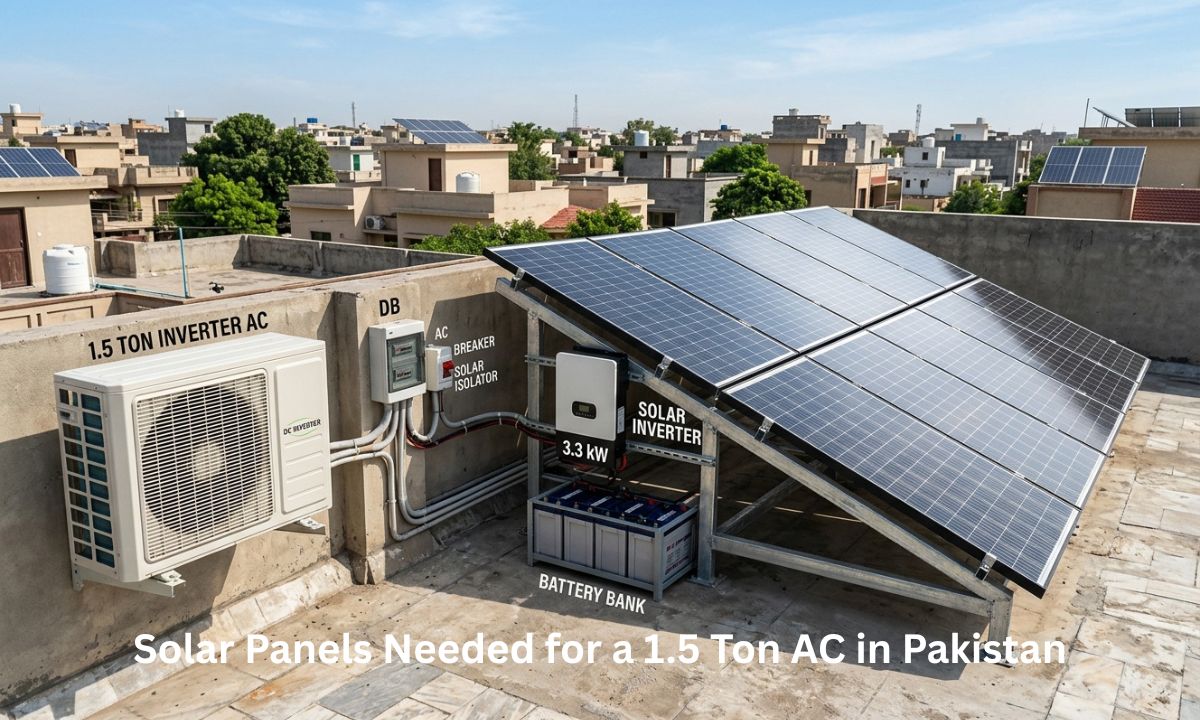
Assalam o Alaikum, friends, Farooq here! Summer in Pakistan gets very hot. A 1.5 ton AC helps keep your room cool. But it also uses a lot of electricity. Many people now want to run their AC on solar power. This saves money and cuts down on load shedding problems. In this guide, I will explain everything in simple words.
A 1.5 ton AC uses about 1500 to 1800 watts of power. This depends on the AC type and its star rating. An inverter AC uses less power than an old-style AC. Knowing the correct wattage is the first step. It helps you pick the right number of solar panels for your home.
To run a 1.5-ton AC, you need enough solar panels to produce that power. Most homes use four to six panels, depending on panel wattage. You also need a good solar inverter and sometimes batteries for backup. The right system size makes sure your AC runs smoothly, even on cloudy days.
In this article, I will break down the exact number of panels you need. I will also share inverter size, battery options, and PKR pricing for 2026. By the end, you will know exactly what to buy for your home. Let’s get started, friends!
How Much Electricity Does a 1.5 Ton AC Consume?
A 1.5 ton AC is the most common AC size in Pakistani homes. It cools medium-size bedrooms and living rooms well. But it also uses a good amount of power every hour.
On average, a 1.5 ton AC uses between 1500 and 1800 watts per hour. This is true for a normal, non-inverter AC running at full speed. In simple words, one hour of AC use equals about 1.5 to 1.8 units of electricity.
An inverter AC uses less power because it adjusts its speed. Once the room gets cool, the compressor slows down. This can bring average consumption down to 900 to 1200 watts per hour.
Here is a simple breakdown, friends:
- Non-inverter 1.5-ton AC: 1500–1800 watts per hour
- Inverter 1.5-ton AC (average use): 900–1200 watts per hour
- Inverter 1.5-ton AC (startup/peak load): up to 1800 watts for a few seconds
Pro tip from real installs: I always tell my clients to check the AC’s star rating label. A 5-star inverter AC can save almost 30% more electricity than an old 1-star unit. This one detail changes your whole solar plan.
If you run the AC for 8 hours a day, a non-inverter unit can consume 12 to 14.4 units daily. An inverter AC, on the other hand, may only use 7 to 9 units in the same time. This difference matters a lot when you size your solar system.
How Many Solar Panels Are Needed for a 1.5 Ton AC?
This is the question every homeowner asks me first. The honest answer is: it depends on your AC type and sunlight hours. But I can give you a solid, real-world number.
Pakistan gets an average of 5 to 6 peak sunlight hours per day. This means your solar panels only work at full strength for about 5 to 6 hours, even though the sun is out longer.
For a non-inverter 1.5-ton AC, you generally need a 3000 to 3500 watt (3kW to 3.5kW) solar array. For an inverter 1.5 ton AC, a 2000 to 2500 watt (2kW to 2.5kW) array is often enough.
Using standard 550-watt panels, here is what that looks like:
- Non-inverter AC: 6 panels of 550W (about 3.3kW)
- Inverter AC: 4 to 5 panels of 550W (about 2.2kW to 2.7kW)
Real experience tip: On one of my recent installs in a Lahore home, we used 5 panels of 550W for an inverter AC. The AC ran smoothly from 10 AM to 6 PM without any load shedding issue. But on a cloudy day, output dropped, so I always add one extra panel as a safety margin.
If you also want to run fans, lights, and a fridge on the same system, add 1 to 2 more panels. Never size your system only for the AC and forget the rest of the house load.
Solar Panel Requirement Table
This table gives you a quick reference, friends. Save it or take a screenshot.
| AC Type | Power Load | Panels Needed (550W each) | Total Panel Wattage |
| Non-inverter 1.5 Ton AC | 1500–1800W | 6 panels | ~3300W |
| Inverter 1.5 Ton AC (light use) | 900–1200W | 4 panels | ~2200W |
| Inverter 1.5 Ton AC (regular use) | 1200–1500W | 5 panels | ~2750W |
| 1.5 Ton AC + basic home load | 2000–2500W | 5–6 panels | ~3000W |
Important: These numbers assume good sunlight and a clean, unshaded roof. If your area gets less sun, or your panels face the wrong direction, you may need one or two extra panels.
Factors That Affect the Number of Solar Panels
Many people think the panel count only depends on the AC. That’s not fully true. Several other things change the final number.
1. AC Type (Inverter vs Non-Inverter): An inverter AC needs fewer panels because it uses less average power. A non-inverter AC needs more panels since it always runs at full load.
2. Sunlight Hours in Your City: Cities like Multan and Bahawalpur get strong, long sunlight. Areas with more clouds or dust need extra panels to make up for lost output.
3. Panel Wattage and Quality: A 550W panel produces more power than an old 300W panel. Higher-wattage, good-quality panels mean you need fewer panels overall.
4. Roof Direction and Shading: Panels facing south get the best sun in Pakistan. Shade from trees, water tanks, or neighboring buildings can cut output by a lot.
5. Inverter Efficiency: A good solar inverter converts DC power to AC power with less loss. Cheap, low-quality inverters waste power, so you may need extra panels to cover that loss.
6. Battery Backup Requirement If you want the AC to also run at night on batteries, your solar array needs to produce extra power during the day to charge those batteries too.
7. Other Home Appliances: Fans, fridge, lights, and a water motor all pull power from the same system. Always plan panels for your whole home load, not just the AC.
Pro tip: I always ask my clients one simple question before quoting a system: “Do you want just the AC, or your full home backup?” The answer completely changes the panel count.
Recommended Solar System Size for a 1.5 Ton AC
Based on real installs and common home setups, here is what I usually recommend, friends.
| Goal | Recommended System Size |
| Run AC only (daytime, no battery) | 2.5kW to 3kW |
| Run AC + basic appliances (daytime) | 3.5kW to 4kW |
| Run AC on daytime solar + battery backup | 5kW |
| Run AC + full home load with backup | 6kW to 8kW |
A 3kW to 5kW system covers most homes with a single 1.5 ton AC. If you have two ACs, or a bigger house, you should move up to 6kW or higher.
Real-life note: Most of my clients in Punjab go for a 5kW hybrid system. This size runs the AC comfortably during the day and still leaves enough power for lights and fans at night through battery backup.
Can a 1.5 Ton AC Run on Solar Without Batteries?
Yes, it can. This is called an on-grid or direct solar setup. During the day, panels send power straight to the AC through the inverter. There’s no battery in between.
This option is cheaper because you skip the battery cost completely. Many homes in Pakistan use this setup only for daytime cooling.
But there’s a catch, friends. Without batteries, your AC only runs when the sun is shining. If a cloud passes over, or it gets dark, the AC either slows down or switches to grid electricity automatically (if you have a hybrid inverter).
Here’s when a battery-free setup makes sense:
- You mostly need cooling during work hours or daytime
- You don’t mind switching to grid power at night
- You want to save money on the upfront cost
- Load shedding in your area is low during the day
Pro tip: I recommend a hybrid inverter even without batteries. This way, the system automatically pulls from the grid when solar power drops, so your AC never fully stops.
Can a 1.5 Ton AC Run on Batteries?
Yes, but this needs careful planning. A 1.5 ton AC pulls a lot of power, so it needs strong batteries to keep running for several hours.
How many batteries do you need?
For a basic backup of 2 to 3 hours, you generally need:
- 2 batteries of 150Ah (12V) in a standard setup
- Or 1 to 2 lithium batteries (5kWh capacity), which are smaller and last longer
For a longer backup of 5 to 6 hours, you may need:
- 4 batteries of 150Ah (12V)
- Or a 10kWh lithium battery bank
| Backup Duration | Lead-Acid Batteries (150Ah) | Lithium Battery Option |
| 2–3 hours | 2 batteries | 1 x 5kWh lithium |
| 4–5 hours | 3–4 batteries | 1 x 10kWh lithium |
| 6+ hours | 4–6 batteries | 2 x 10kWh lithium |
Real-world tip: Lead-acid batteries are cheaper upfront but need more maintenance and replacement every 2 to 3 years. Lithium batteries cost more initially but last 8 to 10 years and handle AC loads much better. I always suggest lithium if the client’s budget allows it.
Best Solar Panels for Running a 1.5 Ton AC
Not all panels perform the same. Here’s what actually works well for AC loads, based on real installs.
1. Mono PERC Panels: These are the most common choice in Pakistan right now. They give high efficiency, work well even in partial shade, and handle heat better than older panel types.
2. Panel Wattage: 545W to 585W. Bigger wattage panels mean fewer panels take up your roof space. This is ideal for homes with limited rooftop area.
3. Reputable Brands Panels from well-known brands like Longi, Jinko, JA Solar, and Canadian Solar are widely available in Pakistan and come with strong warranties, usually 10 to 12 years product warranty and 25 years performance warranty.
| Panel Type | Wattage Range | Best For |
| Mono PERC | 545W–585W | Most homes, best value |
| Half-Cut Cell Panels | 550W–600W | Hot climates, better heat performance |
| Bifacial Panels | 540W–570W | Extra output from reflected light |
Pro tip: Always check the panel’s temperature coefficient. Pakistan gets very hot summers, and panels with a lower temperature coefficient lose less power on extremely hot days. This small detail on the spec sheet can make a real difference in June and July.
Estimated Cost of a Solar System for a 1.5 Ton AC in Pakistan
Prices change often in Pakistan’s solar market, so treat these as rough estimates, friends. Always confirm current rates with your local dealer before buying.
| System Component | Estimated Cost (PKR) |
| 5 x 550W Solar Panels | 130,000 – 160,000 |
| Solar Inverter (3kW–5kW hybrid) | 90,000 – 180,000 |
| 2 Batteries (150Ah each) | 60,000 – 90,000 |
| Mounting Structure & Wiring | 30,000 – 50,000 |
| Installation & Labor | 20,000 – 40,000 |
| Total (approx, without batteries) | 270,000 – 430,000 |
| Total (approx, with batteries) | 330,000 – 520,000 |
These figures cover a 3kW to 5kW system, which is the common size for a single 1.5 ton AC setup. Prices can go up if you choose lithium batteries or premium brand panels.
Pro tip from the field: Always get at least 3 quotations from different installers before you buy. I’ve seen prices for the same system vary by PKR 50,000 or more between vendors in the same city. Also ask about the inverter warranty period — a longer warranty often means better long-term value, even if the upfront price is slightly higher.
Tips to Reduce Solar Panel Requirements
You don’t always need a huge system, friends. Small changes can lower your panel count and save money.
- Choose an inverter AC instead of a non-inverter model. It uses less power and needs fewer panels.
- Set your AC to 24–26°C instead of running it at the lowest setting. Every degree lower increases power use.
- Service your AC regularly. A clean filter and proper gas level help the compressor work less hard.
- Use ceiling fans along with the AC. This spreads cool air faster, so the AC can cycle off sooner.
- Seal doors and windows in the room. Air leaks force the AC to work overtime.
- Use curtains or blinds during peak sun hours to reduce heat entering the room.
- Install panels facing south with the correct tilt angle for your city. Wrong angles reduce output significantly.
- Keep panels clean. Dust buildup can cut solar output by 10% to 20% in Pakistan’s dusty conditions.
Real-life example: One client of mine reduced his panel need from 6 panels to 5 simply by switching from an 18°C setting to 25°C and adding two ceiling fans in the room. Small habits really do add up.
Common Mistakes to Avoid
I’ve seen these mistakes happen again and again on real projects. Avoid them and save yourself money and stress.
1. Undersizing the System: Many people size the system for the AC alone and forget fans, lights, and the fridge. This leads to constant load shedding even after installing solar.
2. Ignoring Peak Sunlight Hours: Some installers calculate power using 10 to 12 hours of “daylight” instead of the real 5 to 6 peak sun hours. This gives a wrong, overly optimistic panel count.
3. Buying Cheap, Unbranded Panels: Low-cost panels often underperform their rated wattage. You may pay less upfront but need more panels later to make up the gap.
4. Skipping a Proper Site Survey: Roof direction, shading, and structure strength all matter. Installing panels without checking these first can lead to poor output.
5. Choosing the Wrong Inverter Size: An inverter that’s too small can’t handle the AC’s startup surge. An inverter that’s too big wastes money. Match the inverter size to your actual load.
6. Not Planning for Future Load: If you plan to add another AC or appliance later, size your system with some extra room now. Expanding later often costs more than planning.
7. Forgetting Maintenance: Solar panels need occasional cleaning and inspection. Skipping this reduces output over time and shortens system life.
Pro tip: Always ask your installer for a written load calculation before signing any agreement. This one document can save you from an undersized or overpriced system.
Choosing the right solar setup for your 1.5-ton AC doesn’t have to be confusing. Once you know your AC’s power draw, your daily sun hours, and your backup needs, the panel count becomes simple math. Most homes do well with 4 to 6 panels and a 3kW to 5kW system, depending on whether you choose an inverter AC and want battery backup.
Take your time comparing quotes, ask questions about panel quality and warranty, and don’t rush into the cheapest option. A well-planned solar system pays for itself over the years through lower electricity bills and fewer load shedding worries.
If you’re still unsure about your exact home needs, talk to a local solar expert who can do a proper site survey. Getting the sizing right the first time saves you money, time, and a lot of headache down the road.
Final Words
Assalam o Alaikum friends, Farooq here again with the final words! Running a 1.5 ton AC on solar power is a smart choice for every Pakistani home. It cuts your electricity bill and gives you cool air even during load shedding. With the right number of solar panels, a good inverter, and proper battery backup, your AC will run smoothly all summer long.
Before you buy, always check your AC’s wattage and star rating. This helps you pick the correct system size for your home. Don’t forget to compare PKR prices from different solar companies before you decide. A little research now saves you money later, friends.
I hope this guide helped you understand everything about solar panels for a 1.5 ton AC. If you still have questions, feel free to ask in the comments below. Stay cool, save energy, and enjoy the power of the sun. Allah Hafiz, friends!
“FAQs”
Can I run 1.5 ton AC on a 3kW solar system?
Yes, a 3kW solar system can run a 1.5 ton AC easily. You just need a good inverter and enough sunlight hours.
How much electricity does 1.5 ton AC consume in 1 hour?
A 1.5 ton AC uses about 1.5 to 1.8 units per hour. This depends on the AC type and star rating.
Can I run a 1.5 ton AC on solar without batteries?
Yes, you can run it directly on solar during daytime. But without batteries, the AC will stop working at night or on cloudy days.
How many batteries are required for a 1.5 ton inverter AC?
You need at least 2 batteries of 150Ah for a few hours of backup. For longer backup, 4 batteries work better.
Which solar panel is best for 1.5 ton AC?
Mono PERC panels of 550W to 580W work best for this AC. They give more power in less roof space.
How many battery is required for a 3kW solar system?
A 3kW solar system usually needs 2 to 4 batteries. The exact number depends on your backup hours and battery type.
How many solar plates are required for a 1.5 ton inverter AC?
You need around 4 to 6 solar plates of 550W each. This gives enough power to run the AC smoothly.
How much solar to run AC all day?
You need a solar system of at least 3kW to 5kW to run AC all day. This also requires good batteries for night use.

I AM CH SAMI ULLAH, THE TOP SOLAR PANEL SELLER AND INSTALLER IN PAKISTAN, WITH CHEAPEST RATES, OF TOP QUALITY. GET THE LATEST RATES ON SOLAR PANELS, FANS, ACs, TUBE WELLS, SOLAR FRIDGES, AND SOLAR ATTA CHAKKIS. WHATSAPP (03461320821)