
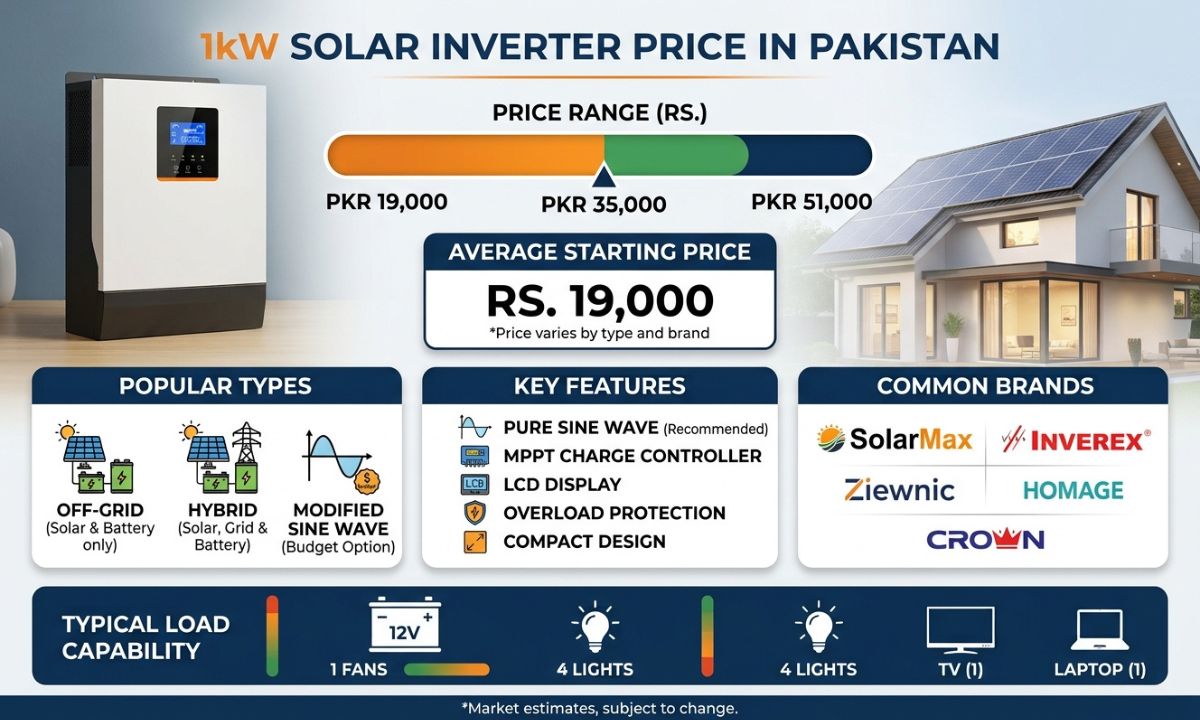
Assalam o Alaikum, dost! I am Farooq, and I install solar systems here in Punjab. Today I want to talk about the 1kW solar inverter price in Pakistan. Many families ask me this question every week. A small inverter is a good start for small homes.
A 1kW solar inverter is best for light loads. It can run a few fans, lights, and a small TV. The price in Pakistan starts from around PKR 25,000 and can go up to PKR 60,000. The final price depends on the brand and the type of inverter you choose.
You can pick between an on-grid, off-grid, or hybrid inverter. Each type has a different price and different uses. In this guide, I will show you the latest rates for 2026. I will also help you pick the right inverter for your home and budget.
What Is a 1kW Solar Inverter?
A 1kW solar inverter is a small machine. It takes DC power from your solar panels and turns it into AC power. Your fans, lights, and TV use AC power. So this small box is the heart of a small solar system.
I have installed many small systems in villages near my area. Most people buy a 1kW inverter for one simple reason. They want to save money on the electricity bill. They do not need a big system for a small house.
This size is perfect for small homes, single rooms, and shops. It is also good for people who are trying solar for the first time. You do not spend too much money, and you still get real benefits.
1kW Solar Inverter Price in Pakistan 2026 (Latest Table)
Prices change every few months. The dollar rate and import cost both affect the price. Here is the current price range you will see in the market today.
| Inverter Type | Price Range (PKR) | Best For |
| Basic On-Grid 1kW | 25,000 – 40,000 | Homes with normal WAPDA supply |
| Off-Grid 1kW | 35,000 – 60,000 | Areas with load shedding |
| Hybrid 1kW (with battery support) | 45,000 – 80,000 | Homes that want backup power |
| Branded 1kW (Inverex, Crown, etc.) | 38,000 – 80,000 | Buyers who want a warranty |
Pro tip: Never buy the cheapest inverter just because of the price tag. I have seen many clients buy a PKR 25,000 inverter, and it stopped working in six months. A good brand may cost PKR 10,000 to 15,000 more, but it will run for years without trouble.
Why Prices Change So Often
Many readers ask me why the price is different every month. I always explain it the same simple way.
- Dollar rate: Most inverter parts come from China. When the dollar goes up, the price goes up too.
- Import taxes: The government changes import duty from time to time.
- Brand name: A known brand always costs more than a local, unknown brand.
- Shop location: Prices in big cities like Lahore and Karachi are sometimes lower because of more competition. Small town shops may charge extra.
- Season: Prices often rise in summer. This is when everyone wants solar because of heavy load shedding.
If you plan to buy soon, always check the current dollar rate before going to the shop. It will help you understand if the price you are getting is fair.
Types of 1kW Solar Inverters
There are three main types of solar inverters. Knowing the difference will save you from buying the wrong one.
1. On-Grid Inverter
This type works only when WAPDA electricity is present. It sends extra power back to the grid. It has no battery backup. So during load shedding, your solar system will also shut down.
- Price: PKR 25,000 – 40,000
- Best for: Areas with very little load shedding
2. Off-Grid Inverter
This type works alone, without WAPDA. It needs a battery to store power. It is a good choice for homes in areas with long load shedding hours.
- Price: PKR 35,000 – 60,000
- Best for: Villages and areas with poor grid supply
3. Hybrid Inverter
This is the smartest type. It can use solar power, battery power, and WAPDA power, all in one system. Most of my clients now prefer this type because it gives full control.
- Price: PKR 45,000 – 80,000
- Best for: Homes that want full backup and flexibility
My honest advice: If your budget allows, always go for a hybrid inverter. It costs a little more, but it gives you the freedom to add a battery later.
Popular 1kW Inverter Brands and Their Prices
Pakistan’s market has many brands. Some are local, and some are imported. Here is a simple table based on what I see in the market today.
| Brand | Approx. Price (PKR) | Notes |
| Inverex | 38,000 – 80,000 | Local brand, easy to find, good service network |
| Crown | 40,000 – 65,000 | Common in small cities, budget-friendly |
| Knox | 45,000 – 70,000 | Good build quality |
| Local/Unbranded | 25,000 – 35,000 | Cheapest option, weaker warranty |
| Off-grid imported models | 35,000 – 60,000 | Good for basic load, simple design |
Real experience: In my own area, Inverex is the most requested brand. People trust it because spare parts are easy to find. If a part breaks, you do not have to wait for weeks. This matters a lot in villages where quick repair is important.
What Can a 1kW Solar Inverter Run?
Many people ask me this question daily. A 1kW system is not for a whole house. It is for light, everyday loads. Here is a simple list of what it can handle.
- 3 to 4 LED bulbs
- 2 to 3 ceiling fans
- 1 LED TV
- 1 WiFi router
- Mobile charging
- 1 small water motor (for short use)
It cannot run:
- Air conditioners
- Refrigerators (large ones)
- Iron
- Washing machine (heavy models)
- Water pumps for tube wells
If your home needs to run big appliances, you should look at a 3kW or 5kW system instead. A 1kW system is meant to reduce your bill on small, daily loads.
Full Cost of a Complete 1kW Solar System
The inverter is just one part. To run your home, you also need solar panels and sometimes a battery. Here is the full picture.
| Component | Approx. Price (PKR) |
| 1kW Inverter | 25,000 – 80,000 |
| Solar Panels (2 x 550W or similar) | 45,000 – 60,000 |
| Battery (if off-grid or hybrid) | 25,000 – 60,000 |
| Wiring, stand, and installation | 15,000 – 25,000 |
| Total Estimated Cost | 110,000 – 225,000 |
Pro tip from the field: Many clients forget to add the cost of the stand and wiring. This can add another PKR 10,000 to 15,000 to your budget. Always ask your dealer for the full cost, not just the inverter price.
Factors That Affect the Final Price
Every home is different. That is why two people can pay different prices for the same size system. Here are the main reasons.
1. Panel Quality
Cheap panels lose power faster. Good solar panels, like Jinko or Canadian Solar, cost more but work well for 20-25 years.
2. Battery Type
- Lead-acid battery: Cheaper, but lasts only 2-3 years
- Lithium battery: Costs more, but lasts 8-10 years
3. Installation Location
Homes in remote areas may pay extra for transport and labor. City installations are usually cheaper.
4. Warranty Length
A brand with a 5-year warranty will always cost more than one with just a 1-year warranty. This is a fair trade because it protects your money later.
5. Dealer Markup
Some shops add a high profit margin. It is always smart to compare prices from at least three shops before buying.
Pro Tips From My Own Installation Experience
I have installed many small systems over the years. Here are a few lessons I learned the hard way, so you do not have to.
- Always check the inverter’s efficiency rating. A rating above 90% means less power waste.
- Buy from a shop with a local service center. If your inverter breaks and the shop is far away, repair can take weeks.
- Do not oversize your battery for a 1kW system. A small battery, matched to your inverter size, works better than a big, mismatched one.
- Keep the inverter in a cool, dry place. Heat is the number one reason inverters fail early. I have seen many units die simply because they were placed near a hot wall.
- Ask for a written warranty card. Verbal promises from shopkeepers often disappear once the sale is done.
- Clean your solar panels every 2 weeks. Dust reduces power output by up to 20%, especially in dusty areas of Punjab.
How to Choose the Right 1kW Inverter for Your Home
Choosing the right inverter is not hard if you follow simple steps.
- Count your daily appliances. Add up fans, bulbs, and small devices.
- Check your load shedding hours. Long hours mean you need a battery-backed model.
- Set your budget. Decide how much you can spend, including panels and battery.
- Pick a trusted brand. Do not choose the cheapest option only for the price.
- Ask about after-sales service. A good dealer should offer support after installation.
Simple rule I tell my clients: If you only want to reduce your bill, go on-grid. If you want backup during outages, go hybrid or off-grid.
Common Mistakes to Avoid When Buying
- Buying an inverter without checking the brand’s local support
- Ignoring the battery type and later facing short battery life
- Choosing a system size that is too small for actual daily needs
- Skipping a written quotation before installation
- Not asking about future upgrade options, in case you want a bigger system later
Is a 1kW Solar System Worth It in 2026?
With electricity bills rising every year, even a small solar system helps. A 1kW system can lower your monthly bill by covering basic loads like fans, lights, and a TV. For a small home or a single room setup, it often pays for itself within 2 to 3 years through bill savings.
It will not remove your bill completely. But it gives real relief, especially during long summer days when fans run for hours. For many of my clients, this small step was their first move toward full solar independence.
City-Wise Price Difference in Pakistan
Prices are not the same in every city. I get messages from readers in different provinces, and the rates always vary a little. Here is what I usually see.
| City | Price Trend | Reason |
| Lahore | Lowest to mid-range | Many shops, strong competition |
| Karachi | Mid-range | Port city, easy import access |
| Islamabad/Rawalpindi | Slightly higher | High demand, premium brands |
| Faisalabad | Mid-range | Growing solar market |
| Small towns (Okara, Sahiwal, etc.) | Highest | Fewer dealers, extra transport cost |
My tip: If you live in a small town like mine, it is often cheaper to travel to a nearby big city for the purchase. You can save a good amount, even after adding the travel cost.
Load Calculation: How Much Power Do You Actually Need?
Before buying, always calculate your daily load. This simple step stops you from buying a system that is too small or too big. Here is an easy table to help you.
| Appliance | Watts (Approx.) | Daily Hours | Total Watt-Hours |
| LED Bulb (5W) x 4 | 20 | 6 | 120 |
| Ceiling Fan x 3 | 225 | 8 | 1,800 |
| LED TV | 80 | 5 | 400 |
| WiFi Router | 10 | 24 | 240 |
| Mobile Charging | 15 | 3 | 45 |
| Total | ~2,605 Wh |
A 1kW system with good sunlight can produce around 4 to 5 units of power per day. This is usually enough to cover the load in the table above, with a little extra for cloudy days.
Pro tip: Always add 20% extra capacity in your planning. Appliances draw more power when they first start, and this buffer keeps your system safe.
Hybrid vs Off-Grid: A Deeper Comparison
I get this question almost every day, so let me explain it in simple words with a clear table.
| Feature | Off-Grid | Hybrid |
| Works without WAPDA | Yes | Yes |
| Works with WAPDA | No | Yes |
| Battery required | Yes, always | Optional |
| Price | Lower | Slightly higher |
| Smart switching | No | Yes, automatic |
| Best for | Areas with no grid access | Most homes in cities and towns |
An off-grid system is simple and cheap, but it depends fully on the battery. A hybrid system is smarter. It switches between solar, battery, and WAPDA power on its own. Most homes today, including many I have installed myself, choose hybrid because it offers more control without much extra cost.
Battery Options for a 1kW System
Your inverter is only as good as the battery behind it. Here is a simple comparison to help you choose.
| Battery Type | Price (PKR) | Lifespan | Best For |
| Lead-Acid (Tubular) | 25,000 – 35,000 | 2 – 3 years | Tight budgets |
| Dry/Gel Battery | 30,000 – 45,000 | 3 – 4 years | Low maintenance homes |
| Lithium (LiFePO4) | 45,000 – 60,000 | 8 – 10 years | Long-term savings |
Real talk from the field: A lithium battery costs more today, but I have clients who replaced their lead-acid battery three times in the same years a single lithium battery would have lasted. In the long run, lithium often saves more money.
Net Metering and Small Solar Systems
Many readers ask if a 1kW system qualifies for net metering with WAPDA. Net metering lets you send extra solar power back to the grid and get credit on your bill. In most cases, a 1kW system is too small to make net metering worthwhile, since the extra power produced is very limited.
Net metering usually becomes useful from 3kW and above. For a 1kW system, the main goal should be self-use, meaning you use the solar power directly for your daily appliances instead of sending it back to the grid.
Installation Process: What to Expect
Many first-time buyers do not know what happens on installation day. Here is a simple step-by-step guide based on real installations I have done.
- Site inspection: The installer checks your roof space and sunlight direction.
- Panel placement: Panels are fixed on a metal stand, facing south for the best sunlight in Pakistan.
- Wiring: Cables connect the panels to the inverter, and the inverter to your home’s main switchboard.
- Battery connection: If you have a battery, it is connected and tested.
- Testing: The installer checks voltage and load before leaving.
- Final handover: You receive your warranty card and a short demo on using the system.
A basic 1kW installation usually takes half a day if the site is simple and easy to access.
Maintenance Tips to Make Your Inverter Last Longer
A solar inverter is not a “buy and forget” product. A little care every month keeps it working well for years.
- Clean the panels every two weeks, especially in dusty months.
- Check wiring connections every few months for loose or damaged wires.
- Keep the inverter ventilated. Do not place it in a closed, hot cupboard.
- Avoid overloading the system beyond its 1kW limit.
- Service the battery as recommended by the manufacturer, especially lead-acid types.
- Watch the display panel for any error codes, and call your dealer early if something looks wrong.
Warranty Comparison Table
Warranty length is one of the biggest differences between a cheap and a branded inverter. Here is what buyers usually get.
| Brand Type | Typical Warranty | Spare Parts Availability |
| Local unbranded | 6 months – 1 year | Difficult to find |
| Known local brand (Inverex, Crown) | 1 – 5 years | Easy, wide network |
| Premium imported brand | 5 – 10 years | Moderate, city-based |
My advice: Never skip reading the warranty card. Some shops offer a long warranty on paper but make it very hard to claim later. Always ask a few honest questions before you pay: What is covered? What is not covered? Where is the service center?
Second-Hand 1kW Inverters: Worth the Risk?
Some buyers try to save money by buying a used inverter. I understand the appeal, but I always warn my clients about the risks.
- You cannot check the internal parts for hidden damage.
- Most used units come with no warranty.
- Old inverters may have reduced efficiency from years of use.
- Repair costs can quickly cancel out the money you saved.
If your budget is very tight, it is often safer to buy a new, basic local brand than a used, unknown unit. A new unit at least comes with some warranty and support.
Solar Inverter vs Traditional UPS
Many Pakistani homes already use a UPS for backup power. It helps to understand how a solar inverter is different.
| Feature | Traditional UPS | Solar Inverter |
| Power source | Grid charging only | Solar panels, sometimes grid too |
| Running cost | Uses electricity units | Free power from the sun |
| Long-term savings | Low | High |
| Environmental impact | Higher | Lower |
A UPS only stores power from WAPDA and gives it back to you later, so you are still paying for those units. A solar inverter, on the other hand, uses free sunlight, which means real savings on your monthly bill over time.
1kW Solar Inverter with Battery Price in Pakistan 2026
A 1kW solar inverter with battery is a good choice if you want backup during load shedding. The full price depends on the battery type you pick.
| Setup Type | Price Range (PKR) | Backup Time (approx.) |
| 1kW Inverter + Lead-Acid Battery | 70,000 – 95,000 | 3 – 4 hours |
| 1kW Inverter + Dry/Gel Battery | 85,000 – 110,000 | 4 – 5 hours |
| 1kW Inverter + Lithium Battery | 100,000 – 140,000 | 5 – 6 hours |
A lead-acid battery keeps your cost low, but you will replace it every 2 to 3 years. A lithium battery costs more today, but it can last 8 to 10 years, so it often saves money in the long run.
Pro tip: Always match your battery size to your inverter. A battery that is too small will drain fast and wear out early, even if the inverter is a good brand.
Homage 1kW Solar Inverter Price in Pakistan 2026
Homage makes a 1kW solar-supported inverter called the HVS-1214SCC (Vertex Series). It is priced around PKR 65,000 to 66,000 in Pakistan today.
| Model | Capacity | Price (PKR) |
| Homage HVS-1214SCC Vertex | 1200VA / 1000W, 12V DC | 65,000 – 66,000 |
Key features of this model:
- Works as a simple UPS or a solar UPS
- Accepts solar and utility (WAPDA) input at the same time
- Simulated sine wave output
- Wide input voltage range, good for Pakistan’s unstable voltage
- 12V DC battery system
Pro tip: Homage is well known for its UPS heritage, so this model doubles well as a regular UPS with solar support added. It sits a bit higher than basic local unbranded inverters (around PKR 25,000–35,000), but you get better build quality and easier local service since Homage has a strong distribution network across Pakistan.
If your budget allows a bit more, Homage’s slightly bigger 1800W HVS-2414SCC model (around PKR 65,000 as well in some listings) gives more headroom for a couple of extra fans or a bigger TV, worth checking against your actual load needs.
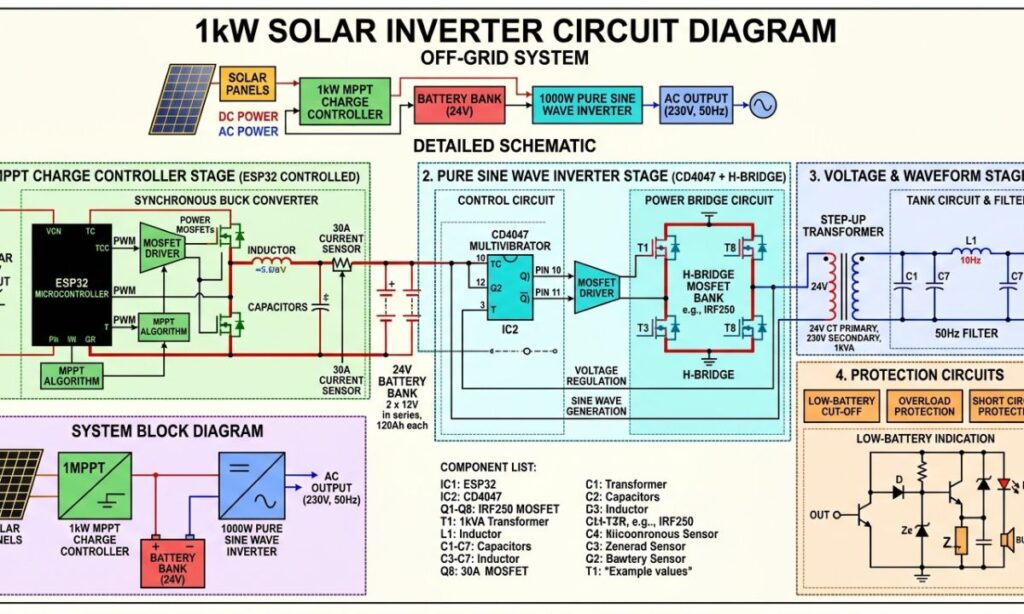
1kw Solar Inverter Circuit Diagram 2026
Final words
A 1kW solar inverter is a smart, low-cost way to start your solar journey. Prices in 2026 range from PKR 25,000 to PKR 80,000, depending on the type and brand you choose. It works best for small homes, single rooms, and shops that only need to run light loads like fans, bulbs, and a TV.
Before you buy, always compare at least three shops, check the battery type, and pick a brand with good local support. A little extra research today can save you from repair costs and headaches later.
“FAQs”
1kw solar inverter price in karachi
In Karachi, a basic 1kW solar inverter costs around PKR 25,000 to 40,000. Prices stay competitive here due to easy import access through the port.
1kw solar inverter price in pakistan
Across Pakistan, a 1kW solar inverter ranges from PKR 25,000 to PKR 80,000. The price depends on the type and brand you choose.
1kw solar inverter price
A 1kW solar inverter starts from around PKR 25,000 for basic models. Branded units with better build quality can go up to PKR 80,000.
2kw solar inverter price in pakistan
A 2kW solar inverter costs more than the 1kW size, usually between PKR 60,000 and PKR 120,000. It suits homes with a slightly bigger daily load.
1kw solar inverter with battery
A 1kW solar inverter with battery costs between PKR 70,000 and PKR 140,000. The price depends mainly on whether you pick a lead-acid or lithium battery.
1kw inverter price in pakistan
A simple 1kW inverter, without solar support, is cheaper and starts from around PKR 20,000. Adding solar charging support raises the price a bit.
1kw solar system price in pakistan
A full 1kW solar system, with panels, inverter, and wiring, costs around PKR 110,000 to 225,000. Adding a battery pushes the total cost higher.
best 1kw solar inverter
The best 1kW solar inverter comes from a trusted brand with good local service support. Brands like Inverex and Homage are popular for being reliable and easy to repair.

I AM CH SAMI ULLAH, THE TOP SOLAR PANEL SELLER AND INSTALLER IN PAKISTAN, WITH CHEAPEST RATES, OF TOP QUALITY. GET THE LATEST RATES ON SOLAR PANELS, FANS, ACs, TUBE WELLS, SOLAR FRIDGES, AND SOLAR ATTA CHAKKIS. WHATSAPP (03461320821)
1 thought on “1kW Solar Inverter Price in Pakistan 2026: Latest Rates”