
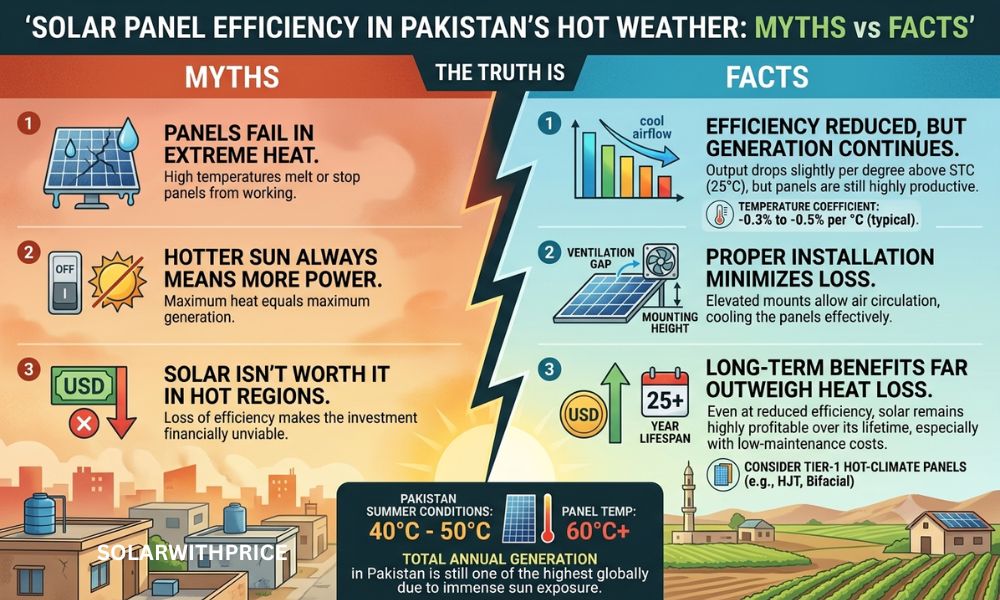
Solar Panel Efficiency in Pakistan’s Hot Weather is affordable for generating more electricity because they are made with the best materials to withstand hot weather. Solar panels are mostly generate huge electricity in summer hot weather.
In Pakistan, summer temperatures often cross 45°C in cities like Multan, Bahawalpur, and even Lahore. Most customers assume that this extreme heat is ideal for solar panels, since we get so much sunlight. But SOLAR panel efficiency and sunlight intensity are two very different things, and mixing them up leads to wrong buying decisions.
In this guide, I will clear up common myths about solar panels and hot weather, drawing on facts from my own installations across Punjab. You will learn why panel temperature actually reduces output, how to pick panels that handle heat better, and what really affects your solar system’s performance in Pakistan’s climate.
Why Heat Affects Solar Panels: The Real Science
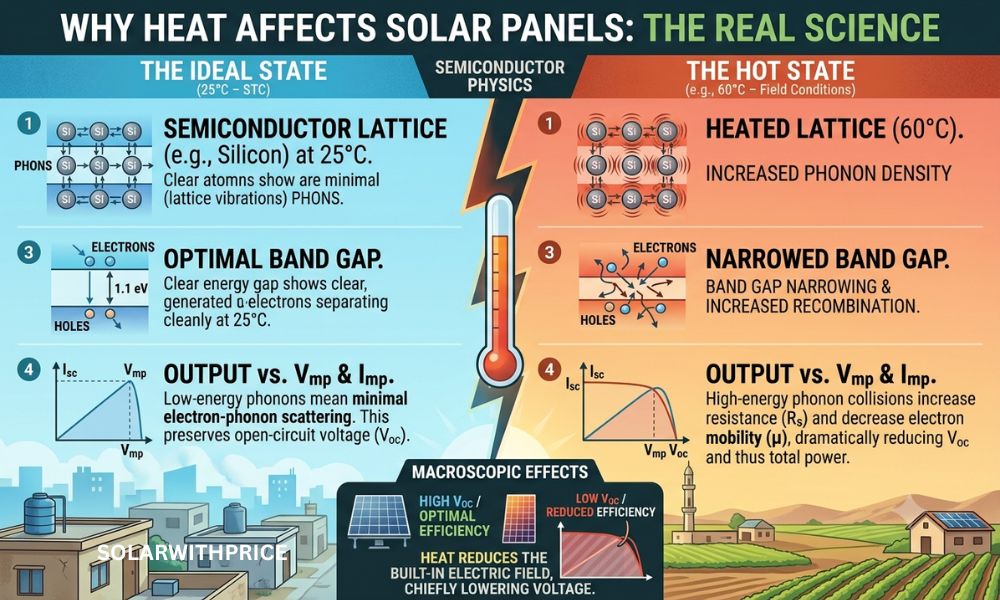
Solar panels need sunlight to make electricity, not heat. These are two different things, and this is where most people get confused.
When solar cells get hot, their voltage drops. This happens even when the sunlight is very strong. This is called the “temperature coefficient” effect, and every solar panel has this number written on its datasheet.
Here is the simple rule: for every degree Celsius the panel temperature rises above 25°C, the panel loses roughly 0.3% to 0.5% of its power output.
In Punjab’s summer, panel surface temperature can reach 60°C to 70°C, even though the air temperature is 45°C.
That temperature gap can mean a loss of 10% to 20% in actual output compared to the panel’s rated capacity.
So a panel rated at 550 watts may only give 450 to 480 watts during peak summer afternoon heat, even under a completely clear sky.
Myth vs Fact: Solar Panels in Pakistan’s Hot Weather
| Myth | Fact |
|---|---|
| More heat means more electricity | More heat reduces panel voltage and output |
| Cloudy cool days are bad for solar | Cool sunny days often give better output than hot sunny days |
| All panels lose the same power in heat | Panels differ based on their temperature coefficient |
| Solar panels stop working above 45°C | Panels keep working but at reduced efficiency, not zero |
| Higher lab efficiency always means higher real output | Real output depends on heat handling too, not just lab rating |
| Panel color and mounting don’t matter in heat | Panel color and mounting height affect heat buildup significantly |
Myth 1: “Hotter Weather Always Means More Power”
This is the biggest misunderstanding I face on site visits. Customers see the sun blazing at 2 PM in June and expect maximum output. In reality, that is often when efficiency drops the most.
Solar irradiance (sunlight strength) is high in summer, yes. But panel temperature rises along with it, and the voltage loss cancels out much of the benefit.
My personal experience: This is why many installations in Punjab actually show slightly better output on a warm, clear day in March or October compared to a scorching June afternoon.
Myth 2: “Solar Panels Don’t Work Well in Winter or Cool Weather”
Many of my clients worry that cooler weather or light cloud cover will kill their system’s output. This is not correct.
Solar cells actually perform more efficiently at lower temperatures, as long as there is enough direct sunlight.
My personal experience: A cool, sunny January morning in Lahore can produce excellent output because the panel stays cooler while still receiving strong light.
Myth 3: “All Solar Panels Handle Heat the Same Way”
Not true at all. Panel technology makes a real difference in hot climates like ours.
Panel types and heat performance:
- Polycrystalline panels – Older technology, weaker heat tolerance, higher losses in extreme temperatures
- Monocrystalline (PERC) panels – Better heat tolerance, commonly used across Punjab installations
- N-type (TOPCon/HJT) panels – Best thermal stability currently available, slower long-term degradation, ideal for Multan, Bahawalpur, and similar high-heat zones
My personal experience: A panel with a slightly lower lab efficiency but a better temperature coefficient can actually outperform a “higher efficiency” panel once installed on a hot rooftop.
Myth 4: “Panel Efficiency Rating Is All That Matters”
Customers often ask me to recommend “the highest efficiency panel available.” I always explain that the efficiency printed on the box is measured in laboratory conditions at 25°C, not on a Multan rooftop in July.
Factors that affect real-world output in Pakistan, besides the lab rating:
- Panel temperature coefficient
- Dust and pollution buildup on the panel surface
- Mounting height and airflow underneath the panel
- Panel color and frame material
- Inverter compatibility and cable losses
- Shading from nearby buildings or trees
My pro tip: A well-designed system with sensible panel choices will always beat a poorly planned system built only around an impressive efficiency number.
How Much Efficiency Do You Actually Lose in Pakistan’s Heat?
Based on field readings from my installations across Punjab, here is a rough breakdown of expected efficiency loss during peak summer heat:
| Condition | Efficiency Loss |
|---|---|
| Mild summer day (35°C–38°C) | 3% to 6% |
| Hot summer day (40°C–45°C) | 8% to 12% |
| Extreme heat (46°C and above) | 12% to 20% |
| Poor mounting with no airflow | Additional 3% to 5% loss |
| Heavy dust buildup (no cleaning) | Additional 5% to 10% loss |
Important Note: These numbers can shift depending on panel brand, installation angle, and system quality, but this gives a realistic idea for budgeting your expected output.
How to Reduce Heat-Related Power Loss
Over the years, I have picked up a few practical habits that genuinely help systems perform better through Punjab’s summer:
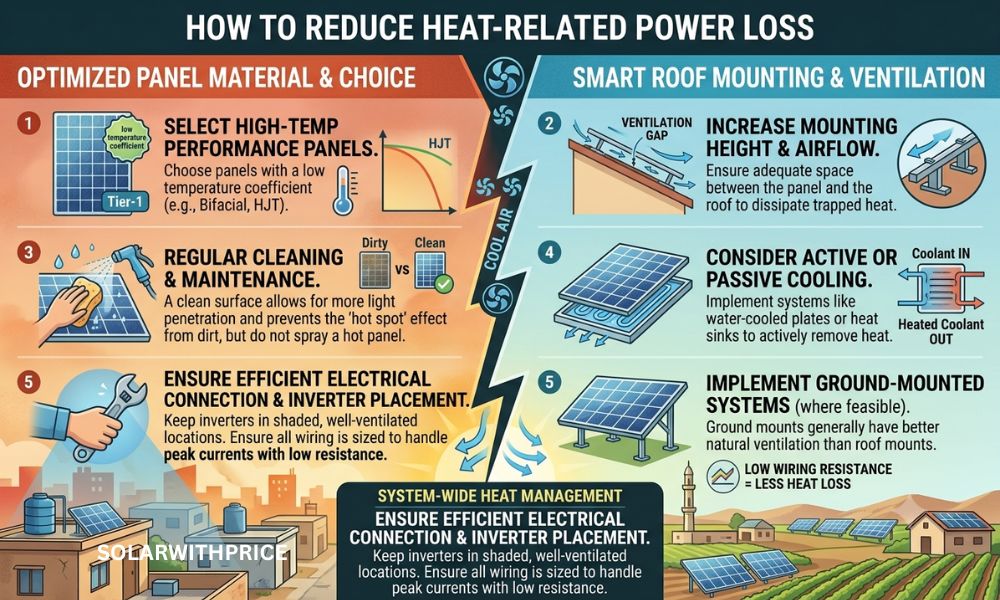
- Mount panels a few inches above the roof. This allows air to flow underneath and cool the panels naturally.
- Choose panels with a good temperature coefficient. Ask your installer for the datasheet, not just the efficiency percentage.
- Keep panels clean. Dust buildup traps heat and blocks sunlight at the same time.
- Avoid flush-mounting directly on hot rooftop surfaces. Trapped hot air underneath raises panel temperature further.
- Get the correct tilt angle for your city. Proper angle improves airflow and reduces direct heat buildup during peak hours.
- Use a good quality inverter. Inverters also lose efficiency in extreme heat if placed in a poorly ventilated spot.
Best Solar Panel Choice for Pakistan’s Climate
For most of my clients in Lahore, Multan, and Karachi, I recommend monocrystalline PERC panels from established Tier-1 brands as a solid, cost-effective choice.
For clients wanting maximum long-term output in very hot districts like Multan or Bahawalpur, N-type panels are worth the extra investment because of their better heat tolerance and slower degradation over 25 years.
My pro tip: Polycrystalline panels are cheaper upfront but generally not the best choice for our climate, since they lose more output in sustained heat and have a shorter effective lifespan.
Solar Panel Temperature vs Power Loss (550W Panel Example)
| Panel Surface Temp | Rise Above 25°C | Power Loss (at 0.4%/°C) | Approx Output (550W Panel) |
|---|---|---|---|
| 25°C | 0°C | 0% | 550 W |
| 35°C | 10°C | 4% | 528 W |
| 45°C | 20°C | 8% | 506 W |
| 55°C | 30°C | 12% | 484 W |
| 60°C | 35°C | 14% | 473 W |
| 65°C | 40°C | 16% | 462 W |
| 70°C | 45°C | 18% | 451 W |
Note: These figures use an average temperature coefficient of 0.4% per °C, which falls within the typical 0.3% to 0.5% range for most panels. Actual loss depends on your specific panel’s datasheet rating.
In Punjab’s summer, panel surface temperature commonly reaches 60°C to 70°C even when the air temperature is around 45°C, since the panel absorbs and holds heat.
My personal experience: This is why a panel rated at 550 watts often produces only 450 to 480 watts during peak summer afternoon hours, even under completely clear skies.
Do Solar Panels Work Better in Hot Weather?
No, solar panels don’t work better in hot weather — this is one of the most common misunderstandings I deal with on site visits. People assume that since Pakistan has intense heat, panels must produce maximum power during peak summer temperatures.
My personal experience: In reality, heat reduces the voltage inside solar cells, which lowers overall output even when the sun is shining brightly.
What actually matters is sunlight intensity combined with a cooler panel surface, not just how hot the day feels. A panel can receive strong sunlight and still underperform simply because its surface temperature has climbed too high.
Why hot weather reduces output:
- Rising cell temperature lowers panel voltage
- Higher resistance builds up in the circuit as heat increases
- Inverters also lose some efficiency when they overheat
- Panel surface can reach 60°C–70°C even when air temperature is 45°C
Do Solar Panels Work Better in Summer?
Summer brings longer daylight hours and stronger sunlight, which does help total daily generation. But this doesn’t mean the panels themselves are running at peak efficiency during summer afternoons.
Morning and late-afternoon summer hours often give better efficiency than the harsh midday heat, since the panel hasn’t fully heated up yet.
My personal experience: So while summer generally produces more total units than winter, that’s mainly because of longer sun hours, not because the panels are working “better” in the technical sense.
| Summer Factor | Effect on Solar Output |
|---|---|
| Longer daylight hours | Increases total daily generation |
| Higher sunlight intensity | Increases power generation potential |
| High panel temperature | Reduces panel efficiency and voltage |
| Midday extreme heat | Causes noticeable output dip |
| Early morning/evening hours | Better efficiency than peak afternoon |
Solar Panels: Winter vs Summer Comparison
Both seasons have trade-offs, and understanding them helps you set realistic expectations for your system’s yearly performance.
| Factor | Winter | Summer |
|---|---|---|
| Sunlight hours | Shorter (6–8 hours) | Longer (10–12 hours) |
| Panel temperature | Cooler, closer to ideal range | Often overheated |
| Cell efficiency | Higher due to lower heat | Reduced due to high heat |
| Total daily output | Lower overall units | Higher overall units |
| Dust accumulation | Lower, occasional rain helps | Higher due to dry, dusty conditions |
| Peak performance time | Midday works well | Morning and evening work best |
Key takeaways:
- Winter panels run more efficiently per hour, but for fewer hours
- Summer panels generate more total electricity, despite reduced efficiency
- Extreme summer heat can offset some of the gains from longer daylight
- A well-ventilated, properly mounted system performs better in both seasons
My personal experience: In short, summer wins on total output because of longer sun hours, but the panels themselves actually run more efficiently in cooler weather. This is why a well-designed system with good heat handling matters more than chasing the hottest, sunniest day of the year.
Final words
Every rooftop I install tells the same story: understanding heat, not chasing efficiency numbers, is what actually saves you money. A slightly lower-rated panel with good heat tolerance will often outperform a “high efficiency” panel that struggles in Multan’s summer sun. Knowledge like this is what separates a smart solar investment from a disappointing one.
Before buying your next system, ask your installer about the temperature coefficient, not just the wattage on the box. Check mounting height, airflow, and panel brand quality, since these small details add up to real savings over 25 years. A well-planned system will always beat an expensive one built on marketing numbers alone.
If this guide cleared up your doubts about solar panels and Pakistan’s hot weather, share it with someone planning their own installation. Feel free to reach out with your rooftop details for a personalized recommendation. Farooq signing off — stay cool, stay powered.
Frequently Asked Questions
What is the 33% rule in solar panels?
This refers to the real-world derating rule of thumb, where combined losses from heat, dust, wiring, and inverter inefficiency reduce actual output by around 25% to 33% below the panel’s rated (STC) capacity. It’s used to set realistic expectations rather than relying on the label wattage.
Can I run 1.5 ton AC on a 5kW solar system?
Yes, a 5kW system can run a 1.5 ton inverter AC, since it typically draws around 1,200 to 1,500 watts on eco mode. You’ll still have some capacity left for lights, fans, and other basic loads.
Which solar panels are high efficiency in Pakistan?
Monocrystalline PERC and N-type (TOPCon) panels from brands like Longi, Jinko, and Canadian Solar offer the highest efficiency, typically 21% to 23%. These handle Pakistan’s heat and dust better than older polycrystalline panels.
Will solar panels ever reach 50% efficiency?
Standard commercial silicon panels are unlikely to reach 50%, since silicon has a theoretical efficiency limit near 29%. Multi-junction or lab-tested cells have crossed 40%+, but these remain too costly for everyday rooftop use.
What is the 120 rule for solar panels?
This is an electrical safety rule stating that the combined rating of your main breaker and solar breaker should not exceed 120% of your electrical panel’s busbar rating. It’s used by electricians to prevent overloading during grid-tie installation.
Does rain affect solar panels?
Rain doesn’t damage solar panels and can actually help by washing away dust from the surface. Output drops during rain due to cloud cover and low light, not because of the water itself.
Is 6kW enough to power a house?
Yes, a 6kW system is usually enough for a medium-sized home running fans, lights, fridge, and one AC unit. For multiple ACs or heavy appliances, you may need to check your daily unit consumption first.
Is a 100% efficient solar panel possible?
No, 100% efficiency is not physically possible because some sunlight is always lost as heat or reflection. Even the best lab-tested cells stay under 50%, and commercial silicon panels max out around 22% to 23%.

I AM CH SAMI ULLAH, THE TOP SOLAR PANEL SELLER AND INSTALLER IN PAKISTAN, WITH CHEAPEST RATES, OF TOP QUALITY. GET THE LATEST RATES ON SOLAR PANELS, FANS, ACs, TUBE WELLS, SOLAR FRIDGES, AND SOLAR ATTA CHAKKIS. WHATSAPP (03461320821)