
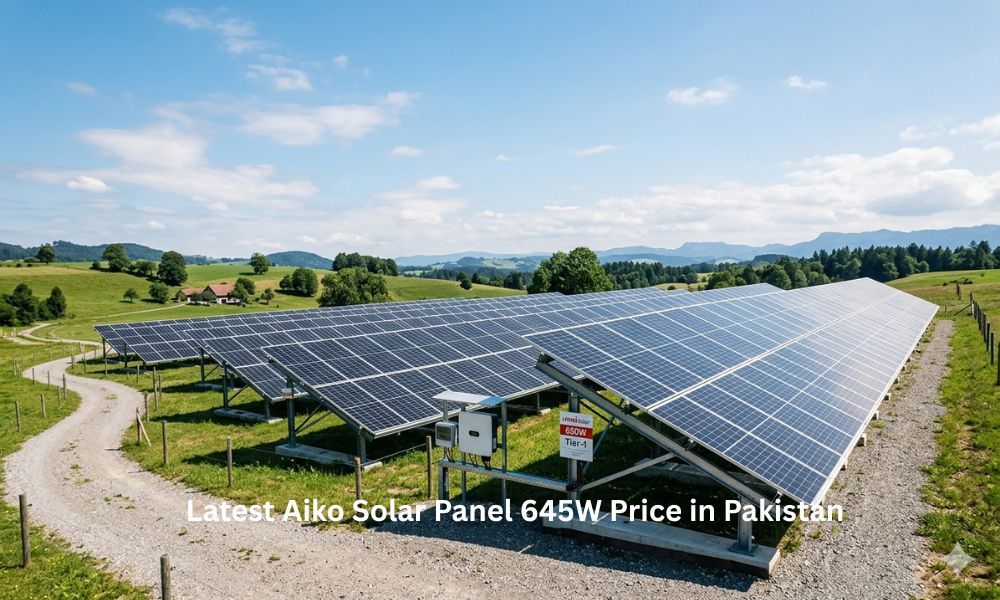
Aiko Solar Panel 645W comes with 24% efficiency rate and a 25-year life, which means once install then generate free electricity for its lifetime. It also comes with ABC technology, which has a low degradation rate and performs better in low-light conditions.
The latest Aiko Solar Panel 645W Price is 26,000 to 27,000 rupees, depending on the quality, area, availability, and technology like N-type or P-type, as well as mono-perc or bifacial in Pakistan 2026.
The per-watt Aiko Solar Panel 645W price is only 40 to 44 rupees nowadays in local markets in Lahore, Multan, Faisalabad, and Karachi in Pakistan. The Aiko solar panel is trending in Pakistan because of its best performance in generating more electricity.
Current Price of Aiko 645W Solar Panel in Pakistan 2026
I’ve noticed the spread between dealers is wider for Aiko than for older brands like Jinko or Canadian Solar, simply because the brand is newer here and not every shop is pricing it the same way yet.
Some shops are still working through older container stock at lower rates, while others are selling fresh imports of the Comet and Stellar series at the premium end.
| Series / Model | Wattage | Per-Watt Price | Panel Price |
|---|---|---|---|
| Neostar 2P (Standard ABC) | 645W | Rs. 40 | Rs. 25,800 |
| Comet / Stellar Series (Bifacial) | 645W | Rs. 43 | Rs. 27,735 |
| General Market Average | 645W | Rs. 44 | Rs. 28,380 |
A quick note on accuracy: solar panel pricing in Pakistan moves almost every week because of dollar fluctuation and shipping costs, so treat this as a reliable estimate rather than a fixed number.
My pro tip: Always confirm the day’s rate with your dealer directly before placing an order, especially if you’re buying in bulk for a 5kW or 10kW system.
Why Prices Differ So Much Between Dealers in Pakistan 2026
A reader recently messaged me, confused about why one shop quoted Rs. 23,000 for the panel and another quoted nearly Rs. 28,000 for what looked like the same product. There are a few real reasons behind this, and once you understand them, the gap stops feeling random:
The series matters more than people realize. Aiko’s standard Neostar line is priced lower than its Comet and Stellar series, which are built specifically for higher bifacial gain and commercial-scale projects. A shop selling Neostar stock will naturally quote less than one selling Stellar panels, even at the same wattage.
City and shipping costs also play a role. Karachi-based dealers tend to quote slightly lower because the panels arrive at the port there, while Lahore and Islamabad prices usually carry an extra freight cost. I’ve seen this pattern hold across almost every solar brand we cover, not just Aiko.
Stock age is another factor. Older shipments sometimes get discounted to clear inventory before a new container arrives, so a slightly older batch might save you a few thousand rupees if you’re not picky about having the absolute newest production date.
And finally, bulk orders change the math. If you’re installing a larger system, ten panels or more, dealers will often shave a rupee or two off the per-watt rate, which adds up fast on a full system.
My advice, the same advice I give for every premium brand, is to call at least three dealers before you commit. The difference between the lowest and highest quote in the same city can sometimes cover your entire installation labor cost.
What Makes the Aiko 645W Panel Technically Different 2026
I’ll admit, when I first started researching Aiko, I expected it to be just another Chinese solar brand entering our market with a marketing push. The technology behind it changed my mind.
All Back Contact (ABC) Cell Design
Every standard solar panel you’ve probably installed has thin silver lines running across its front surface. Those are busbars, and they exist to carry electrical current, but they also block a small percentage of incoming sunlight.
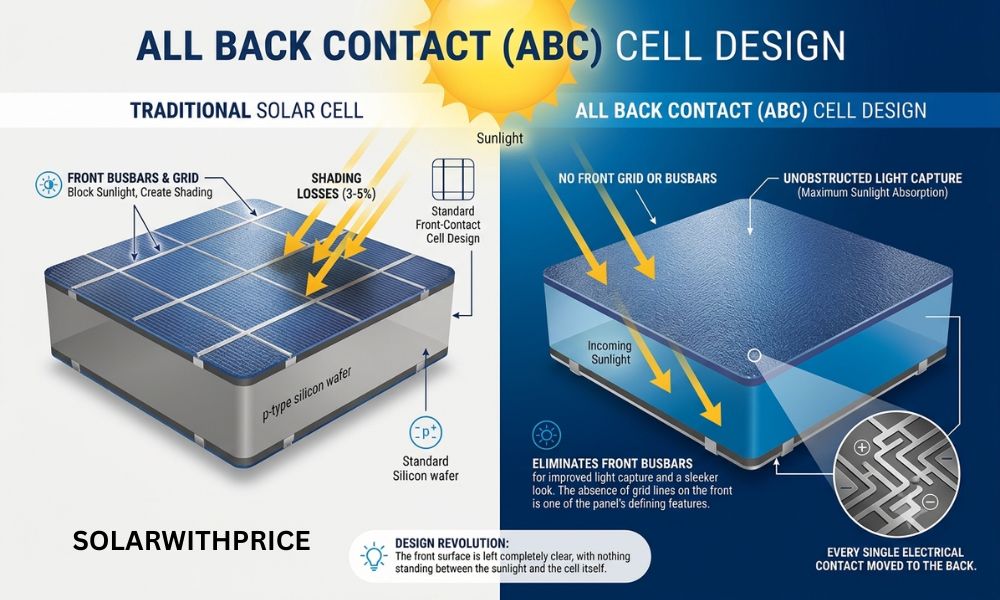
Aiko’s engineering team moved every single electrical contact to the back of the cell. The front surface is left completely clear, with nothing standing between the sunlight and the cell itself.
This design eliminates front busbars for improved light capture and a sleeker look, and the absence of grid lines on the front is one of the panel’s defining features.
Efficiency Numbers That Actually Hold Up
According to Aiko’s own technical datasheet for this module, the panel reaches an output efficiency of 24.8%, though most retail listings in Pakistan quote a slightly more conservative range between 23.6% and 24%.
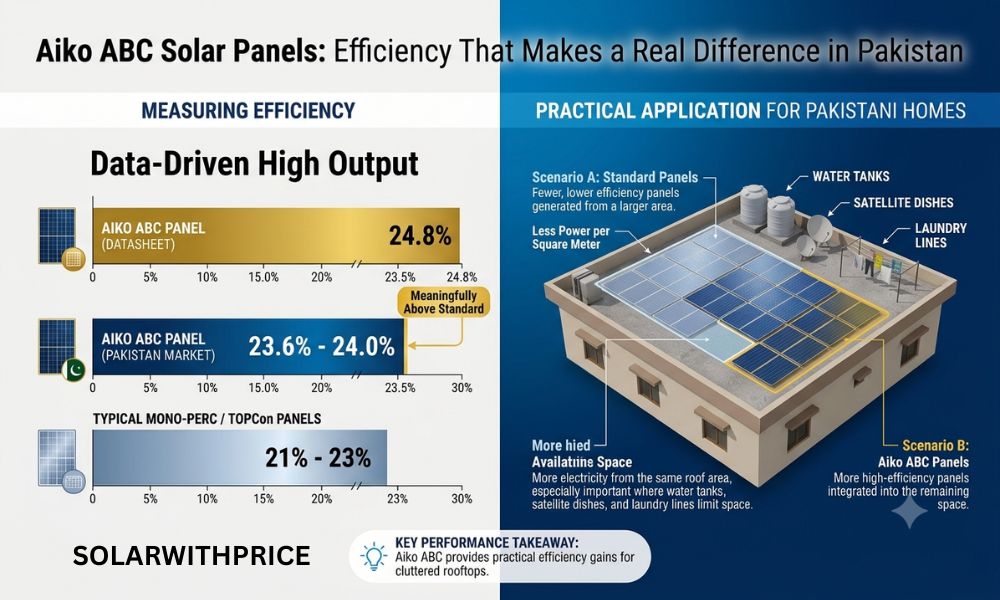
Either way, this sits meaningfully above the 21 to 23% efficiency typical of standard mono-PERC or even TOPCon panels from other major brands. In practical terms, this means you can generate more electricity from the same roof area,
which matters a lot for Pakistani homes, where rooftop space is often eaten up by water tanks, satellite dishes, and laundry lines.
Degradation Rate
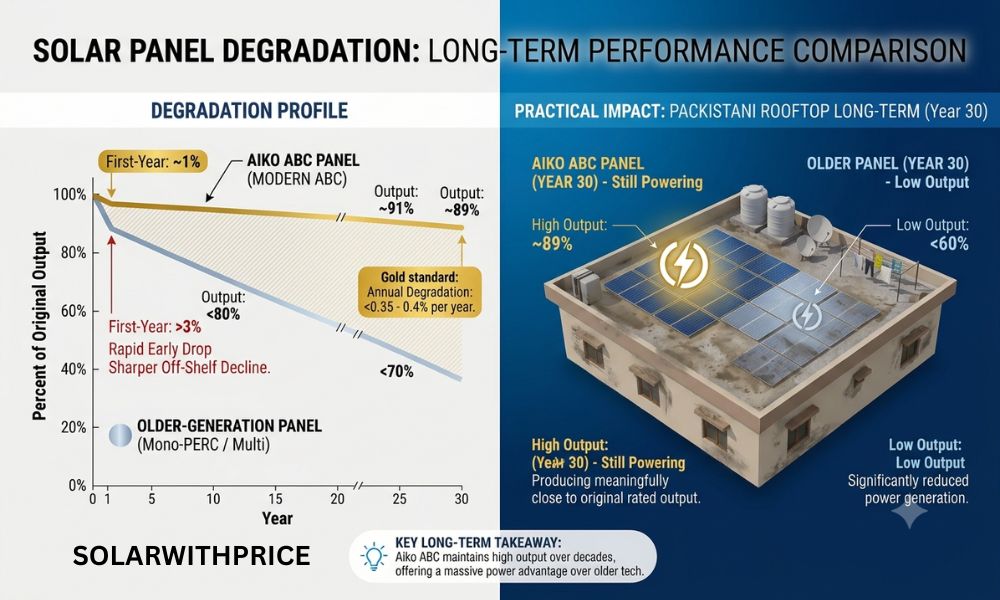
The panel’s degradation profile is notably better than older-generation technology, with first-year degradation limited to roughly 1% and annual degradation after that staying under 0.35 to 0.4% per year.
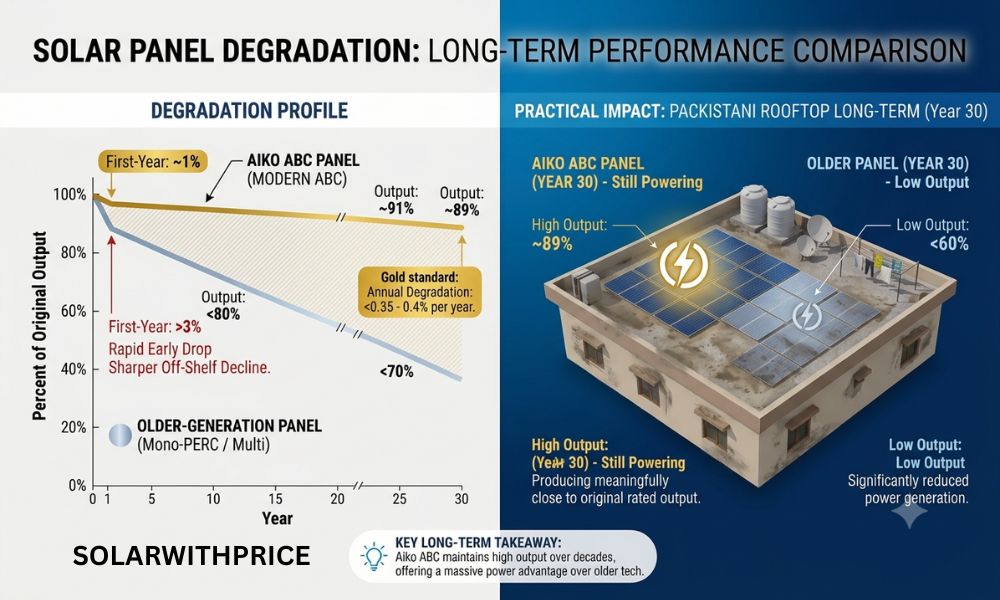
Over a 25 to 30 year lifespan, this translates into a panel that’s still producing meaningfully close to its original rated output decades after installation, rather than dropping off sharply in the first decade like older panel generations sometimes did.
Temperature Performance for Pakistani Summers
This is the part that matters most for those of us dealing with real Pakistani weather, not lab conditions. Our summers are brutal between June and August, and rooftop surface temperatures in cities like Multan, Hyderabad, and even Lahore regularly cross 60 to 65°C during peak afternoon hours in June.
Standard P-Type panels lose close to 0.45% of their output for every degree above 25°C, which adds up to a real performance hit during the hottest months of the year, exactly when you need maximum output the most.
Aiko’s N-Type ABC cells carry a temperature coefficient between -0.26%/°C and -0.29%/°C, which is noticeably better than the standard panel benchmark. In plain terms, this panel loses less power as the temperature climbs, so on a 45°C June afternoon in Punjab, an Aiko panel holds onto more of its rated output than a comparable standard panel sitting right next to it.
Bifacial Gain
The 645W version of this panel uses a dual-glass bifacial design, meaning it generates power from both the front and rear surfaces. The front captures direct sunlight as normal, while the rear panel picks up reflected light bouncing off your roof, a white-coated surface, or the ground beneath a mounted structure.
This additional rear-side generation can meaningfully boost your daily unit output, particularly on reflective rooftops or ground-mounted commercial installations, though the exact gain depends heavily on your mounting height, surface reflectivity, and roof orientation.
Dust and Micro-Crack Resistance
Because the front surface has no raised busbars, there are fewer physical edges for dust to settle on and accumulate around, something that matters a great deal in our dusty, low-rainfall climate, where panels can lose a noticeable percentage of output between cleanings.
Aiko’s technology also uses copper instead of expensive silver for interconnections, which not only helps keep production costs stable but makes the panels more resistant to the micro-cracks that tend to develop during dust storms and rough handling during transport and installation, both common realities on Pakistani construction sites.
Full Technical Specifications Aiko 645W Solar Panel 2026
| Specification | Detail |
|---|---|
| Rated Power Output | 645W |
| Cell Technology | N-Type Monocrystalline, ABC (All Back Contact) |
| Panel Construction | Bifacial, Dual-Glass, No Backsheet |
| Module Efficiency | 23.6% – 24.8% (per datasheet) |
| Temperature Coefficient | -0.26%/°C to -0.29%/°C |
| First-Year Degradation | ≤1.0% |
| Annual Degradation (Year 2-30) | ≤0.35% – 0.40% |
| Dimensions | Approximately 2382 × 1134 × 30 mm |
| Weight | Approximately 27.7 – 29 kg |
| Frame Material | Anodized aluminum alloy |
| Junction Box Rating | IP68 |
| Connector Type | MC4 EVO2, approx. 1.4m cable length |
| Performance Warranty | Up to 30 years |
| Net Metering Compatibility | NEPRA and major DISCO approved |
Is the Aiko 645W the Right Choice for Your System 2026?
Here’s where I’ll give you my honest opinion rather than just a list of specs. If you’re building a budget system and your roof has plenty of unused space, you can probably get a slightly better deal per watt with a standard Jinko or Canadian Solar panel and still hit your target system size comfortably.
But there are specific situations where paying the premium for Aiko’s 645W genuinely makes financial sense. If your roof space is tight, fewer high-wattage panels means you can still hit a 5kW or 10kW system size without running out of room.
If you’re on net metering and exporting surplus units back to the grid, the higher efficiency and better heat performance translate directly into more units exported and a faster payback period. If you’re in a particularly hot district like Multan, Bahawalpur, or interior Sindh, the better temperature coefficient genuinely matters during the months when standard panels are losing the most output.
And for commercial or industrial rooftop installations, the bifacial gain becomes more significant at scale, where even a small percentage improvement adds up to meaningful extra units across a large array.
For a typical home installation in a moderate climate with no major space constraints, the case for paying the Aiko premium is weaker, and your money might be better spent on a slightly larger system using a more budget-friendly panel.
Comparing Aiko 645W Against Other Premium Brands 2026
| Brand | Per-Watt Price (PKR) | Typical Efficiency | Best Suited For |
|---|---|---|---|
| Aiko 645W | Rs. 33 – 44 | 23.6% – 24.8% | Limited roof space, hot climates, net metering |
| Longi Hi-MO | Rs. 28 – 63 | 21% – 23% | General residential installs |
| Jinko | Rs. 28.5 – 44 | 21% – 23% | Budget-conscious buyers |
| Canadian Solar | Rs. 27 – 45 | 21% – 22.5% | Mid-range residential and commercial |
| JA Solar | Rs. 26 – 54 | 21% – 23% | Wide availability, flexible budgets |
Final Thoughts
The latest Aiko Solar Panel 645W Price is 26,000 to 27,000 rupees, depending on the quality, area, availability, and technology like N-type or P-type, as well as mono-perc or bifacial in Pakistan 2026.
The per-watt Aiko Solar Panel 645W price is only 40 to 44 rupees nowadays in local markets in Lahore, Multan, Faisalabad, and Karachi in Pakistan. The Aiko solar panel is trending in Pakistan because of its best performance in generating more electricity.

I AM CH SAMI ULLAH, THE TOP SOLAR PANEL SELLER AND INSTALLER IN PAKISTAN, WITH CHEAPEST RATES, OF TOP QUALITY. GET THE LATEST RATES ON SOLAR PANELS, FANS, ACs, TUBE WELLS, SOLAR FRIDGES, AND SOLAR ATTA CHAKKIS. WHATSAPP (03461320821)