
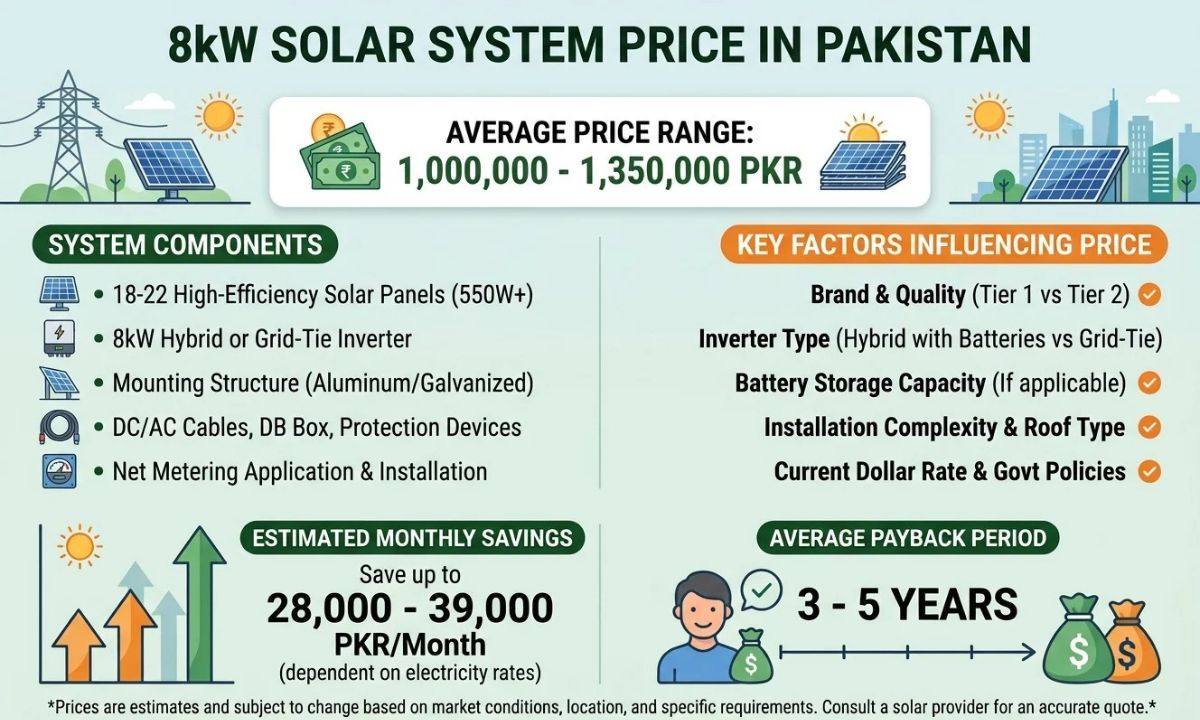
Assalam o Alaikum, friends, Farooq here! Today, many people in Pakistan are asking about the 8kW solar system price. Electricity bills keep going up every year, and this makes solar power a smart choice for many homes. An 8kW system is a popular size for medium to large houses. It gives strong power output without a huge extra cost.
In this guide, I will share the latest 2026 prices for on-grid, hybrid, and off-grid 8kW systems. You will also learn how much energy this system makes and how much money it can save each month. I will explain things in simple words, so you understand everything clearly. This is based on real market prices and real installation experience.
Many families choose an 8kW system because it runs ACs, fridges, and daily appliances with ease. It also works well during load shedding if you add a battery. By the end of this article, you will know the exact cost, the best components, and how to pick the right system for your home. Let’s begin!
☀️ 8kW Solar System Price Calculator Pakistan 2026
Calculate the estimated cost of an 8kW solar system in Pakistan based on your preferred system type, solar panels, inverter, battery, and installation requirements.
Detailed Cost Breakdown
| Component | Estimated Cost |
|---|---|
| Solar Panels (8kW Set: 14-15 x 580W-600W) | PKR 0 |
| Solar Inverter (8kW Capacity) | PKR 0 |
| Battery System | PKR 0 |
| Mounting Structure (Galvanized Steel) | PKR 0 |
| Installation Services & Labour | PKR 0 |
| Wiring, Cables & Protection Gear | PKR 0 |
| Additional Options (Net Metering & Monitoring) | PKR 0 |
| Estimated Total Range | PKR 0 |
Financial ROI & Savings Estimate
8kW Solar Generation Estimate
🟢 On-Grid System
Best for homes with reliable grid electricity and lower upfront budget. Supports net metering but provides zero backup during load shedding.
🔵 Hybrid System
Best for homes needing load shedding backup and net metering support. Cost varies depending on whether 5kWh or 10kWh lithium batteries are selected.
🟠 Off-Grid System
Best for remote locations or farmhouses with no WAPDA connection, relying entirely on heavy battery storage systems.
8kW Solar System Price in Pakistan 2026: On-Grid vs Off-Grid
Electricity bills in Pakistan keep going up every year, leading more families and shop owners to transition to solar energy. An 8kW solar system is an ideal power capacity for medium to large 5 to 7-bedroom houses in Pakistan because it comfortably powers heavy daily appliances—including 3 to 4 Inverter ACs simultaneously, a water pump, refrigerator, washing machine, lights, and fans—without exorbitant upfront costs.
In 2026, a fully installed 8kW solar system ranges between PKR 850,000 and PKR 1,750,000. On-grid configurations sit at the lower price bound (PKR 850,000 – 1,100,000), whereas hybrid systems with 5kWh to 10kWh LiFePO4 lithium batteries command higher ranges (PKR 1,250,000 – 1,750,000).
A properly installed 8kW solar array produces approximately 32 to 40 units (kWh) per day, amounting to 960 to 1,200 units monthly. Generating monthly bill savings between PKR 45,000 and PKR 65,000, an 8kW system generally pays for itself within 3 to 4.5 years while delivering clean electricity for over 25 years.
What Does an 8kW Solar System Mean?
An 8kW solar system means the solar panels and inverter together can produce 8,000 watts of power in full sunlight. The “kW” stands for kilowatt, which is a unit to measure power.
Think of it like the engine size of a car. A bigger engine can pull more weight. In the same way, an 8kW solar system can run more appliances than a small 3kW or 5kW system.
This size is one of the most popular choices in Pakistan right now. It sits in the middle range — big enough for a large home with ACs and heavy appliances, but not so big that it becomes an unnecessary expense. Most 10-marla to 1-kanal houses in Punjab, Sindh, and KPK are choosing 8kW systems in 2026 because it matches their real electricity usage.
I have installed many 8kW systems for families who were tired of PKR 40,000 to PKR 70,000 monthly bills. In almost every case, the system paid for itself within three years.
How Many Appliances Run on an 8kW Solar System?
An 8kW system can run a lot of appliances at the same time. Here is a simple table so you can check your own home’s load.
| Appliance | Approx. Load (Watts) | Can 8kW Run It? |
| 1.5 Ton Inverter AC | 1,500W | Yes, up to 2-3 units |
| Refrigerator | 200-300W | Yes, easily |
| LED Bulbs (10 pcs) | 100W | Yes, easily |
| Ceiling Fans (5 pcs) | 375W | Yes, easily |
| LED TV | 100-150W | Yes, easily |
| Washing Machine | 500-800W | Yes, easily |
| Water Motor / Pump (1 HP) | 750W | Yes, easily |
| Iron | 1,000W | Yes, easily |
| Microwave Oven | 1,200W | Yes, easily |
Pro tip: Never add all your appliances’ watts together and assume the system will run them all at once forever. What matters is your peak load — the highest amount of power running at the same exact moment. A good installer always checks this before sizing your system.
How Much Energy Does an 8kW Solar System Generate?
In Pakistan, an 8kW solar system usually produces between 30 and 40 units (kWh) of electricity per day, depending on your city and sunlight hours. Over a full month, this comes out to roughly 900 to 1,200 units.
Here is a rough breakdown by season:
| Season | Sunlight Hours | Daily Units | Monthly Units |
| Summer (May-Aug) | 6-7 hours | 35-40 units | 1,050-1,200 units |
| Winter (Nov-Feb) | 4-5 hours | 22-28 units | 660-840 units |
| Spring/Autumn | 5-6 hours | 28-32 units | 840-960 units |
Cities like Multan, Bahawalpur, and Sukkur get more sunlight, so their generation is on the higher side. Cities like Islamabad and Murree get slightly less due to clouds and hills.
Real experience tip: Dust is the biggest enemy of solar output in Pakistan. A dirty panel can lose 15-20% of its power. I always tell my clients to clean panels every 15-20 days with plain water and a soft cloth, especially during dust storm season.
How Much Money Does an 8kW Solar System Save?
This is the question every homeowner really wants answered. Let’s break it down honestly.
If your current WAPDA bill is between PKR 40,000 and PKR 70,000 per month, an 8kW system can bring that bill down to almost zero, or sometimes into net metering credit, depending on your usage pattern and whether you go on-grid or hybrid.
| Monthly Bill Before Solar | Estimated Savings After 8kW Solar |
| PKR 30,000 | PKR 25,000 – 28,000 |
| PKR 50,000 | PKR 42,000 – 47,000 |
| PKR 70,000 | PKR 55,000 – 65,000 |
Based on current market prices, most 8kW systems pay for themselves in 2.5 to 4 years. After that, your electricity is basically free for the next 20-25 years, minus small maintenance costs.
Bold fact: Electricity prices in Pakistan seldom go down. Every year the per-unit rate increases. This means your solar savings actually grow bigger every year, because you are avoiding a bill that keeps rising.
On-Grid, Off-Grid, or Hybrid 8kW Solar System Costs 2026
This is the part everyone searches for. Prices change often, but here is a realistic 2026 price range based on the current Pakistani market.
| System Type | What It Means | Price Range 2026 (PKR) |
| On-Grid 8kW | Connected to WAPDA, no battery, uses net metering | 700,000 – 950,000 |
| Hybrid 8kW | Connected to WAPDA + has a lithium battery for backup | 1,150,000 – 1,700,000 |
| Off-Grid 8kW | Fully independent, large battery bank, no WAPDA connection needed | 1,300,000 – 1,900,000 |
On-Grid systems are the cheapest and most common choice for homes that just want to lower their bill. They send extra power back to WAPDA through net metering, and you get credit for it.
Hybrid systems are the most popular choice in 2026. They give you the bill-saving benefit of on-grid, plus a battery so your fans, lights, and even your AC keep running during load shedding.
Off-grid systems are best for areas with no WAPDA connection at all, like far-off villages or farmhouses. They need a bigger battery bank because there is no grid to fall back on.
My honest advice: if your area has frequent load shedding, spend the extra money and go hybrid. The peace of mind alone is worth it, especially in the hot summer nights.
Secret Benefits of an 8kW Solar System Price in Pakistan
Most articles only talk about savings. But there are hidden benefits people do not think about until after installation.
Lower Electricity Bills
This is the most obvious benefit. Your monthly bill can drop by 70% to 100%, depending on your usage and system type.
Affordable Investment
Compared to a 12kW or 15kW system, an 8kW setup needs a smaller upfront cost while still covering most household needs.
Perfect for Small and Medium Homes
An 8kW system fits well on a 5 to 10-marla rooftop without needing extra structural work.
Backup During Load Shedding
With a hybrid or off-grid setup, your home keeps running even when WAPDA shuts down the area.
Eco-Friendly Energy
Solar power does not burn fuel or release smoke. It is one of the cleanest ways to generate electricity in Pakistan.
Low Maintenance
Once installed, an 8kW system only needs occasional panel cleaning and a yearly inverter check. There are no moving parts to break down.
Long Lifespan
Good quality solar panels last 25 years or more, with only a small drop in output over time.
Increases Property Value
Homes with an already-installed solar system sell faster and at a better price in today’s market, because buyers want to avoid high electricity bills.
Energy Independence
You stop depending fully on WAPDA. Even small power cuts and voltage issues affect you less once you are running on solar.
Factors Affecting the Pricing of an 8kW Solar System in Pakistan
Prices are not fixed everywhere. Several things push the cost up or down.
Quality and Grade
A-grade panels cost more but perform better and last longer. B-grade panels are cheaper but may have small visible flaws and slightly lower output. Always ask your supplier which grade you are buying.
Size and Wattage
Bigger panels, like 585W or 615W models, need fewer panels to reach 8kW. Fewer panels can sometimes mean lower installation cost, even if the per-watt price is similar.
Material and Technology
Newer panel technology like N-Type TOPCon panels usually costs a bit more than older P-Type panels, but they generate more power in the same space and handle heat better — which matters a lot in Pakistani summers.
Shipping and Logistics
Most solar components are imported from China. Currency exchange rate changes and shipping costs directly affect the final price you pay.
Government Policies
Import duties, taxes, and NEPRA’s net metering rules all play a role in how much a complete system costs. Policy changes can shift prices within weeks.
Market Demand
During peak summer, when everyone wants solar installed before the heat hits, prices can rise slightly due to high demand. Buying in the off-season, like winter, can sometimes get you a better deal.
Where To Find The Best Solar Panels in Pakistan?
Online Shops
Many verified online solar shops now sell panels, inverters, and full kits with home delivery across Pakistan. This is convenient if you already know the exact brand and specs you want, and it lets you compare prices easily before buying.
Physical Shops
Markets like Hall Road in Lahore, Saddar in Karachi, and College Road in Rawalpindi are well known for solar equipment. Visiting in person lets you check the panel quality with your own eyes and negotiate the price directly.
Pro tip from experience: Whichever way you buy, always ask for the panel’s official test certificate and check that the brand name is printed clearly on the panel. Fake or mislabeled panels are unfortunately common in the local market.
Major Components Required for an 8kW Solar System Installation
A complete 8kW solar system is not just panels. It needs several parts working together.
- Solar Panels – Convert sunlight into DC electricity. For 8kW, you typically need 14-20 panels depending on wattage.
- Solar Inverter – Converts DC power from panels into AC power your home appliances can use.
- Battery (Optional) – Stores extra power for use at night or during load shedding. Needed only for hybrid and off-grid systems.
- Mounting Structure – The metal frame that holds panels securely on your rooftop.
- DC & AC Wiring – Cables that carry electricity safely between panels, inverter, and your home’s electric board.
- Protection System – Includes surge protectors, circuit breakers, and earthing to keep your system and home safe.
- Net Meter (Optional) – Required if you want to sell extra electricity back to WAPDA under net metering.
- Charge Controller (if required) – Regulates the charging speed of your battery, mostly used in off-grid setups.
8kW Solar System Load Capacity
The load capacity of an 8kW system means how much power it can safely handle at one time. In real terms, an 8kW inverter can typically manage a continuous load of around 7,000 to 7,500 watts, keeping a small safety margin.
This is usually enough for:
- 2 to 3 inverter ACs running together
- Full home lighting
- Refrigerator, TV, fans, and washing machine
- A small water pump
Important: Do not run your motor, iron, washing machine, and 3 ACs all at the same exact second. Spreading out heavy loads across the day protects your inverter and gets you smoother, longer performance.
8kW Solar System with Battery Backup
Adding a battery turns your 8kW system into a true power backup solution. In 2026, most people are choosing lithium batteries over old lead-acid batteries because they charge faster, last longer, and take up less space.
| Battery Type | Backup Time (Basic Load) | Lifespan |
| Lithium (10kWh) | 6-8 hours | 8-10 years |
| Lead-Acid (200Ah x 4) | 3-5 hours | 3-4 years |
A 10kWh lithium battery paired with an 8kW system is currently the sweet spot for most Pakistani homes. It can comfortably run fans, lights, fridge, TV, and even one AC through the night without touching WAPDA.
Real tip: Never fully drain your battery to 0% regularly. Keeping it between 20% and 90% charge will add years to its life.
How Many ACs Can Run on an 8kW Solar System?
This is one of the most searched questions, and the honest answer depends on the AC’s ton size.
| AC Size | Load per Unit | How Many on 8kW? |
| 1 Ton Inverter AC | ~1,000W | 3-4 units |
| 1.5 Ton Inverter AC | ~1,500W | 2-3 units |
| 2 Ton Inverter AC | ~2,000W | 2 units |
These numbers assume you are also running normal household appliances like fridge, fans, and lights at the same time. If you plan to run only ACs with nothing else, the system can handle slightly more.
Pro tip: Inverter ACs are far more solar-friendly than old non-inverter ACs, because they use less power once the room cools down. If you are buying new ACs alongside your solar system, always choose inverter models.
How Many Panels Are Needed for an 8kW Solar System?
The number of panels depends on the wattage of each panel you choose.
| Panel Wattage | Panels Needed for 8kW |
| 400W | 20 panels |
| 450W | 18 panels |
| 550W | 15 panels |
| 585W | 14 panels |
| 615W | 13 panels |
Higher wattage panels mean fewer panels and less roof space needed, which is a big advantage if your rooftop area is limited. Most installers in 2026 are recommending 550W to 615W panels for new 8kW systems because they offer the best balance of cost and space savings.
Final Thoughts
An 8kW solar system is a smart choice for Pakistani homes in 2026. It fits medium to large houses very well. It can run ACs, fridges, and daily appliances without any problem. The price range depends on whether you choose on-grid, hybrid, or off-grid.
Electricity prices in Pakistan keep rising every year. This makes an 8kW solar system a long-term savings plan. Most systems pay back their cost in just 2.5 to 4 years. After that, your electricity becomes almost free for many years.
Before you buy, always check the panel grade and ask for proper certificates. Get quotes from more than one supplier. A little research today can save you big money tomorrow. I hope this guide helped you understand everything clearly.
“FAQs”
How many ACs can run on an 8kW solar system?
An 8kW system can run 2 to 3 units of 1.5 Ton inverter AC along with normal home appliances. If you use only 1 Ton ACs, it can run 3 to 4 units at once.
Is 8 kW enough to run a house?
Yes, 8kW is enough for most medium to large homes with ACs, a fridge, and daily appliances. It works well for houses with a monthly bill of PKR 40,000 to 70,000.
How many solar panels are required for 8 kW?
You need 13 to 20 panels, depending on the wattage. Higher-wattage panels like 550W to 615W need fewer panels for the same 8kW output.
What can an 8 kW solar system run?
It can run ACs, a fridge, a TV, fans, lights, a washing machine, and a water pump together. With a battery, it can also power your home during load shedding.
Can I run 2 ACs on a 5kW solar system?
Yes, a 5kW system can run 1 to 2 units of 1 Ton AC along with basic home appliances. Running bigger ACs will reduce backup for other devices.
What is the monthly load capacity of an 8kW solar system?
An 8kW system can produce around 900 to 1,200 units per month, depending on sunlight and season. This covers most household loads with ease.
How much power does an 8kW solar system produce per day?
It usually produces 30 to 40 units per day in good sunlight. In winter, this can drop to around 22 to 28 units per day.
What is the price of an 8-kilowatt solar inverter in Pakistan?
An 8kW inverter alone usually costs between PKR 180,000 and 350,000, depending on brand and technology. Hybrid inverters cost more than simple on-grid models.

I AM CH SAMI ULLAH, THE TOP SOLAR PANEL SELLER AND INSTALLER IN PAKISTAN, WITH CHEAPEST RATES, OF TOP QUALITY. GET THE LATEST RATES ON SOLAR PANELS, FANS, ACs, TUBE WELLS, SOLAR FRIDGES, AND SOLAR ATTA CHAKKIS. WHATSAPP (03461320821)