
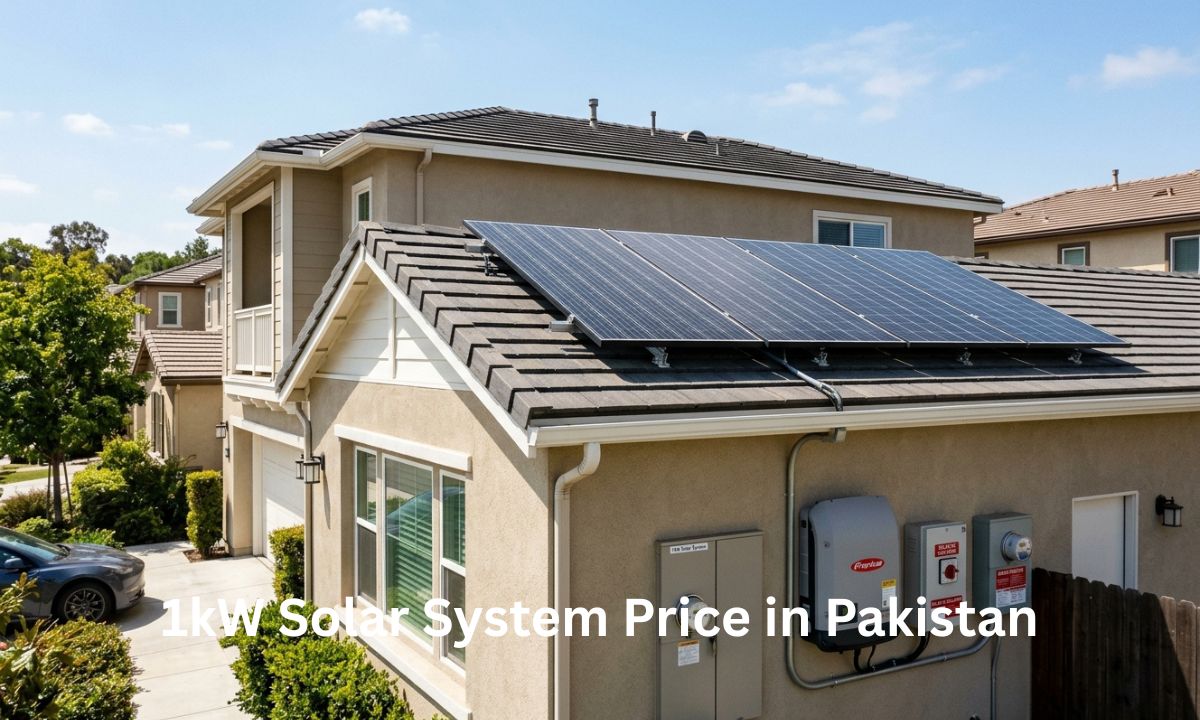
A 1kW solar system is a great choice for small homes in Pakistan. It can power fans, lights, an LED TV, and a few small appliances without any problem. Many families choose this size because it fits well on small rooftops. It also costs less than bigger systems, so it is easy on the budget.
In 2026, the price of a 1kW solar system in Pakistan usually falls between PKR 90,000 and PKR 150,000. This price depends on the brand of panels, the inverter you pick, and the installation work. If you add a battery for backup power, the cost can go up to around PKR 200,000. Prices also change a little from city to city, like Lahore, Karachi, and Islamabad.
I know choosing the right solar system can feel confusing with so many prices online. That’s why I made this guide simple and honest, just like I would explain it to my own neighbor. In this article, I will break down the real cost, the best components, and how you can avoid overpaying. By the end, you will know exactly what a good 1kW system should cost you in 2026.
1kW Solar System Price Calculator Pakistan 2026
Calculate the estimated total cost of a 1kW solar system setup in Pakistan based on your selected panels, inverter, battery storage, and accessories.
Estimated 1kW Solar System Price
Estimated total: ₨ 165,000
| Component | Estimated Cost (PKR) |
|---|---|
| Solar Panels (2x 550W) | ₨ 42,000 |
| Inverter (Hybrid) | ₨ 55,000 |
| Batteries (2.4 kWh) | ₨ 52,800 |
| Mounting Structure | ₨ 6,500 |
| Installation Labor | ₨ 12,000 |
| Electrical Wiring & Safety Accessories | ₨ 30,000 |
| Total Estimated Cost | ₨ 198,300 |
Estimated Cost per kW: ₨ 198,300 / kW
1kW Solar System Price in Pakistan 2026
The estimated price of a complete 1kW solar system setup in Pakistan in 2026 generally ranges between PKR 130,000 to PKR 210,000. Basic setups without heavy battery backup are available at lower rates, whereas hybrid 1kW systems configured with lithium or tubular deep-cycle batteries fall into higher price ranges.
What Is Included in a 1kW Solar System?
A standard 1kW solar system package includes:
- Solar Panels: 2 high-efficiency 500W–580W solar panels (N-Type TOPCon or Bifacial).
- Solar Inverter: A 1kW or 1.2kW Hybrid or Off-grid UPS/Solar inverter unit.
- Storage Battery: 1x or 2x 12V Tubular Deep Cycle battery or a compact LiFePO4 pack.
- Mounting Frame: L2 or customized galvanized iron framing structures.
- Electrical Safety & Cable: AC/DC copper wiring, circuit protection breakers, and fuses.
What Loads Can a 1kW Solar System Run?
A 1kW solar system is an ideal basic alternative for homes and small shops to eliminate UPS dependence during load-shedding. It can easily power:
- 3 to 5 LED lights or bulbs
- 2 to 3 Ceiling Fans (or Energy Savers)
- 1 LED TV or Wi-Fi Router
- Mobile phone / Laptop charging station
How Many Panels Are Needed for a 1kW Solar System?
The panel count depends on the module wattage chosen:
- 500W Panels: 2 panels ($1,000 \text{W} \div 500 \text{W} = 2$)
- 550W Panels: 2 panels ($1,000 \text{W} \div 550 \text{W} \approx 1.82$)
- 580W Panels: 2 panels ($1,000 \text{W} \div 580 \text{W} \approx 1.72$)
What is a 1kW Solar System Price in Pakistan?
A 1kW solar system is the smallest and most affordable solar setup you can install in Pakistan. It uses solar panels to catch sunlight and turn it into electricity for your home. “1kW” means the system can produce one kilowatt of power at its best working moment.
In 2026, the average 1kW solar system price in Pakistan falls between PKR 100,000 and PKR 240,000. The final price depends on whether you choose a simple on-grid system or a full hybrid system with battery backup. It also depends on the brand of panels and inverter you pick.
I have installed many small solar systems for families across Punjab, and I always tell my clients the same thing. The price tag is not the whole story. What matters more is the quality of components and whether the system matches your real electricity needs.
Current 1kW Solar System Price in Pakistan
Let me break this down clearly, because prices change based on the type of system you want.
| System Type | Price Range (PKR) | Best For |
| Basic on-grid (no battery) | 100,000 – 150,000 | Homes with steady grid power |
| Off-grid (with battery) | 150,000 – 210,000 | Areas with heavy load shedding |
| Hybrid (grid + battery) | 210,000 – 240,000 | Homes wanting full backup |
Pro tip: If your area does not have long power cuts, do not waste money on a big battery setup. Many of my clients in cities pay for backup they barely use.
Solar Panel prices themselves have also changed a lot. Tier-1 brands like Longi, Jinko, and Canadian Solar now cost around PKR 24 to PKR 40 per watt, depending on the panel type. For a 1kW system, that means panels alone can cost PKR 24,000 to PKR 40,000.
Typical Technical Proposal & Cost Breakdown
When I prepare a technical proposal for a client, I always list every single item. This helps people see exactly where their money goes. Here is a real-style breakdown for a standard 1kW on-grid system.
| Component | Approximate Price (PKR) |
| Solar panels (2 x 500W or similar) | 30,000 – 40,000 |
| Inverter (1kW – 1.6kW) | 35,000 – 60,000 |
| Mounting structure/frame | 8,000 – 15,000 |
| Wiring, breakers, connectors | 5,000 – 10,000 |
| Installation and labor | 10,000 – 20,000 |
| Total (approx.) | 90,000 – 145,000 |
If you add a battery for backup power, add another PKR 40,000 to PKR 90,000, depending on the battery type. I will explain battery types in more detail further down this article.
This is just a sample breakdown. Your actual technical proposal may change based on your roof type, the distance from your meter, and the brand you select.
What Affects the 1kW System Price?
Many people ask me why one shop quotes PKR 100,000, and another quotes PKR 180,000 for the “same” system. The truth is, several hidden factors change the final price.
Here are the main things that push the price up or down:
- Panel brand and type – Tier-1 panels like Longi or Jinko cost more than local, unbranded panels.
- Inverter quality – A basic off-grid inverter is cheaper than a smart hybrid inverter with app monitoring.
- Battery type – Lithium batteries cost more upfront but last much longer than lead-acid types.
- Roof structure – A flat concrete roof is cheaper to install on than a tricky tin or slanted roof.
- City and location – Transport costs are higher in remote areas, which raises the final bill.
- Installer experience – A skilled team may charge slightly more, but they avoid costly mistakes.
Real talk from experience: I once had a client in a rural area near Multan who was quoted a very low price. When we inspected the system later, the wiring was thin and unsafe. Cheap is not always good. Always ask what brand of wire and breaker is being used.
What Can a 1kW Solar System Power?
A 1kW solar system produces around 4 to 5 units (kWh) of electricity per day in good sunlight. Over a month, that adds up to roughly 100 to 150 units, depending on your city and the weather.
This amount of power is enough for basic daily needs in a small home. It is not designed to run heavy appliances like air conditioners or motors.
Here is what a 1kW system can comfortably handle:
- 4 to 6 LED lights
- 2 to 3 ceiling fans
- 1 LED TV
- Mobile and laptop charging
- A small Wi-Fi router
If your home has more appliances than this, I always suggest going for a 2kW or 3kW system instead. Trying to squeeze too much load onto 1kW will drain your battery fast and shorten its life.
How Many Batteries for a 1kW Solar System
This is one of the most common questions I get from clients. The honest answer depends on your backup hours and battery type.
For a basic 1kW off-grid setup, most homes use one to two batteries. Here is a simple guide:
| Battery Type | Batteries Needed | Approx. Backup Time |
| Lead-acid (150Ah) | 1 battery | 3 – 4 hours |
| Lead-acid (150Ah) | 2 batteries | 6 – 8 hours |
| Lithium (100Ah) | 1 battery | 5 – 6 hours |
Pro tip: Lithium batteries cost more, but they last 8 to 10 years, while lead-acid batteries usually need replacing every 2 to 3 years. Over time, lithium often saves you more money.
If you live in a village with 8 to 10 hours of daily load shedding, one battery will not be enough. I always recommend testing your real appliance load before buying batteries, so you don’t overspend.
1kW Solar System Price in Punjab 2026
Punjab is the biggest solar market in Pakistan, and prices here are usually a bit more competitive because of higher demand. As someone based in Punjab myself, I see these prices change almost every season.
In cities like Lahore, Faisalabad, Multan, and Gujranwala, a basic 1kW on-grid system costs around PKR 95,000 to PKR 145,000 in 2026. With battery backup, expect to pay PKR 155,000 to PKR 220,000.
Smaller towns and rural areas in Punjab sometimes have slightly higher prices because of transport costs. However, labor charges in these areas can be a little lower, which balances things out.
| City in Punjab | Basic 1kW Price (PKR) | 1kW with Battery (PKR) |
| Lahore | 100,000 – 145,000 | 160,000 – 220,000 |
| Faisalabad | 95,000 – 135,000 | 155,000 – 210,000 |
| Multan | 95,000 – 140,000 | 150,000 – 210,000 |
| Rural Punjab | 100,000 – 150,000 | 160,000 – 230,000 |
1kW Solar System with Battery Backup
A 1kW solar system with battery backup is the most popular choice for homes facing daily load shedding. It stores extra solar power during the day and releases it at night or during power cuts.
This type of system usually costs between PKR 150,000 and PKR 240,000, depending on the battery capacity and type. It includes solar panels, an off-grid or hybrid inverter, a battery, and installation.
Here is why many of my clients prefer this option:
- Works during power cuts – you are not left in the dark
- Stores extra energy – nothing goes to waste
- Good for villages – ideal where grid supply is weak or unreliable
- Long-term savings – less dependency on rising electricity bills
The main downside is the higher starting cost. But if you face frequent outages, the backup is often worth every rupee.
How Many Devices Can We Run with a 1 kW Solar System?
People often imagine a 1kW system can run a whole house. In reality, it is best suited for light daily use, not heavy machines.
Here is a practical device list a 1kW system can typically manage at the same time:
- 4 LED bulbs (10 watts each)
- 2 ceiling fans (60 watts each)
- 1 LED TV (60 – 80 watts)
- 1 Wi-Fi router (10 watts)
- Mobile phone charging (a few watts)
Adding up these loads gives roughly 500 to 600 watts, which fits well within a 1kW system’s daily output. However, running a refrigerator, washing machine, or air conditioner on this size is not realistic. Those need at least a 3kW to 5kW system.
Pro tip from the field: Always calculate your total load in watts before buying a system. Add up every appliance you plan to run at the same time, then choose a system size with some extra room. This avoids overloading and protects your inverter.
Components Required for a 1 kW Solar System
Every solar system, no matter the size, needs a few main parts working together. Let me explain each one in simple words.
Solar Panels
Solar panels are the heart of the system. They catch sunlight and turn it into DC electricity. For a 1kW system, you usually need two panels of around 500 to 550 watts each, or a few smaller panels adding up to 1000 watts.
Tier-1 brands like Longi, Jinko, and Canadian Solar are known for better efficiency and longer life. A good panel should come with at least a 10- to 12-year product warranty and a 25-year performance warranty.
Frames
The frame, also called the mounting structure, holds your panels safely in place on the roof. It is usually made of iron or aluminum.
A strong frame protects your panels from wind damage and helps them face the sun at the right angle. Never skip on frame quality just to save a small amount of money — a weak frame can cause serious damage during storms.
Batteries
The battery stores extra solar power so you can use it at night or during outages. As explained earlier, you can choose between lead-acid and lithium batteries.
- Lead-acid batteries – cheaper upfront, shorter lifespan (2–3 years)
- Lithium batteries – costlier upfront, longer lifespan (8–10 years), lighter weight
If your budget allows, lithium is usually the smarter long-term choice.
Inverter
The inverter converts the DC power from panels into AC power that your home appliances can use. For a 1kW system, inverters usually cost between PKR 35,000 and PKR 60,000.
There are three main inverter types:
- On-grid inverter – works with the government grid, shuts off during power cuts
- Off-grid inverter – works independently with batteries, ideal for load shedding areas
- Hybrid inverter – combines both grid and battery power for full flexibility
Benefits of Installing a 1kW Solar System in Pakistan
Installing solar, even at a small scale, brings real benefits to Pakistani households. Here are the main advantages I have seen firsthand with my clients.
- Lower electricity bills – you generate part of your own power for free
- Protection from load shedding – with battery backup, you stay powered during cuts
- Low maintenance – solar panels need very little upkeep, just occasional cleaning
- Eco-friendly power – solar energy does not create pollution
- Good starter option – ideal for small homes or as a first step before upgrading later
- Fast return on small investment – smaller systems recover their cost faster on a percentage basis
Many of my clients start with a 1kW system to test solar power before investing in a bigger setup. It is a smart, low-risk way to begin your solar journey.
Is a 1kW Solar System Worth It?
Yes, for the right household, a 1kW solar system is worth it. It suits small families, single rooms, shops, or homes with light electricity needs.
However, it is not the right choice for every home. If your family uses a refrigerator, washing machine, AC, or water motor regularly, a 1kW system will not be enough to cover your needs.
Here is a simple way to decide:
| Your Situation | Is 1kW Right for You? |
| Small home, basic lights and fans | Yes |
| Shop with a few lights and a fan | Yes |
| Home with fridge and washing machine | No, go for 3kW+ |
| Farmhouse with a water motor | No, go for 5kW+ |
Honest advice from Farooq: Before you invest, list every appliance you use daily and add up their watts. If your total stays under 600–700 watts, a 1kW system will serve you well.
1kW Solar System Off-Grid Price
An off-grid 1kW solar system works completely independent of the government grid. It relies fully on solar panels and batteries, making it perfect for areas with no grid connection or extremely poor supply.
In 2026, a complete 1kW off-grid system typically costs between PKR 150,000 and PKR 210,000. This price includes panels, an off-grid inverter, at least one battery, wiring, and installation.
| Off-Grid Component | Approx. Price (PKR) |
| Solar panels (1kW) | 30,000 – 40,000 |
| Off-grid inverter | 35,000 – 60,000 |
| Battery (1–2 units) | 40,000 – 90,000 |
| Frame, wiring, installation | 25,000 – 35,000 |
| Total | 150,000 – 210,000 |
Off-grid systems are especially popular in rural areas and farmhouses where the electricity grid is unreliable or simply not available. If you live somewhere far from the main grid, this setup gives you true independence from WAPDA.
Final Words
Choosing the right 1kW solar system does not have to be confusing. Once you understand the components, the real costs, and what the system can actually power, you can make a decision that truly fits your home and your budget.
I always tell my clients the same thing: do not just chase the lowest price. Look at the brand quality, ask for a proper technical proposal, and make sure the installer explains every cost clearly. A well-installed 1kW system can serve your family reliably for many years.
If you are still unsure whether 1kW is enough for your household, sit down and list your daily appliances first. This small step will save you money and headaches down the road, and it will help you pick a system size that actually matches how you live.
“FAQs”
What can a 1 kW solar system run?
A 1kW solar system can run small loads like 4 to 6 LED lights, 2 fans, an LED TV, and mobile charging. It is best for light daily use, not heavy appliances.
Can a 1kW solar panel run AC?
No, a 1kW system cannot run an air conditioner. Even a small AC needs at least a 1.5kW to 2kW system to start and run safely.
Is a 1kW solar system worth it?
Yes, it is worth it for small homes with basic lights, fans, and a TV. It is not enough for homes with a fridge, motor, or AC.
What is the maximum load capacity of a 1 kW solar system?
A 1kW system can safely handle around 600 to 800 watts of load at one time. Going beyond this limit can overload the inverter and damage it.
How many solar panels are in 1 kW?
You usually need two panels of 500 to 550 watts each to make 1kW. Some setups use smaller panels, as long as the total reaches 1000 watts.
What are 5 disadvantages of solar power?
Solar power has a high upfront cost, and it depends on sunlight, so cloudy days lower output. Batteries need replacement every few years, panels need occasional cleaning, and rooftop space can be limited for bigger systems.

I AM CH SAMI ULLAH, THE TOP SOLAR PANEL SELLER AND INSTALLER IN PAKISTAN, WITH CHEAPEST RATES, OF TOP QUALITY. GET THE LATEST RATES ON SOLAR PANELS, FANS, ACs, TUBE WELLS, SOLAR FRIDGES, AND SOLAR ATTA CHAKKIS. WHATSAPP (03461320821)