
Do you ever wonder if your solar panel is really making the power it promises? Checking the watts is easier than most people think, and you don’t need to be an electrician to do it. With just a few simple tools and a sunny day, you can find out the true output of any solar panel in minutes.
Many homeowners buy solar panels but never check if they are working at full strength. Dust, shade, wrong angles, and old age can all lower a panel’s real watts without you even noticing. Learning how to test your panel helps you catch problems early and get the most value from your solar investment.
In this guide, we will walk you through 5 easy steps to check a solar panel’s watts, using simple tools like a multimeter or a watt meter. By the end, you will know exactly how to measure your panel’s power, compare it to its rated wattage, and understand what a healthy reading looks like.
What Does “Solar Panel Watts” Mean?
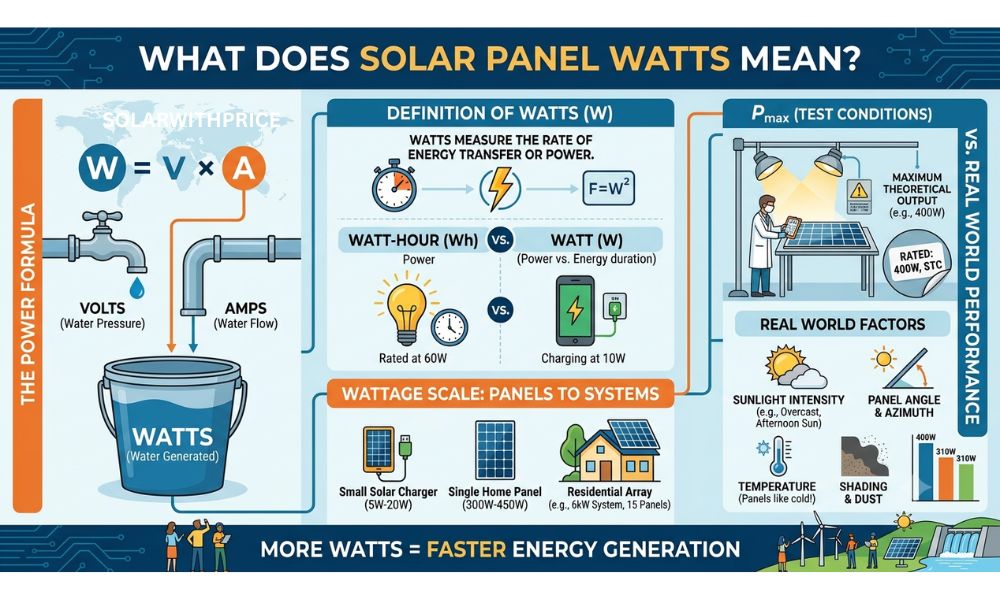
Watts are the unit we use to measure power. When we say a solar panel is “100 watts” or “300 watts,” it means that under perfect sunlight, the panel can make that much power in one hour.
Think of it like a water tap. A bigger tap gives more water in one minute. A bigger solar panel (in watts) gives more electricity in one hour of full sunlight.
Why Watts Matter
Here are simple reasons why checking solar panel watts is useful:
- It tells you how much electricity your panel can make.
- It helps you know if your panel is working properly.
- It helps you plan how many panels you need for your home.
- It helps you find out if a panel is fake or damaged.
Where to Find the Watt Rating on a Solar Panel
Before doing any testing, always check the panel itself first. Every solar panel has a small sticker on the back. This sticker is called the nameplate or specification label.
On this sticker, you will usually find:
| Term | Meaning |
|---|---|
| Pmax (Maximum Power) | The panel’s rated watts, like 300W |
| Vmp (Voltage at Max Power) | The normal working voltage |
| Imp (Current at Max Power) | The normal working current (amps) |
| Voc (Open Circuit Voltage) | Voltage when nothing is connected |
| Isc (Short Circuit Current) | Current when wires are shorted |
The Pmax number is the simplest way to know your panel’s watts. But if the sticker is missing, damaged, or you want to check if the panel is really working at its full power, you need to test it yourself.
Tools You Need to Check Solar Panel Watts
You do not need many tools. Here is a short list:
- A multimeter – a small device that measures voltage and current.
- A solar power meter (watt meter) – an easier tool that shows watts directly.
- Sunny weather – testing only works well in strong, direct sunlight.
- A notebook – to write down your readings.
Simple Formula to Calculate Watts
The most important thing to remember is this small formula:
Watts = Volts × Amps
This means if you measure the voltage and the current (amps) of your panel, you can multiply them to get the watts.
For example:
- If a panel gives 18 volts and 5 amps
- Then Watts = 18 × 5 = 90 watts
This is the same idea used in almost every solar test.
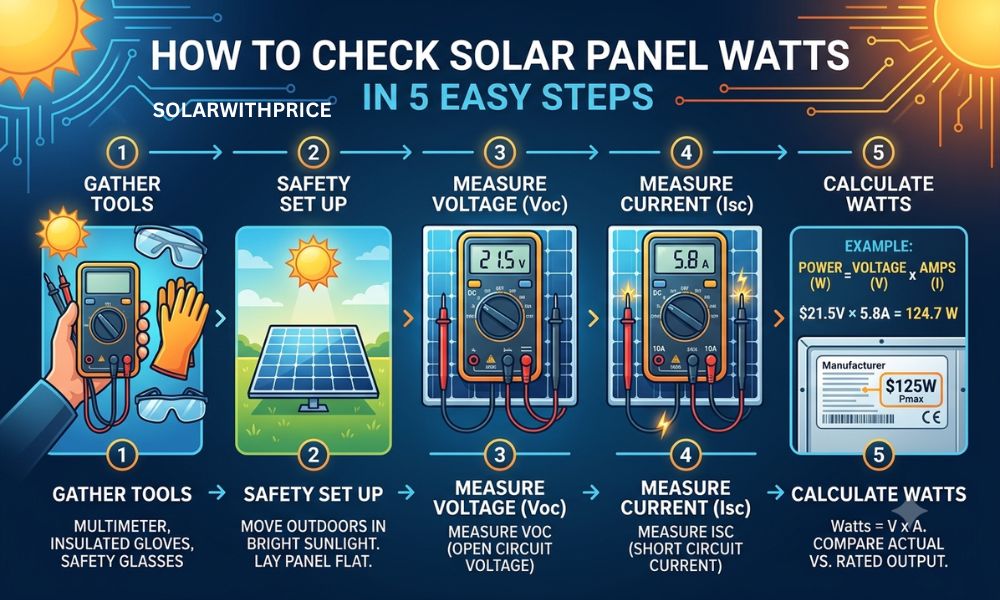
Step-by-Step: How to Check Solar Panel Watts with a Multimeter
Follow these steps carefully. Do this test only in bright sunlight for correct results.
Step 1: Prepare Your Panel
Place the solar panel in a sunny, open area. Make sure no shadow, cloud, or dust is blocking the sunlight. Clean the panel surface if it looks dirty.
Step 2: Measure the Voltage (Volts)
- Set your multimeter to DC Voltage mode.
- Choose a range higher than the panel’s rated voltage (for example, if the panel is 20V, set the meter to 200V range).
- Connect the red probe to the positive wire and the black probe to the negative wire.
- Write down the number shown. This is your voltage reading.
Step 3: Measure the Current (Amps)
- Set your multimeter to DC Amps mode.
- Move the red probe to the correct amp socket on the meter (this is important, or you may damage the meter).
- Connect the probes the same way as before.
- Write down the number. This is your current reading in amps.
Step 4: Calculate the Watts
Now use our formula:
Watts = Volts × Amps
Multiply the two numbers you wrote down. This gives you the real, working wattage of your solar panel at that moment.
Step 5: Compare with the Sticker Rating
Look at the Pmax number on the panel’s sticker. Compare it with your test result.
- If your number is close to the sticker rating, your panel is healthy.
- If your number is much lower, something may be wrong, such as dirt, shade, old age, or a bad connection.
How to Check Solar Panel Watts Using a Watt Meter (Easier Method)
If a multimeter feels difficult, a solar watt meter is a much simpler tool. It is made only for this job and shows watts directly on its screen.
Here is how to use it:
- Connect the watt meter between the solar panel and the charge controller (or battery).
- Cover the panel first with a cloth, so no power flows yet.
- Remove the cloth and place the panel in direct sunlight.
- The meter will automatically turn on and show volts, amps, and watts together.
- Read the watt number directly from the screen.
This method is great for beginners, students, and anyone who does not want to do manual calculations.
Table: Comparing the Two Testing Methods
| Method | Tools Needed | Difficulty | Accuracy |
|---|---|---|---|
| Multimeter method | Multimeter | Medium | Good |
| Watt meter method | Solar watt meter | Easy | Very good |
| Checking sticker only | None | Very easy | Basic (only shows rated value, not real output) |
Why Your Reading May Be Lower Than the Rated Watts
It is very common for your test result to be lower than the number printed on the sticker. This is normal and does not always mean the panel is broken. Some common reasons are:
- Weak or cloudy sunlight – panels need strong, direct sun for full power.
- Wrong angle – if the panel is not facing the sun directly, power drops.
- Dust or dirt – a dirty panel blocks sunlight and lowers output.
- Shadows – even a small shadow on part of the panel can reduce power a lot.
- Hot temperature – very hot panels actually produce slightly less power.
- Old panels – panels slowly lose a little power every year as they age.
- Loose wires – bad connections reduce the power reaching your meter.
Tips for Getting an Accurate Reading
To get the best and most correct results, follow these easy tips:
- Test your panel around noon, when the sun is highest and strongest.
- Choose a clear, sunny day with no clouds.
- Clean the panel before testing.
- Make sure the panel faces the sun directly, with no shade.
- Keep wires tight and properly connected.
- Repeat the test two or three times to be sure.
Simple Daily Output Formula
Once you know your panel’s real watts, you can also guess how much energy it can make in a day. Many experts use this simple formula:
Daily Watt-Hours = Panel Watts × Sunlight Hours × 0.75
Here, 0.75 (or 75%) is used because sunlight is not always at full strength during the whole day.
Example:
If your panel is 300 watts and your area gets 5 hours of good sunlight:
300 × 5 × 0.75 = 1,125 watt-hours per day
This tells you how much energy your panel can give in one day, not just for one moment.
Safety Tips While Testing Solar Panels
Testing is simple, but safety is important too. Please remember:
- Never touch bare wires with wet hands.
- Do not touch the metal probe tips together while connected to the panel, as this can cause a spark.
- Always double-check your multimeter settings before connecting it.
- Keep children away from open wires during testing.
- If you are unsure, ask an adult or a trained solar technician for help.
When Should You Test Your Solar Panel’s Watts?
You do not need to test your panel every day. Here are the best times to check it:
- When you first buy or install a new panel.
- If you feel your electricity output has dropped.
- Once every few months, for regular maintenance.
- After heavy rain, dust storms, or cleaning.
- Before selling or reusing an old panel.
How to Check Solar Panel Watts with a Multimeter
A multimeter is the most reliable tool for checking real solar panel output at home. It measures volts and amps separately, and once you have both numbers, a simple multiplication gives you the true wattage.
Steps to follow:
- Place the panel in direct sunlight with no shade or dust on the surface.
- Set the multimeter to DC Voltage mode and record the reading (Volts).
- Switch the meter to DC Amps mode, move the probe to the amp socket, and record the reading (Amps).
- Multiply the two numbers: Watts = Volts × Amps.
- Compare your result with the Pmax value printed on the panel’s label.
| Multimeter Setting | What It Measures | Typical Range for Home Panels |
| DC Voltage (V) | Panel voltage output | 12V – 40V |
| DC Amps (A) | Panel current output | 1A – 12A |
| Calculated Watts | Actual power output | 50W – 500W |
This method works for almost any panel size, and it’s the same basic test used by solar technicians before installing a system.
How to Check Solar Panel Watts in Pakistan
Checking solar panel watts in Pakistan works the same way as anywhere else, but local conditions matter a lot. Strong summer sun in cities like Multan, Lahore, and Karachi often pushes panels close to their rated output, while dusty weather and haze can pull readings down quickly.
Points to keep in mind for Pakistani weather:
- Test between 12 PM and 2 PM, when sunlight is strongest across most of Pakistan.
- Clean the panel often, since dust and smog are common in Punjab and Sindh throughout the year.
- In winter, expect lower readings even on clear days because sunlight is weaker.
- Local markets sell affordable digital multimeters and solar watt meters at electronics shops in most major cities.
| Season | Expected Panel Performance in Pakistan |
| Summer (May–August) | Close to full rated watts, sometimes even higher for short periods |
| Monsoon (July–September) | Lower and inconsistent due to clouds and humidity |
| Winter (December–February) | Reduced output due to weaker sunlight and shorter days |
Testing your panel a few times a year helps you know if your solar system is still giving you good value, especially with local electricity rates rising every year.
How to Check Solar Panel Watts Using a Calculator
If you don’t want to do manual math, a solar wattage calculator makes the job much simpler. You just enter your voltage and amperage readings, and it instantly shows you the watts.
What you typically need to enter:
- Panel voltage (V) — from your multimeter or panel label
- Panel current (A) — from your multimeter or panel label
- Number of sunlight hours per day (optional, for daily output estimate)
| Input | Example Value | Calculated Result |
| Voltage | 18V | — |
| Current | 5A | — |
| Watts (V × A) | — | 90W |
| Daily Output (Watts × 5 hrs × 0.75) | — | 337.5 Wh |
A calculator is especially handy when you’re comparing several panels at once or planning how many panels you need for a home system, since it removes the chance of manual calculation errors.
How to Calculate Solar Panel Wattage for Home Use
Before buying a solar system, most people want to know how many watts they actually need for their home. This depends on your daily electricity usage, not just the size of your roof.
Simple steps to calculate your home’s wattage need:
- List all your appliances and their wattage (fan, fridge, lights, TV, etc.).
- Add up the total watts these appliances use per hour.
- Multiply by the number of hours you use them daily to get watt-hours.
- Divide your total daily watt-hours by average sunlight hours in your area to estimate the panel wattage you need.
| Appliance | Average Watts | Hours Used Daily | Watt-Hours |
| LED Bulbs (5) | 50W | 6 hrs | 300 Wh |
| Ceiling Fan | 75W | 8 hrs | 600 Wh |
| Refrigerator | 150W | 24 hrs | 3,600 Wh |
| Television | 100W | 4 hrs | 400 Wh |
| Total | — | — | 4,900 Wh/day |
Once you know your daily watt-hour need, dividing it by your area’s average sunlight hours (usually 5–6 hours) tells you roughly how many total panel watts your home system should have.
How to Test a Solar Panel Without a Multimeter
Not everyone has a multimeter at home, and that’s okay. There are simpler, low-tech ways to get a rough idea of whether your panel is working.
Easy ways to test without a multimeter:
- Small appliance test – Connect the panel to a small DC device, like an LED bulb or fan, and see if it powers on properly in sunlight.
- Battery charging test – Connect the panel to a battery through a charge controller and check if the battery charging indicator shows normal activity.
- Solar phone charger method – If your panel is small, plug in a USB solar charger accessory and see if your phone charges at a normal speed.
- Visual inspection – Look for cracks, discoloration, or loose wiring, which are common signs of reduced output.
| Method | Accuracy | Best For |
| Small appliance test | Low | Quick working/not-working check |
| Battery charging test | Medium | Everyday off-grid users |
| Visual inspection | N/A (no watts shown) | Spotting physical damage |
These methods won’t give you an exact watt number, but they’re a fast way to confirm your panel is producing power before doing a full multimeter test.
How to Check Solar Panel Damage
A damaged solar panel often shows lower watts than expected, even in perfect sunlight. Knowing the warning signs helps you catch problems before they get worse.
Common signs of solar panel damage:
- Visible cracks or spider-web patterns on the glass surface
- Dark or discolored spots on the cells (called hot spots)
- Yellowing or bubbling of the panel’s back sheet
- Loose, corroded, or burnt connectors and wires
- A sudden, noticeable drop in wattage compared to previous readings
| Damage Type | Visible Sign | Effect on Watts |
| Micro-cracks | Thin lines on cells | Slight to moderate drop |
| Hot spots | Dark discolored patches | Noticeable drop, safety risk |
| Water damage | Fogging under the glass | Gradual power loss |
| Broken connectors | Loose or burnt wires | Sudden output drop or zero output |
If your multimeter test shows watts far below the panel’s rated value even in strong sunlight, a physical inspection is the next step to confirm whether damage is the cause.
How to Calculate Solar Panel Wattage in Series and Parallel
When you connect multiple solar panels together, the way you wire them (series or parallel) changes your system’s voltage and current, but the total wattage math still follows a clear pattern.
Series connection:
- Voltage adds up, current stays the same.
- Total Watts = (Sum of Voltages) × Current
Parallel connection:
- Current adds up, voltage stays the same.
- Total Watts = Voltage × (Sum of Currents)
| Connection Type | Voltage | Current | Example (2 panels, 100W each, 20V/5A) |
| Series | Adds up | Stays same | 40V × 5A = 200W |
| Parallel | Stays same | Adds up | 20V × 10A = 200W |
Notice that total wattage stays the same either way, 200W, but series wiring is better for longer cable runs, while parallel wiring is better when you want to keep voltage low and safe for smaller systems. Choosing between them usually depends on your charge controller and battery setup.
Final words
Checking a solar panel’s watts doesn’t have to feel technical or confusing. With just five simple steps, a multimeter or watt meter, and a bit of sunshine, anyone can find out exactly how much power their panel is really producing.
Making this check a regular habit helps you spot problems early, keep your system running at full strength, and get the best value from every panel you own. A few minutes of testing today can save you money and worry down the road.
So the next time you’re unsure about your solar panel’s performance, don’t guess. Grab your tools, pick a sunny afternoon, and follow these five easy steps to know your panel’s true watts with confidence.
FAQs
What size is a 300W solar panel?
A standard 300W solar panel is usually about 65 to 66 inches long and 39 inches wide. It weighs around 18 to 20 kg on average. Exact size varies slightly by brand and cell type (monocrystalline or polycrystalline).
How many watts is 1 solar panel?
Most home solar panels range between 250W and 450W, with 330W to 400W being the most common today. Smaller portable panels can be as low as 50W to 100W. The exact wattage is always printed on the panel’s back label as Pmax.
How many watts from a 200W solar panel?
A 200W panel is rated to produce up to 200 watts under ideal Standard Test Conditions with full, direct sunlight. In real daily use, actual output is often lower, around 140W to 180W, due to weather and angle. On a good sunny day with 5 hours of sun, it can generate roughly 750 to 1,000 watt-hours.
Can a 200W solar panel charge a 200Ah battery?
Yes, a 200W solar panel can charge a 200Ah battery, but it will take a long time, often 2 to 3 full sunny days. This is because a 200Ah battery needs far more total watt-hours than a single 200W panel can produce in one day. For faster charging, using 2 or more panels together is recommended.
What is the 20 rule for solar panels?
The “20% rule” refers to sizing your charge controller and wiring to handle 125% to 130% of your panel’s rated current, adding a safety margin of about 20-25%. It helps prevent overheating or damage from unexpected power spikes on sunny days.
Some people also use “20%” to describe keeping solar-charged battery banks from being drained below 20% capacity for longer battery life.
Can I mix 100W and 200W solar panels?
Yes, you can mix a 100W and 200W panel, but it works best when wired in parallel rather than series. In parallel, each panel keeps its own voltage and current, so the mismatch in wattage doesn’t drag down the stronger panel’s output. In series, the weaker 100W panel would limit the current of the whole string, wasting some of the 200W panel’s potential.
How to calculate solar panel capacity for home?
Start by adding up the total watts of all appliances you plan to run, then multiply by the hours you use them daily to get your total watt-hours needed. Next, divide that number by your area’s average sunlight hours, usually 5 to 6 hours in Pakistan, to find your required panel wattage. Adding a buffer of 20-25% on top of this figure helps cover cloudy days and system losses.
Is 10 kW enough to run a house?
For most average-sized homes, a 10 kW solar system is more than enough to cover daily electricity needs, including fans, lights, a fridge, and a few air conditioners.
Larger homes with heavy AC usage, electric heaters, or big appliances may need a bigger system or careful load management.
The right size always depends on your actual daily electricity consumption, which is best checked using your monthly electricity bill in units (kWh).

I AM CH SAMI ULLAH, THE TOP SOLAR PANEL SELLER AND INSTALLER IN PAKISTAN, WITH CHEAPEST RATES, OF TOP QUALITY. GET THE LATEST RATES ON SOLAR PANELS, FANS, ACs, TUBE WELLS, SOLAR FRIDGES, AND SOLAR ATTA CHAKKIS. WHATSAPP (03461320821)