
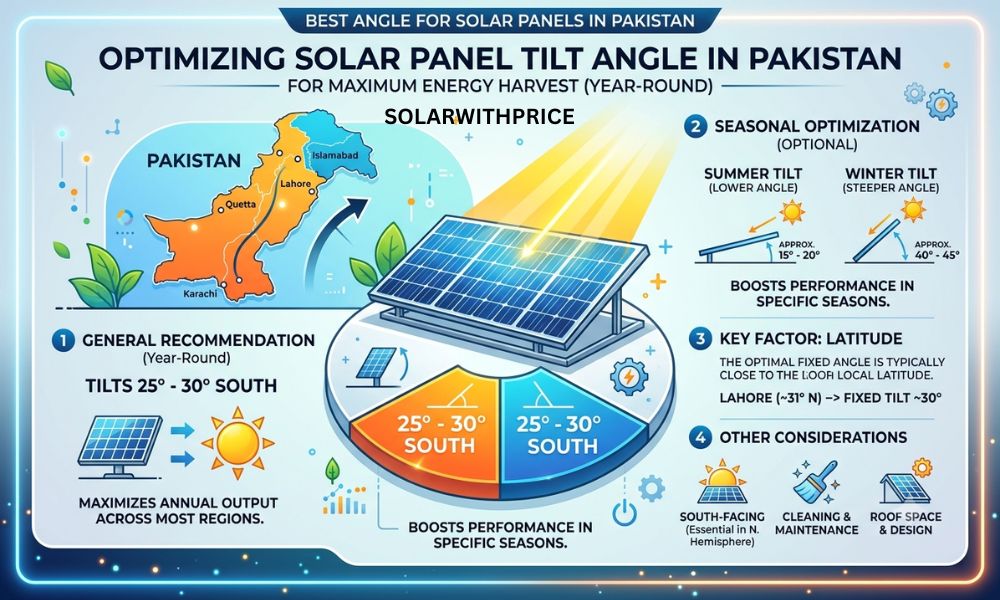
I install solar panels on fields and in homes in Punjab every day. One question I hear a lot from clients is: “What is the best angle for solar panels in Pakistan?” Today I will answer this in very simple words. I verified that the south direction with a 30 ° angle is best for maximum electricity in Pakistan in 2026.
It is also important that getting the right solar panel angle is not a small thing in 2026. If you set your panels wrong, you can lose 20% to 30% of your solar power every single day. That is a big loss of money from your own pocket. Many people install solar panels flat and regret it later.
In this guide, I will tell you the best tilt angle for every season and every city in Pakistan. I will also share the tricks I use myself on real rooftops and fields. This way, your solar panels will give maximum output all year round. You will also get the best return on your investment.
What Is Solar Panel Angle?
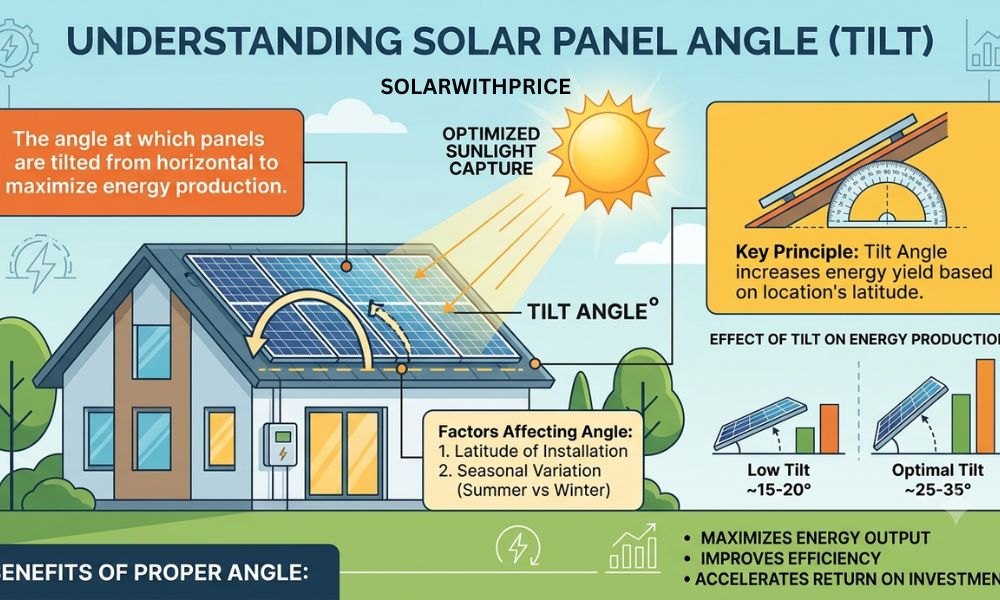
- Tilt angle: This is how much the panel leans up from flat ground. It decides how directly sunlight hits the panel.
- Azimuth angle (direction): This is which way the panel faces — north, south, east, or west.
My personal experience: Both angles work together. If either one is wrong, your panels will not give full power, even if you bought the best solar panel brand on the market.
Why Does Solar Panel Angle Matter So Much?
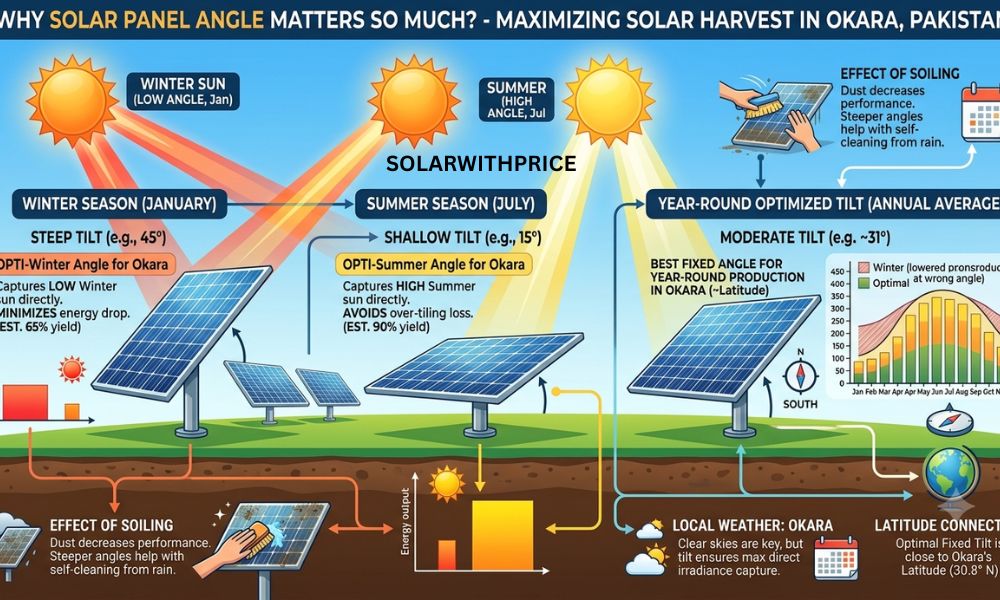
A solar panel makes the most electricity when sunlight falls on it straight, at 90 degrees. When the panel is too flat or too steep for the season, sunlight hits it at a slant. Less direct light means less power.
My personal experience: Pakistan gets very strong sunlight almost all year. But the sun’s position changes a lot between summer and winter.
My pro tip: In summer, the sun sits high in the sky. In winter, it sits low. A panel angle that works great in June may waste power in January.
Best Tilt Angle for Solar Panels in Pakistan
For most homes and fields across Pakistan, a fixed tilt angle between 25 and 33 degrees works well for the whole year. This range balances both summer and winter sun positions without needing constant adjustment.
Here is a simple breakdown by season:
| Season | Sun Position | Recommended Tilt |
|---|---|---|
| Summer (April–September) | High in the sky | 15° to 20° |
| Winter (October–March) | Low in the sky | 30° to 40° |
| Year-round fixed setup | Mixed | 25° to 33° |
My personal experience: If you can only pick one fixed angle, go with your city’s latitude number. That is the safest general rule I follow on-site.
Best Solar Panel Angle by City (Latitude-Based Rule)
Every city in Pakistan sits at a slightly different latitude, so the ideal angle shifts a little from place to place.
| City | Approximate Latitude | Best Fixed Tilt Angle |
|---|---|---|
| Karachi | 25° | 24° – 25° |
| Lahore | 31.5° | 28° – 31° |
| Islamabad | 30° | 28° – 30° |
| Faisalabad | 31° | 28° – 31° |
| Multan | 30° | 27° – 30° |
| Peshawar | 34° | 30° – 34° |
| Quetta | 30° | 28° – 30° |
| Gilgit | 35° | 30° – 32° |
Simple tip: Search your city’s latitude online, then use that same number, or a few degrees less, as your panel tilt. This one trick solves most angle confusion.
Which Direction Should Panels Face?
In Pakistan, south is the best direction for almost every location. Since we are in the northern half of the globe, the sun spends most of its time toward the south sky. A south-facing panel catches the most sunlight through the day.
If your roof does not face south:
- A southeast or southwest-facing roof is the next best option.
- East-facing panels catch strong morning sun.
- West-facing panels catch strong afternoon sun.
- North-facing panels give the lowest output, so avoid this direction if you have a choice.
Fixed Angle vs Adjustable Angle Structure
You have two choices when installing your mounting structure.
| Type | Cost | Efficiency | Best For |
|---|---|---|---|
| Fixed structure | Lower cost | Good, steady output | Most homes and small businesses |
| Adjustable structure | Higher cost | Better seasonal output | Farms, commercial setups, tube wells |
From my own field experience, most homeowners are better off with a fixed structure at 25–30 degrees. Adjustable frames need someone to actually change the angle twice a year, and honestly, most people forget.
My personal experience: A good fixed angle, chosen correctly once, saves you the hassle.
Should You Adjust the Angle With Seasons?
Yes, if you have an adjustable frame, changing the tilt twice a year helps.
- Before summer: Lower the angle by around 10 to 15 degrees from your base setting.
- Before winter: Raise the angle back up to capture the low winter sun.
This small seasonal change can noticeably boost your output, especially in the winter months when sunlight is weaker and shorter.
Common Mistakes I See on Rooftops
Over the years, I have fixed many angle mistakes on client roofs. Here are the ones I see the most:
- Flat installation: Panels laid completely flat to save on structure cost. This collects dust fast and loses power.
- Copying a neighbour’s angle: Every roof and city is a little different. What works for one house may not suit another.
- Ignoring shading: Even a perfect angle fails if a wall, tree, or water tank casts a shadow on the panel for part of the day.
- One angle for all seasons without checking latitude: Some installers use a random number like 30 degrees everywhere without checking the actual city.
- No cleaning schedule: A dusty panel at the perfect angle still underperforms.
How Much Power Can Wrong Angle Cost You?
Based on field experience and general solar data, a poorly angled panel can lose a meaningful share of daily output compared to a correctly tilted one. The exact loss depends on how far off the angle is, shading, and dust.
This is why I always tell clients: spend five extra minutes getting the angle right during installation. It pays back for the next 25 years.
Angle Tips for Different Setups
- Rooftop homes: Use a mounting frame set to your city’s latitude angle.
- Ground-mounted systems: Easier to angle correctly since you are not limited by roof shape.
- Agricultural tube wells: A fixed angle around 25–30 degrees works well across most of Punjab’s tube well installations.
- Sloped roofs: If your roof already slopes close to the ideal angle, you may not need extra mounting structure at all.
What Angle Should Solar Panels Be At?
The short answer: for most parts of Pakistan, a fixed tilt angle between 25 and 33 degrees gives good output all year round. This is the range I personally use on rooftops across Punjab.
The angle depends on three things:
- Your city’s latitude — higher latitude means a steeper angle is needed.
- The season — summer sun sits high, winter sun sits low.
- Your roof type — flat roofs need a mounting frame; sloped roofs may already be close to ideal.
| Factor | Effect on Angle |
|---|---|
| Higher latitude city | Needs a steeper tilt |
| Lower latitude city | Needs a flatter tilt |
| Summer season | Flatter angle works better |
| Winter season | Steeper angle works better |
| Flat roof | Needs a mounting structure to create an angle |
Best Angle for Solar Panels in Lahore, Pakistan
Lahore sits at around 31.5 degrees latitude. Because of this, the best tilt angle for solar panels in Lahore falls between 28 and 31 degrees for a fixed year-round setup.
- Summer months (April–September): Lower the angle to around 18–20 degrees if your frame is adjustable.
- Winter months (October–March): Raise it to around 35–38 degrees for stronger winter sun capture.
- Direction: Always face panels south in Lahore for maximum daily sunlight.
My personal experience: Most of my Lahore clients go with a fixed 28–30 degree frame since Lahore roofs are usually flat and need a mounting structure anyway.
Best Angle for Solar Panels in Multan, Pakistan
Multan sits slightly lower in latitude than Lahore, around 30 degrees. So the best angle for solar panels in Multan, Pakistan is a touch flatter, around 27 to 30 degrees.
| Season | Recommended Angle in Multan |
|---|---|
| Summer | 17° – 19° |
| Winter | 33° – 36° |
| Fixed year-round | 27° – 30° |
My pro tip: Multan gets very intense summer heat and sunlight, so even a slightly flatter angle still produces strong output for most of the year. I usually recommend a fixed 28-degree setup for tube wells and homes in this area.
Best Angle for Solar Panels in Karachi
Karachi’s latitude is close to 25 degrees, which is lower than Lahore and Multan. This means the best angle for solar panels in Karachi is naturally flatter, around 24 to 25 degrees for a fixed setup.
- Karachi gets strong sun almost the whole year, so seasonal changes matter a little less here than up north.
- If adjustable, use 15–20 degrees in summer and around 30–35 degrees in winter.
- Coastal humidity and dust from sea air mean panels need regular cleaning, angle or no angle.
How to Angle Solar Panels (Step-by-Step)
If you are wondering how to angle solar panels yourself before calling an installer, here is the simple method I follow on-site:
- Find your city’s latitude using any online search.
- Use that number as your starting tilt angle.
- Subtract 10–15 degrees if you want to favour summer output.
- Add 10–15 degrees if you want to favour winter output.
- Face the panel south for the best daily sun exposure.
- Check for shading from walls, trees, or water tanks at different times of day.
- Lock the mounting frame firmly so wind or heavy rain does not shift the angle over time.
What Angle for Solar Panels: Quick Comparison Table
| City | Latitude (approx) | Fixed Year-Round Angle | Summer Angle | Winter Angle |
|---|---|---|---|---|
| Lahore | 31.5° | 28° – 31° | 18° – 20° | 35° – 38° |
| Multan | 30° | 27° – 30° | 17° – 19° | 33° – 36° |
| Karachi | 25° | 24° – 25° | 15° – 18° | 30° – 33° |
| Islamabad | 30° | 28° – 30° | 18° – 20° | 34° – 37° |
Why Getting This Angle Right Matters
A wrong angle does not stop your system from working, but it does reduce how much electricity you get every single day. Over months and years, that adds up to real money lost, especially during winter when sunlight is already weaker.
My personal experience: this is why I always check latitude and shading before fixing any mounting frame, whether it’s a small home system or a big tube well setup.
Final words
Dosto, that’s everything you need to know about picking the right solar panel angle in Pakistan. Match your tilt to your city’s latitude, face your panels south, and always check for shading and dust before you finalize the setup.
My personal experience: Get these basics right once, and your solar system will keep giving you strong, steady power for the next 20 to 25 years. If you have any more questions, feel free to ask in the comments section below. Stay powered up!

I AM CH SAMI ULLAH, THE TOP SOLAR PANEL SELLER AND INSTALLER IN PAKISTAN, WITH CHEAPEST RATES, OF TOP QUALITY. GET THE LATEST RATES ON SOLAR PANELS, FANS, ACs, TUBE WELLS, SOLAR FRIDGES, AND SOLAR ATTA CHAKKIS. WHATSAPP (03461320821)