
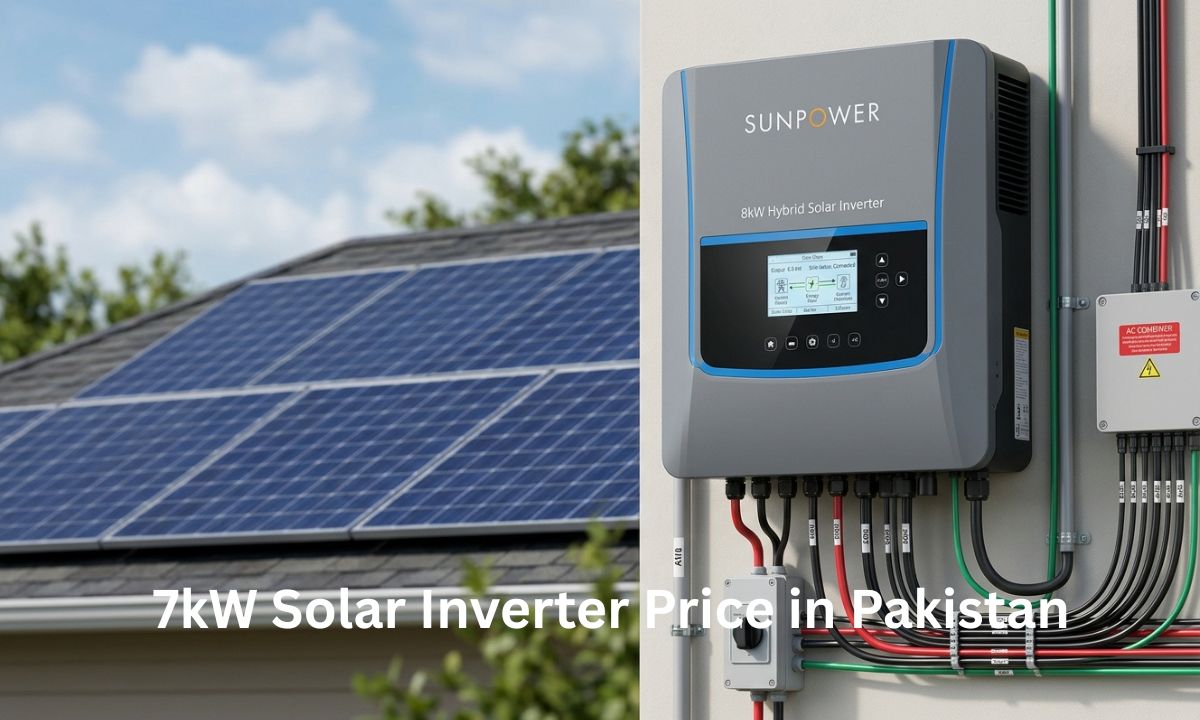
Salam, friends! I am Farooq, your solar guy from Punjab. Today we are talking about the 7kW solar inverter price in Pakistan. Many homes and shops need this size. It provides strong power for daily use. I will keep this simple and easy for you.
A 7kW inverter is a good choice for medium to large homes. It can run your fans, fridge, AC, and motor at the same time. The price depends on the brand and type. You can choose on-grid, off-grid, or hybrid models. Each type has its own price range and benefits.
In this guide, I will share the latest 2026 prices in Pakistani Rupees. You will see rates for top brands like Growatt, Huawei, Inverex, and Solis. I will also explain which one gives the best value. By the end, you will know the right inverter for your home or shop.
What Does a 7kW Solar Inverter Actually Do?
A solar inverter is the heart of your solar system. Your solar panels make DC power. But your fridge, fan, and TV do not use DC power. They use AC power. The inverter changes DC power into AC power. Without it, your panels are useless.
A 7kW inverter can handle a load of about 7000 watts at one time. This size is good for medium and large homes. It can run heavy items like an AC, a motor, a washing machine, and normal home lights together.
Many families in Punjab, Sindh, and KPK now choose this size because their homes need more power than a small 3kW or 5kW system can provide.
7kW Solar Inverter Price in Pakistan 2026 (Quick Overview)
Let me give you the short answer first, then we go deep.
| Inverter Type | Price Range (PKR) |
| On-Grid 7kW Inverter | 150,000 – 260,000 |
| Off-Grid 7kW Inverter | 180,000 – 300,000 |
| Hybrid 7kW Inverter | 230,000 – 420,000 |
Important point: these are indicative prices. Rates change every month because of the dollar rate, import duty, and stock availability. Always check the latest rate with your local dealer before buying.
Types of 7kW Solar Inverters in Pakistan
Not every 7kW inverter is the same. There are three main types. Each one works in a different way, and this changes the price too.
On-Grid 7kW Inverters
An on-grid inverter connects directly to the WAPDA grid. It does not use a battery. Extra power you make goes back into the grid through net metering. This is the cheapest option. It is best for people who do not face heavy load shedding in their area.
Pro tip from Farooq: on-grid is a smart choice for city areas like Lahore, Faisalabad, and Multan, where grid supply is fairly stable.
But if load shedding hits your area often, this inverter will not give you power during a cut. It stops working when the grid stops, for safety reasons.
Off-Grid 7kW Inverters
An off-grid inverter works with a battery bank. It does not depend on WAPDA at all. This is the right choice for rural areas or places with very poor grid supply. The system is more expensive because you also pay for batteries.
Hybrid 7kW Inverters
A hybrid inverter is the best of both worlds. It works with the grid and with a battery. When the sun is out, it uses solar power.
When the grid is available, it uses that too. When both fail, the battery takes over. Most Pakistani homes now prefer hybrid inverters because load shedding is still common in many cities and towns.
In my own experience visiting client homes across Punjab, 8 out of 10 people now ask for hybrid inverters, even if they add a battery later. It gives peace of mind.
Best 7kW Solar Inverter Brands in Pakistan (2026 Pricing)
Here is a detailed comparison table of the top brands available for 7kW to 8kW loads. I picked the closest matching models since exact 7kW units are rare — most brands make 6kW, 8kW, or 7.5kW versions that cover a 7kW home load.
| Brand | Type | Approx. Price (PKR) | Best For |
| Growatt | Hybrid, 8kW | 235,000 – 330,000 | Budget buyers who still want good quality |
| Huawei | Hybrid, 8kW (3-phase) | 350,000 – 450,000 | Homes that want top efficiency and app monitoring |
| Inverex | Hybrid, 7–8kW | 250,000 – 360,000 | Local support and easy spare parts |
| Solis | On-Grid/Hybrid | 180,000 – 300,000 | Value-for-money on-grid systems |
| SolarMax | Hybrid, 7–8kW | 220,000 – 320,000 | Mid-range homes and small shops |
| Crown | On-Grid/Hybrid | 170,000 – 280,000 | First-time solar buyers on a tight budget |
| Sungrow | Hybrid, 8kW | 320,000 – 480,000 | Buyers who want a strong international brand |
Growatt 7kW–8kW Inverters
Growatt is one of the most trusted names in Pakistan right now. It is known for strong build quality, a wide dust filter, and handling our voltage fluctuations well.
The ShinePhone mobile app lets you check your daily savings from your phone. Growatt gives a 5-year standard warranty, which can often be extended to 10 years.
Huawei 7kW–8kW Inverters
Huawei is a premium choice. Its SUN2000 series is known for high efficiency, smart MPPT tracking, and a strong 10-year warranty. It costs more than Growatt or Crown, but many customers say it is worth the extra rupees because of its long-term reliability and low failure rate.
Inverex 7kW–8kW Inverters
Inverex is a local favourite. It is a Pakistani brand, so spare parts and service centers are easy to find in almost every city. This matters a lot when something goes wrong, and you need fast help.
Solis 7kW Inverters
Solis is popular for on-grid systems. If your area has good WAPDA supply and you mainly want to cut your electricity bill, Solis gives good value without spending too much.
SolarMax 7kW–8kW Inverters
SolarMax sits in the mid-range category. It balances price and performance well for homes that need steady daily power without going for the most expensive option.
Crown 7kW Inverters
Crown is a good pick for people buying solar for the first time and who want to keep the budget low. It does the basic job well, though the warranty and monitoring features are simpler than premium brands.
Sungrow 7kW–8kW Inverters
Sungrow is another strong international brand. It sits close to Huawei in price and quality. Many commercial buyers and larger homes prefer it for its stable performance.
Factors That Affect 7kW Solar Inverter Price
Many readers ask me: “Farooq bhai, why does the same size inverter cost different amounts?” Here is why:
- Brand reputation — known international brands cost more than local or unknown brands.
- Type of inverter — hybrid costs more than on-grid because it has extra battery-management hardware.
- Phase type — single-phase is cheaper than three-phase.
- Warranty length — a 10-year warranty adds cost compared to a 5-year one.
- Dollar exchange rate — most inverter parts are imported, so rupee value affects price directly.
- IP rating — IP65 (dust and water resistant) units cost more than IP21 indoor-only units.
- Battery compatibility — inverters that work with lithium batteries are usually priced a bit higher.
- Dealer margin — prices can differ from shop to shop, even for the same model.
7kW Inverter vs Other Common Sizes
Choosing the right size matters more than people think. A wrong size wastes your money either way. Here is a simple comparison to help you decide.
| Inverter Size | Best For | Typical Price Range (PKR) |
| 5kW | Small homes, 3–4 rooms | 170,000 – 350,000 |
| 6kW | Medium homes, small shops | 200,000 – 380,000 |
| 7kW | Medium-large homes, homes with AC and motor | 230,000 – 420,000 |
| 8kW | Large homes, mini commercial use | 250,000 – 450,000 |
| 10kW | Large houses, small factories | 350,000 – 550,000 |
Pro tip: do not just look at the room count in your house. Count your heavy appliances — AC units, water motor, washing machine, iron, geyser. These decide your real load, not the number of rooms.
Is a 7kW Solar Inverter Right for Your Home?
A 7kW inverter usually fits a home that has:
- 1 to 2 split AC units running for a few hours daily
- A water motor or tube well pump
- Normal daily items — fridge, fans, lights, TV, washing machine
- A medium to large house size, around 7 to 12 marla
If your home only has a fridge, fans, and lights, a 5kW inverter may be enough, and you would save money.
If you run a small business at home, like a shop with freezers, you may even need 8kW or 10kW. Getting this size decision right is the most important step before you spend any money.
On-Grid vs Off-Grid vs Hybrid — Which One Should You Buy?
This is the question I get asked the most on WhatsApp every single day. Here is my honest, simple answer:
- Choose on-grid if load shedding in your area is rare, and your only goal is a lower electricity bill.
- Choose off-grid if your area has no reliable grid at all, or you live far from the main city.
- Choose hybrid if you want backup power during outages and you want to save on your bill. This is the choice for most Pakistani homes today.
From my field visits, I always tell clients: do not skip the hybrid option just to save some rupees today. Adding battery backup later is possible, but it usually costs more than doing it right the first time.
Installation Cost of a 7kW Solar Inverter System
The inverter price is only one part of the total cost. A full 7kW solar system also includes panels, mounting structure, wiring, and safety equipment.
Based on current market trends, a complete 7kW solar system (inverter + panels + structure, without battery) usually falls between PKR 850,000 and PKR 1,200,000, depending on panel brand and whether you add a battery.
Here is a simple breakdown of what a full system includes:
| Component | Purpose |
| Solar Panels | Convert sunlight into DC electricity |
| Inverter | Converts DC to usable AC power |
| Battery (optional) | Stores extra power for night or outage use |
| Mounting Structure | Holds panels at the right angle, usually 28°–32° in Pakistan |
| Cables (DC & AC) | Carry electricity safely between components |
| Safety Kit | DP box, circuit breakers, earthing, surge protection |
How to Choose the Best 7kW Solar Inverter
Here is a simple checklist I give to every customer before they buy:
- Check the warranty — never buy a unit with less than 5 years warranty.
- Confirm it is genuine — ask for an authorized dealer invoice, not a grey-market unit.
- Match the load correctly — get your electrician to calculate your real daily load first.
- Pick the right IP rating — go for IP65 if the inverter will sit outdoors or in a dusty spot.
- Check local service support — a cheap inverter with no local service center can cost you more later.
- Ask about battery compatibility — even if you skip the battery today, keep the option open for the future.
- Compare at least three dealers — prices can differ by tens of thousands of rupees for the same model.
Common Mistakes People Make When Buying a 7kW Inverter
I have seen these mistakes again and again in my years of fieldwork:
- Buying the cheapest unit without checking the brand’s track record.
- Ignoring the warranty terms and only asking about price.
- Skipping proper load calculation, which leads to buying the wrong size.
- Choosing on-grid in an area with heavy load shedding, then feeling disappointed later.
- Not asking about after-sales service before making the payment.
- Buying from unauthorized sellers who cannot honor the warranty.
My Pro Tips From the Field
After years of installing and recommending solar systems across Punjab, here are a few things I always tell my clients:
Tip 1: Always ask for the serial number and check it on the brand’s official app or website. Fake units are common in the local market.
Tip 2: If your area gets very hot in summer, pick an inverter with natural cooling or a strong fan system. Heat is one of the biggest reasons inverters fail early in Pakistan.
Tip 3: Do not install the inverter in direct sunlight. Even outdoor-rated units last longer in a shaded spot.
Tip 4: Get your net metering application started early if you plan to go on-grid or hybrid with export. The paperwork with LESCO, MEPCO, or IESCO can take a few weeks.
Tip 5: Keep a small maintenance budget aside. Even the best inverter needs occasional dust cleaning and a checkup once a year.
Maintenance Tips to Extend Your Inverter’s Life
A good inverter can easily last 10 to 15 years if you take basic care of it. Here is what I recommend:
- Clean the outer vents gently every few months to remove dust.
- Check the display or app regularly for any error codes.
- Avoid overloading the inverter beyond its rated capacity.
- Get a professional checkup once a year, especially before summer.
- Keep the installation area dry and well-ventilated.
Single-Phase vs Three-Phase 7kW Inverters
This is a small detail that many buyers miss, and it can change your price a lot.
Single-phase inverters are the standard choice for most homes. They work fine with a normal household electricity connection. Most 7kW homes in Pakistan use single-phase units, and they are also cheaper than three-phase models.
Three-phase inverters are built for bigger loads, like large houses, small factories, or shops with heavy motors. They balance the load across three wires instead of one. If your house has a three-phase WAPDA meter already, a three-phase inverter makes more sense. But if you have a normal single-phase meter, there is usually no need to pay extra for three-phase.
Pro tip: ask your electrician to check your meter type before you shop. I have seen customers pay extra for a three-phase unit when their home only had a single-phase connection. That money was wasted.
Lithium vs Lead-Acid Batteries for a 7kW System
If you go for a hybrid or off-grid 7kW setup, you will also need to pick a battery type. This choice affects your total cost a lot, so let me break it down simply.
| Feature | Lithium (LiFePO4) | Lead-Acid |
| Upfront Cost | Higher | Lower |
| Lifespan | 8–15 years | 2–4 years |
| Charge Cycles | 4,000–6,000+ | 300–500 |
| Maintenance | Almost none | Regular water top-up needed |
| Weight | Light | Heavy |
| Space Needed | Small | Larger |
Lead-acid batteries look cheaper on the price tag, but you may replace them three or four times during the life of one lithium battery. In my own field experience, most customers who switch to lithium after using lead-acid say they wish they had done it from day one. It saves money over the full 10-year period, even though the first bill looks bigger.
Net Metering and Payback Period for a 7kW System
Many readers ask me how fast a solar system pays for itself. This depends on your electricity usage, your DISCO’s buyback rate, and how much sunlight your area gets. But here is a simple, honest way to think about it.
- A well-sized 7kW hybrid system usually pays back its full cost within 4 to 6 years, if your monthly bill was already high before solar.
- After net metering approval, any extra units you send back to the grid are adjusted against your bill, under NEPRA’s current Prosumer Regulations.
- Homes that use most of their solar power during the day save faster than homes that use power mostly at night.
Pro tip: apply for net metering with your local DISCO — LESCO, MEPCO, IESCO, or others — as soon as your system is installed. Do not delay this step, because you cannot get bill adjustment until the meter is officially approved.
City-Wise Notes for Pakistani Buyers
Solar needs are not exactly the same in every city. Here is what I have noticed from working across different regions:
- Lahore, Faisalabad, Multan: Grid supply is fairly steady in most areas, so hybrid remains popular, but pure on-grid also works well for many homes.
- Karachi: Heat and humidity are high, so an inverter with strong cooling and a good IP rating matters more here.
- Islamabad, Rawalpindi: Many housing societies now require net metering paperwork before final approval, so plan your timeline early.
- Smaller towns and rural Punjab/Sindh: Grid supply can be weak or unstable, so off-grid or hybrid with a strong battery is usually the safer choice.
Financing and Installment Options
A full 7kW solar system is a big one-time expense for most families. The good news is that financing has become easier in the last couple of years.
- Several banks in Pakistan now offer solar financing schemes with instalment plans, often through green energy loan programs.
- Some solar dealers offer their own easy installment plans, usually spread over 12 to 36 months.
- Government-backed schemes, like the CM Punjab Solar Panel Scheme, have also helped reduce the upfront cost for eligible households in Punjab.
Pro tip: always read the fine print on markup rates before signing an installment plan. A slightly higher price with 0% markup can be cheaper overall than a low price with a high interest rate attached.
Warranty Comparison Across Brands
Warranty length is one of the biggest hidden factors in total value, not just price. Here is a simple comparison based on standard terms offered in the Pakistani market:
| Brand | Standard Warranty | Extendable To |
| Growatt | 5 years | 10 years |
| Huawei | 10 years | Manufacturer-dependent |
| Inverex | 5 years | 7–10 years (model-dependent) |
| Solis | 5 years | 10 years |
| SolarMax | 5 years | 7 years |
| Crown | 3–5 years | Limited extension |
| Sungrow | 10 years | Manufacturer-dependent |
A cheaper inverter with a short warranty may actually cost you more over 10 years if it fails early and you need a replacement. Always weigh the price against the warranty length before deciding.
Safety Precautions Every Buyer Should Know
Solar systems are generally safe, but a few basic precautions protect your home and your family.
- Never let an unlicensed electrician handle your DC wiring — mistakes here can cause fires.
- Always install a proper earthing system with your inverter.
- Keep the inverter away from direct rain exposure, even if it has an outdoor rating.
- Do not let children or untrained staff touch the DP box or breaker panel.
- Get your full system inspected once a year, especially the cable joints and connectors.
Final Words
That is all for today, friends! We covered the 7kW solar inverter price in Pakistan in detail. You now know the best brands, their rates, and which type suits your home or shop. Always choose a trusted brand with a good warranty.
Do not go for the cheapest option blindly. A good inverter saves you money for many years. Check the efficiency, battery support, and after-sales service before buying. This small check can save you from big trouble later.
I hope this guide helped you pick the right 7kW solar inverter. If you have any questions, feel free to ask. I am Farooq, and I am always here to guide you on your solar journey. Stay connected for more solar price updates!
“FAQs”
How much does a 7kW solar system cost in Pakistan?
A complete 7kW solar system costs between PKR 850,000 and PKR 1,200,000. This price includes panels, inverter, structure, and wiring, but not the battery.
How many AC can run on a 7kW solar system?
A 7kW system can easily run 1 to 2 split AC units, along with your fridge, fans, and lights. The exact number depends on your AC’s tonnage and daily usage hours.
How much does a 7kW solar inverter cost?
A 7kW solar inverter price ranges from PKR 230,000 to PKR 420,000, depending on the brand and type. Hybrid models cost more than simple on-grid units.
What is the price of a 7.5 kW inverter in Pakistan?
A 7.5kW inverter usually falls in the PKR 240,000 to PKR 430,000 range. The price is close to a standard 7kW or 8kW unit, since brands often round to these common sizes.
What is the price of a 7 kilowatt inverter in Pakistan?
A 7 kilowatt inverter costs between PKR 230,000 and PKR 420,000 in 2026. The final price depends on the brand, warranty, and whether it is hybrid or on-grid.
How many AC can run on a 7.5 kVA inverter?
A 7.5 kVA inverter can run 1 to 2 split AC units without much trouble. Adding a third AC is possible only if your other appliance load stays low at the same time.

I AM CH SAMI ULLAH, THE TOP SOLAR PANEL SELLER AND INSTALLER IN PAKISTAN, WITH CHEAPEST RATES, OF TOP QUALITY. GET THE LATEST RATES ON SOLAR PANELS, FANS, ACs, TUBE WELLS, SOLAR FRIDGES, AND SOLAR ATTA CHAKKIS. WHATSAPP (03461320821)