
Assalam o Alaikum, friends, Farooq here! Today I want to talk about the 7kW solar system price in Pakistan for 2026. Many families ask me about this size because it can run a big house with 2 ACs, a fridge, lights, and fans all at once. If you are tired of load shedding and high bills, a 7kW system might be the right size for your home.
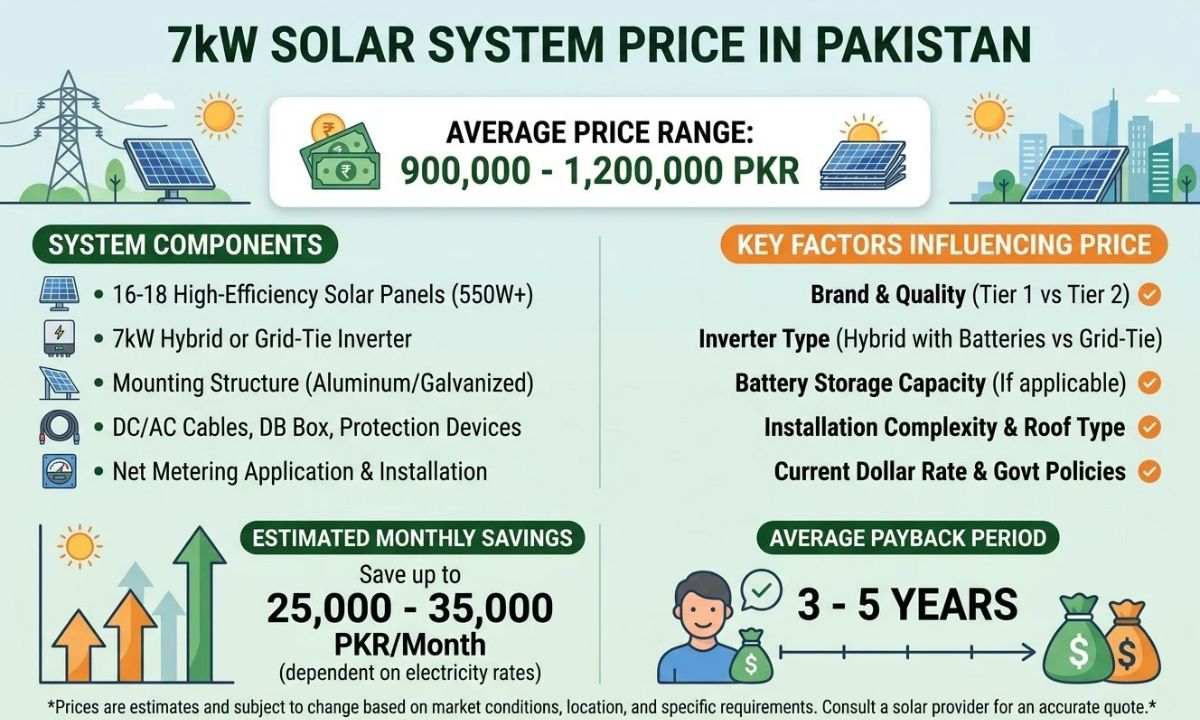
In 2026, a 7kW solar system in Pakistan costs between PKR 780,000 and PKR 1,200,000. The price changes based on the system type. An on-grid system (no battery) is the cheapest option. A hybrid system (with battery backup) costs more but gives you power during load shedding too.
The final price also depends on the brand you choose, the quality of panels, and the type of battery. Tier-1 panels and lithium batteries cost more, but they last longer and work better. In this guide, I will break down every cost so you can pick the best 7kW solar system for your home and budget.
☀️ 7kW Solar System Price Calculator Pakistan 2026
Calculate the estimated cost of a 7kW solar system in Pakistan based on your preferred system type, solar panels, inverter, battery, and installation requirements.
Detailed Cost Breakdown
| Component | Estimated Cost |
|---|---|
| Solar Panels (7kW Set: 12-13 x 580W-600W) | PKR 0 |
| Solar Inverter (7kW-8kW Capacity) | PKR 0 |
| Battery System | PKR 0 |
| Mounting Structure (Galvanized Steel) | PKR 0 |
| Installation Services & Labour | PKR 0 |
| Wiring, Cables & Protection Gear | PKR 0 |
| Additional Options (Net Metering & Monitoring) | PKR 0 |
| Estimated Total Range | PKR 0 |
Financial ROI & Savings Estimate
7kW Solar Generation Estimate
🟢 On-Grid System
Best for homes with reliable grid electricity and lower upfront budget. Supports net metering but provides zero backup during load shedding.
🔵 Hybrid System
Best for homes needing load shedding backup and net metering support. Cost varies depending on whether 5kWh or 10kWh lithium batteries are selected.
🟠 Off-Grid System
Best for remote locations or farmhouses with no WAPDA connection, relying entirely on heavy battery storage systems.
7kW Solar System Price in Pakistan 2026: On-Grid vs Off-Grid
Electricity bills in Pakistan keep going up every year, leading more families and shop owners to transition to solar energy. A 7kW solar system is an ideal power capacity for medium to large 4 to 6-bedroom houses in Pakistan because it comfortably powers heavy daily appliances—including 2 to 3 Inverter ACs simultaneously, a water pump, refrigerator, washing machine, lights, and fans—without exorbitant upfront costs.
In 2026, a fully installed 7kW solar system ranges between PKR 750,000 and PKR 1,550,000. On-grid configurations sit at the lower price bound (PKR 750,000 – 980,000), whereas hybrid systems with 5kWh to 10kWh LiFePO4 lithium batteries command higher ranges (PKR 1,100,000 – 1,550,000).
A properly installed 7kW solar array produces approximately 28 to 35 units (kWh) per day, amounting to 840 to 1,050 units monthly. Generating monthly bill savings between PKR 35,000 and PKR 55,000, a 7kW system generally pays for itself within 3 to 4.5 years while delivering clean electricity for over 25 years.
What Does a 7kW Solar System Mean?
A 7kW solar system means a solar setup that can make 7 kilowatts of power at full sun. Think of it like this: “kW” just tells you the size of the system, not how much electricity it makes every day. It is like the engine size of a car. A bigger engine can pull more weight, and a bigger solar system can run more appliances.
In simple words, a 7kW system is a mid-to-large-sized solar setup. It is bigger than the common 3kW or 5kW systems that small homes use. It is built for big houses, joint family homes, or small offices that use a lot of electricity every day.
Pro tip from my own experience: Many people think “7kW” means they will get exactly 7 units of electricity per hour, all day long. That is not true. Real output changes with sunlight, weather, and the angle of your roof. I always tell my clients to expect peak output only during the strongest sun hours, usually between 11 AM and 3 PM.
A 7kW system usually has:
- Solar panels that catch sunlight
- A solar inverter that turns sunlight into usable electricity
- Wiring to connect everything
- A mounting structure to hold panels on the roof
- A battery (only if you want backup power at night)
How Many Appliances Run on a 7kW Solar System?
This is the question I get asked the most. A 7kW system gives you enough power to run a fully loaded home. Here is a simple list of what it can handle at the same time:
- 2 air conditioners (1.5 ton each), running together
- 1 refrigerator
- 4 to 6 ceiling fans
- LED lights across the whole house
- 1 washing machine
- A water motor or pump
- TV, iron, microwave, and small kitchen appliances
Real example: I helped a family in a 10-marla house in Punjab install a 7kW hybrid system last year. They run 2 ACs, a fridge, fans in every room, and their water pump — all at the same time during summer afternoons. Their system handles it without any strain.
If your home has 3 or more ACs, or you run heavy machines for a small business, you may need a bigger system like 8kW or 10kW. A 7kW system is best for homes that want strong daily power, not for very heavy commercial loads.
How Much Energy Does a 7kW Solar System Generate?
A 7kW solar system in Pakistan produces around 26 to 33 units (kWh) of electricity per day. This depends on your city, the season, and how much direct sunlight your roof gets.
Over a month, this adds up to roughly:
| Time Period | Units Generated |
| Per Day | 26 – 33 units |
| Per Month | 750 – 900+ units |
| Per Year | 9,000 – 10,800+ units |
Why the range changes: Summer months give more sun hours, so your system makes more power. Winter and cloudy days lower the output a bit. Cities like Multan, Bahawalpur, and Sukkur usually get more sun than northern areas like Islamabad or Murree.
Pro tip: Always ask your installer to face your panels south for the best sunlight in Pakistan. A wrong angle can lower your output by 10% to 20%, and most people never notice this mistake until they check their bill savings.
City-wise, sunlight matters too. Homes in Sindh and southern Punjab often get slightly higher output because of stronger, more direct sun through the year. Homes in northern areas still generate strong power in summer, but winter output drops a bit more compared to the south.
This does not mean a 7kW system is a bad choice in the north — it just means your monthly units may swing a little more between seasons.
Dust is another silent output killer. In many parts of Pakistan, dust builds up fast on rooftops, especially near busy roads or farmland.
A layer of dust can quietly cut your output by 5% to 15% without you noticing. I always tell my clients to set a simple reminder to clean their panels every two to three weeks during dry months.
How Much Money Does a 7kW Solar System Save?
This is where solar really shines for Pakistani homes. Electricity bills keep going up, but sunlight is free. Here is a simple breakdown of typical savings:
- If your monthly bill is around PKR 25,000 to 35,000, a 7kW system can bring it close to zero during sunny months.
- Yearly savings often reach PKR 250,000 to 400,000, depending on your usage and city.
- Most families recover their full investment (payback period) in 2 to 4 years.
- After payback, you get almost free electricity for the next 15 to 20 years.
Real talk from Farooq: I always tell my clients not to expect a zero bill every single month. Even with solar, you still pay a small fixed charge to the electricity company, and cloudy days lower your output. But the drop in your bill is huge — most families see their bill fall by 70% to 90%.
If you add net metering, any extra power your system makes during the day gets sent back to the grid. The electricity company gives you credit for those units, which lowers your bill even more.
A word of honesty here: net metering buyback rates have dropped in recent times, so you should not plan your whole savings around selling extra units back to the grid.
The real value of solar still comes from using your own power during the day instead of buying it from WAPDA. Think of net metering as a small bonus, not your main savings strategy.
Another thing worth knowing — your savings grow bigger every year, even without touching your system. That’s because grid electricity prices keep rising, but your solar system keeps producing the same free power.
So the money you save this year will likely be even more valuable in three or four years, once grid rates go up again.
On-Grid, Off-Grid, or Hybrid 7kW Solar Systems Costs 2026
Choosing the right type of system changes your price a lot. Here is what each type means and what it costs in 2026:
On-Grid 7kW Solar System
This system stays connected to the WAPDA grid and has no battery. It is the cheapest option, and it works great during the day. But it shuts off during loadshedding for safety reasons.
- Price Range: PKR 780,000 – PKR 900,000
Off-Grid 7kW Solar System
This system runs completely on solar power and batteries, with no connection to the grid at all. It needs a bigger battery bank, which raises the cost.
- Price Range: PKR 900,000 – PKR 1,100,000
Hybrid 7kW Solar System
This is the most popular choice in Pakistan right now. A hybrid system connects to the grid AND has battery backup. You get power from the sun during the day, backup power at night, and grid power when needed.
- Price Range: PKR 950,000 – PKR 1,300,000
| System Type | Battery Included | Works During Loadshedding | Price Range (PKR) |
| On-Grid | No | No | 780,000 – 900,000 |
| Off-Grid | Yes | Yes | 900,000 – 1,100,000 |
| Hybrid | Yes | Yes | 950,000 – 1,300,000 |
Pro tip: If loadshedding is a big problem in your area, always choose hybrid. Yes, it costs more upfront, but the peace of mind during long power cuts is worth every rupee.
How to decide between the three: Ask yourself two simple questions. First, how many hours of loadshedding does your area really face? Second, how much are you willing to spend upfront? If your area rarely loses power and you just want lower bills, on-grid is the smart, budget-friendly pick.
If loadshedding is frequent and long, hybrid gives you the best mix of savings and backup. Off-grid is usually only worth it for homes far from the main grid, like farmhouses or rural properties, where connecting to WAPDA is expensive or not possible at all.
Installation cost is also part of the final price, and it is often left out of quotes people see online. Labor, wiring, net metering paperwork, and structure fitting can add PKR 40,000 to PKR 90,000 on top of the equipment cost, depending on your roof type and how far your house is from the main installer’s base.
Secret Benefits of a 7kW Solar System in Pakistan
Most guides only talk about saving money. But there are more benefits that people don’t think about until after they install solar. Here are the real ones:
Lower Electricity Bills
The biggest and most obvious benefit. Your monthly bill drops sharply once your system is running, especially in the summer when solar output is at its highest.
Affordable Investment
Compared to the yearly cost of rising electricity bills, a 7kW system pays for itself in a few years and then gives you almost free power after that.
Perfect for Small Homes and Big Families
A 7kW system fits well for medium to large homes, joint family setups, and small home-based businesses that need reliable daily power.
Backup During Load Shedding
With a hybrid or off-grid setup, your home stays powered even when your neighbors are sitting in the dark. This matters a lot in areas with long loadshedding hours.
Eco-Friendly Energy
Solar power does not burn fuel and does not create smoke or pollution. It is one of the cleanest ways to power your home.
Low Maintenance
Solar panels need very little care. A simple wipe-down every few weeks to remove dust is usually enough to keep them working well.
Long Lifespan
Good quality solar panels last 20 to 25 years. That is decades of power from one investment.
Increases Property Value
Homes with solar panels installed often sell for a higher price. Buyers like the idea of lower electricity bills from day one.
Energy Independence
You depend less on WAPDA and rising fuel prices. Your home makes its own power, which gives you more control over your electricity costs.
A benefit most guides miss: solar also protects you from sudden voltage fluctuations that damage appliances like fridges, ACs, and motors.
A good hybrid inverter smooths out power delivery, so your expensive electronics face less stress compared to raw, unstable grid power. Over the years, this alone can save you real money on repairs.
Factors Affecting the Pricing of a 7kW Solar System in Pakistan
Solar prices are not fixed everywhere. Many things can push your price up or down. Here are the main factors:
Quality and Grade
A-grade solar panels cost more but last longer and produce more power. Lower-grade panels are cheaper but wear out faster and lose efficiency over time.
Size and Wattage
Bigger panels (like 580W panels) need fewer pieces to reach 7kW, which can sometimes lower installation cost. Smaller panels need more units, which adds to labor and wiring costs.
Material and Technology
Monocrystalline panels are more efficient and cost more. Older technology, like polycrystalline panels, is cheaper but less efficient in Pakistan’s hot weather.
Shipping and Logistics
Since most solar equipment is imported, prices shift with the rupee-dollar exchange rate, shipping costs, and import taxes. This is why prices can change month to month.
Government Policies
Net metering rules, import duties, and renewable energy incentives from the government all affect final pricing. A change in these policies can move prices up or down quickly.
Market Demand
During peak summer months, demand for solar systems goes up. High demand can sometimes push prices higher, while off-season months may bring better deals.
Pro tip: I always advise buying solar equipment a bit before peak summer season (around February–March) when demand is lower and installers are more willing to offer better rates.
Installer Experience and Warranty
Two systems with the exact same panels and inverter can still perform very differently if one is installed poorly. A good installer checks your roof strength, wiring safety, and shading before they even quote a price. Always ask how many years of installation warranty they offer, separate from the manufacturer’s panel and inverter warranty. A weak installation warranty is a warning sign, even if the equipment brand looks good on paper.
Where To Find The Best Solar Panels in Pakistan?
You have two main choices when buying solar equipment: online or from a physical shop. Both have their own pros and cons.
Online Shops
Buying online lets you compare prices easily and read reviews from other buyers. Many solar companies now offer online quotes and even free site surveys before you commit.
- Easy price comparison
- Wider brand selection
- Convenient for busy buyers
- Always confirm the seller is verified before paying
Physical Shops
Local solar markets, especially in big cities like Lahore, Karachi, Islamabad, and Faisalabad, let you see the panels in person and ask questions directly.
- You can check panel quality by hand
- Easier to negotiate price
- Good for building trust with local installers
- Faster after-sales support if something goes wrong
Pro tip: Whether you buy online or offline, always ask for the panel’s datasheet and check that it matches what the seller promised. This one habit saves buyers from a lot of regret later.
It also helps to ask for references from past buyers, especially people who installed a similar size system a year or two ago. A quick phone call to a real customer tells you more about after-sales support than any glossy brochure ever will.
Major Components Required for a 7kW Solar System Installation
A full 7kW solar setup needs several parts working together. Here is what goes into it:
- Solar Panels – Catch sunlight and turn it into DC electricity
- Solar Inverter – Converts DC power into usable AC power for your home
- Battery (Optional) – Stores extra power for use at night or during loadshedding
- Mounting Structure – Holds the panels firmly on your roof at the right angle
- DC & AC Wiring – Carries electricity safely between all parts of the system
- Protection System – Includes fuses and breakers that protect your system from damage
- Net Meter (Optional) – Measures extra power sent back to the grid for bill credit
- Charge Controller (if required) – Controls how power flows into your battery to keep it safe and healthy
Each part plays its own role, and skipping on quality in any one of them can lower the performance of your whole system.
Which part matters most? In my years of dealing with solar installs, I have seen more systems fail because of a cheap inverter than cheap panels.
The inverter is the “brain” of your system — it manages power flow, protects your battery, and switches between solar, battery, and grid power. If you have to save money somewhere, save it on labor negotiation, not on your inverter brand.
7kW Solar System Load Capacity
The load capacity of a 7kW system tells you how much electrical load it can safely handle at one time. In simple terms, it means how many appliances can run together without tripping the system.
A properly installed 7kW system can safely carry a load of around 5,500 to 6,500 watts running at the same time, leaving a small safety margin. This is enough for:
- 2 ACs running together
- Fridge, fans, and lights across the house
- Small kitchen appliances and a water motor
Pro tip: Never run your system at its full rated capacity all the time. Keeping a small buffer helps your inverter last longer and avoids overheating.
If you plan to add more appliances later, like a second fridge or an extra AC, tell your installer upfront. A good installer can size your wiring and inverter slightly higher from day one, so you don’t have to rewire your whole system later when your needs grow.
7kW Solar System with Battery Backup
Adding a battery to your 7kW system gives you power even when the sun goes down or the grid goes off. This is called battery backup, and it is the most requested add-on I get from clients.
Common battery choices in Pakistan include:
| Battery Type | Lifespan | Cost Level | Maintenance |
| Lead-Acid / Tubular | 3–5 years | Low | Needs regular water top-up |
| Lithium (LiFePO4) | 8–15 years | High | Almost zero maintenance |
A mid-size battery bank for a 7kW system usually adds PKR 150,000 to PKR 400,000 to your total cost, depending on whether you choose tubular or lithium batteries.
Pro tip: Lithium batteries cost more upfront, but they last three to four times longer than tubular batteries. Over 15 years, lithium often works out cheaper because you avoid replacing batteries every few years.
How much backup do you actually need? Not every home needs a huge battery. If you just want lights, fans, a fridge, and internet running through the night, a smaller battery does the job at a lower cost.
If you want to run an AC through the night too, you will need a much bigger battery bank, and this can add a serious amount to your total price. Be honest with yourself about what you truly need overnight, instead of buying the biggest battery just because it sounds impressive.
How Many ACs Can Run on a 7kW Solar System?
A 7kW solar system can comfortably run 2 air conditioners (1.5 ton each) at the same time, along with your normal household load like fans, lights, and a fridge.
If you add a bigger battery bank and reduce other loads, some homes stretch this to 3 ACs, but it depends on:
- Type of AC – Inverter ACs use less power than non-inverter ACs
- Hours of use – Running ACs for fewer hours saves power for other appliances
- Sunlight available – Cloudy days reduce how much power you have to use
Real example: One of my clients in Faisalabad runs 2 ACs almost all day in peak summer, plus their full household load, without any issue on their 7kW hybrid system. But when they tried adding a third AC in the same room, the system needed extra support from the grid.
How Many Panels Are Needed for a 7kW Solar System?
The number of panels depends on the wattage of each panel you choose. Higher wattage panels mean fewer panels needed to reach 7kW.
| Panel Wattage | Panels Needed for 7kW |
| 545W | 13 panels |
| 550W | 13 panels |
| 580W | 12 panels |
| 600W | 12 panels |
Most 7kW systems in Pakistan use 12 to 14 panels. You will need roughly 400 to 550 square feet of roof space to fit them all with proper spacing for airflow and maintenance access.
Pro tip: Always leave a small gap between panel rows. This helps with cooling and makes it much easier to clean the panels later without stepping directly on them.
Final Thoughts
That covers everything you need to know about a 7kW solar system price in Pakistan for 2026. Prices can shift a little with the dollar rate and import costs, so always get a fresh quote before you buy. But the numbers in this guide give you a solid, honest starting point to plan your budget.
If you are serious about cutting your electricity bill and getting real backup power during loadshedding, a 7kW system is one of the smartest sizes to pick for a medium-to-large Pakistani home. Just remember to compare quotes from a few installers, check the quality of panels and batteries, and always ask for a proper written breakdown before you pay anything.
Solar is not just a purchase — it’s a long-term investment in your home. Choose good components, get a trusted installer, and you’ll be enjoying lower bills for the next 20 years.
“FAQs”
How many ACs can run on a 7kW solar system?
A 7kW solar system can comfortably run 2 air conditioners (1.5 ton each) along with normal household loads like fans, lights, and a fridge. With a bigger battery and lighter other loads, some homes stretch this to 3 ACs.
How much power does a 7kW solar system produce?
A 7kW solar system produces around 26 to 33 units (kWh) per day, which adds up to roughly 750 to 900+ units per month. Actual output depends on your city, season, and sunlight hours.
What is the price of a 7kW solar system in Pakistan?
A 7kW solar system in Pakistan costs between PKR 780,000 and PKR 1,300,000, depending on the system type. On-grid is the cheapest, while hybrid with battery backup costs the most.
Is 7kW enough to run a house?
Yes, 7kW is enough for a medium-to-large house running 2 ACs, a fridge, fans, lights, and other daily appliances. For homes with 3 or more ACs or heavy commercial loads, a bigger system is recommended.
Can I run 2 ACs on a 5kW solar system?
Running 2 ACs on a 5kW system is possible but tight, especially with other appliances running at the same time. A 7kW system gives more comfortable room for 2 ACs plus your full household load.
How many solar panels for 7kW?
A 7kW solar system usually needs 12 to 14 panels, depending on the wattage you choose. For example, 545W panels need about 13 panels, while 580W panels need about 12.
How much does a 7kW solar system with battery cost?
A 7kW solar system with battery backup (hybrid or off-grid) typically costs between PKR 900,000 and PKR 1,300,000. The exact price depends on whether you choose tubular or lithium batteries.

I AM CH SAMI ULLAH, THE TOP SOLAR PANEL SELLER AND INSTALLER IN PAKISTAN, WITH CHEAPEST RATES, OF TOP QUALITY. GET THE LATEST RATES ON SOLAR PANELS, FANS, ACs, TUBE WELLS, SOLAR FRIDGES, AND SOLAR ATTA CHAKKIS. WHATSAPP (03461320821)