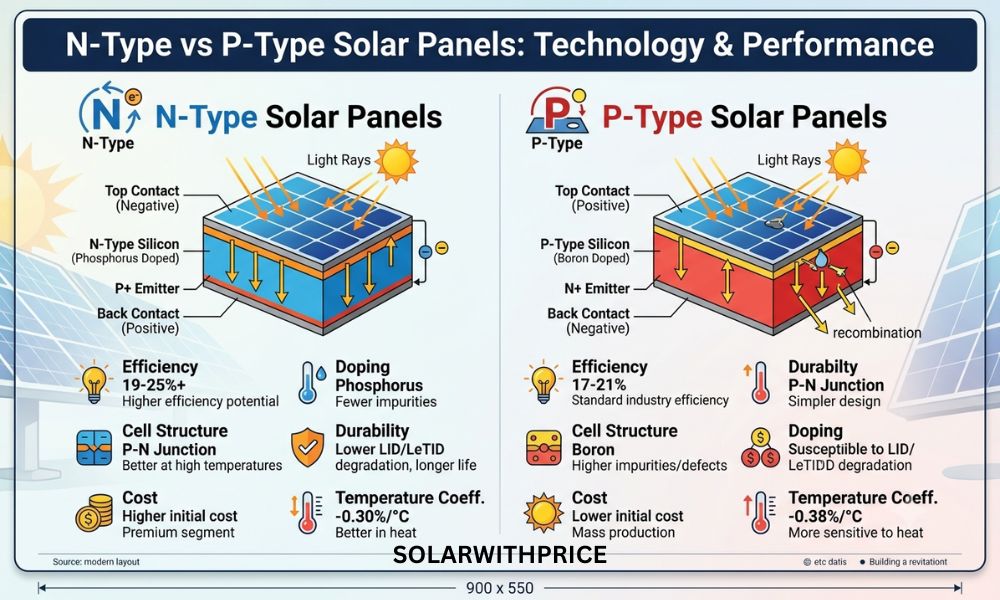
It is very informative news that N-type solar panels are an excellent choice for Pakistan’s hot climate to generate more electricity. They are highly recommended because they handle high temperatures better than older models and are more efficient, converting 22% to 25% of sunlight into usable electricity. It is also important to note that they suffer from almost no power loss over time, ensuring consistent performance for years in 2026.
On the other side, “P-type” solar panels may be cheaper to purchase initially, but n-type panels provide better value in Pakistan. They are slightly less efficient than n-type panels. They are also more sensitive to heat and gradually lose power over time, making them a standard, cost-effective entry-level choice.
My Pro Tip: By generating more power every day, they help you save more money on energy bills, allowing them to pay for themselves much faster. Always keep your solar panels neat & clean to generate more electricity for 25 years.
I recommended you to install bifacial solar panels as well as N-Type technology because they generate more solar energy, and their degradation rate is much lower. The n-type solar panels perform better in hot weather in Pakistan.
What Is a P-Type Solar Panel?
It is very informative news that P-Type panels have been around for a long time in Pakistan. They were the standard choice for solar systems for over 40 years in the world.
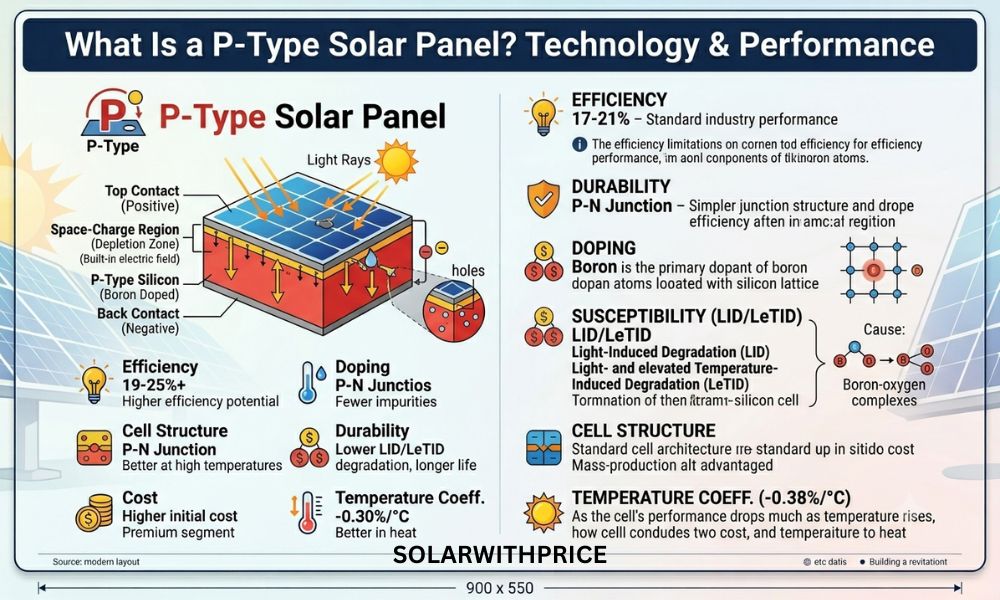
Technology: Inside a P-Type solar panel, the silicon is mixed with boron in 2026. Boron has fewer electrons than silicon. This creates what engineers call “holes” – small gaps that carry electricity through the cell.
P-Type solar panels are:
- Cheaper to buy
- Widely available all over Pakistan
- Good for budget-conscious buyers
- Tested and proven technology
My personal experience: Most of the older solar installations in Pakistan, homes, shops, and schools, use P-Type solar panels. They work fine. But they have some weaknesses, especially in hot weather.
What Is an N-Type Solar Panel?
It is also very informative news that N-Type solar panels are the newest technology in the world in 2026. They are now becoming popular in Pakistan because of their benefits. They generate more electricity in every weather condition.
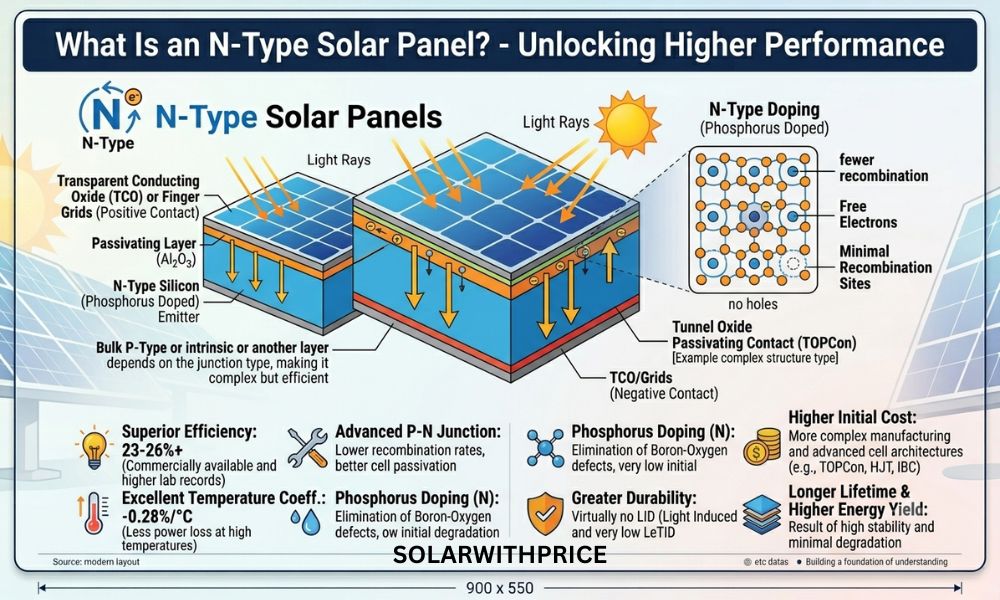
Technology: Inside an N-Type panel, the silicon is mixed with phosphorus. Phosphorus adds extra electrons. This creates a different kind of electrical flow – one that is more stable and more efficient.
N-Type solar panels are:
- More efficient (produces more electricity per square metre)
- Better in hot weather
- More durable over 25 years
- Slightly more expensive
My personal experience: Right now, big solar brands like LONGi, Jinko, Trina, and JA Solar are all shifting their best products to N-Type technology.
N-Type vs P-Type – The Main Differences
Here is a simple side-by-side comparison so you can understand clearly by reading our easy table in detail as follows.
| Feature | P-Type Panel | N-Type Panel |
|---|---|---|
| Silicon Doping | Boron | Phosphorus |
| Efficiency | 19% to 21% | 21% to 24% |
| Temperature Performance | Average | Excellent |
| Light-Induced Degradation (LID) | Yes (degrades over time) | Almost Zero |
| Lifespan | 25 years | 25–30 years |
| Price per Watt (Pakistan 2025) | Rs. 42 to Rs. 43 | Rs. 45 to Rs. 48 |
| Availability in Pakistan | Very High | Growing Fast |
| Best For | Budget systems | Long-term investment |
Why Pakistan’s Climate Matters
Pakistan has a very hot climate in summer from May to September every year. In Lahore, Karachi, Multan, and Faisalabad, summer temperatures regularly go above 40°C. In many cities, rooftop temperatures can go above 60°C during June and July.
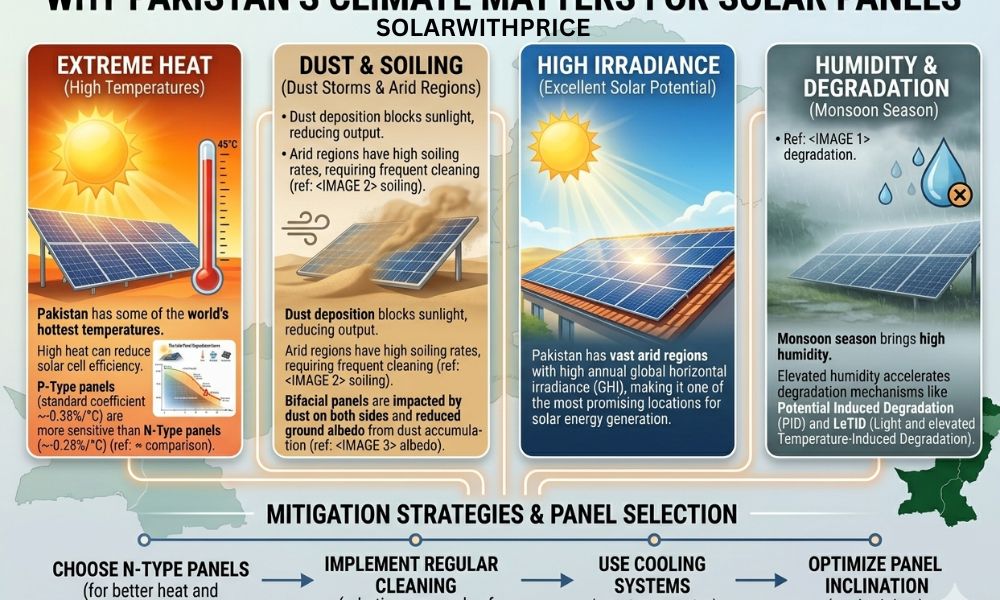
Solar panels produce less electricity when they get very hot. This is measured by something called the temperature coefficient. It tells you how much output a panel loses per degree Celsius above 25°C.
- P-Type panels: around -0.35% per °C
- N-Type panels: around -0.29% per °C
This does not sound like a big difference. But in Pakistan’s summers, it adds up. Over a full year, N-Type panels generate noticeably more electricity than P-Type panels installed side by side on the same roof.
My personal experience: Pakistan’s summers are long, almost 7 months. Your solar panels will be sitting in 45°C heat for 5 to 6 months. N-Type handles this better. Every extra unit of electricity saves you money on your bill.
Light-Induced Degradation (LID) – A Big Problem for P-Type
When a P-Type panel is first exposed to sunlight, it loses some of its power. This is called Light-Induced Degradation, or LID.
In the first few days or weeks of use, a P-Type panel can lose 1% to 3% of its rated output. You pay for a 545W panel, but it performs like a 530W panel from day one.
N-Type panels have almost zero LID. This means what is written on the box is what you actually get. No hidden loss. No early degradation.
Over 25 years, this difference adds up to a meaningful amount of lost electricity with P-Type panels.
N-Type vs P-Type Price Comparison in Pakistan (2026)
Let me be honest about the prices. N-Type panels cost more upfront. But the gap is not as big as it used to be.
| Feature | N-Type (TOPCon/HJT) | P-Type (Mono PERC) |
| Price Per Watt | PKR 44 – 48 | PKR 40 – 43 |
| Market Positioning | Premium / Industry Standard | Budget-Friendly / Entry-Level |
| Heat Tolerance | Excellent | Average |
| Efficiency | Higher (22% – 25%) | Standard (20% – 22%) |
| Degradation | Near-zero (Longer lifespan) | Higher (Faster power loss) |
| Best For | Long-term ROI & Heat Resilience | Lower Upfront Investment |
For a full 5kW residential system:
| System Type | Verified Total Cost (PKR) |
|---|---|
| 5kW with P-Typesolar panels | Rs. 750,000 |
| 5kW with N-Type solar panels | Rs. 800,000 |
Yes, N-Type costs about Rs. 100,000 to Rs. 150,000 more. But N-Type also produces roughly 15% more electricity over the same period.
My personal experience: For a household using 30 units per day, that is roughly 135 extra units per month – saving you thousands of rupees in electricity bills every month.
N-Type Sub-Technologies: TOPCon and HJT in Pakistan 2026
There are two main types you will see in Pakistan, like TOPCon and HJT, and here we will discuss each.
TOPCon (Tunnel Oxide Passivated Contact)
This is the most common N-Type technology available in Pakistan right now. Brands like LONGi Hi-MO 10, Jinko Tiger Neo, Trina Vertex N, and JA Solar Deep Blue 4.0 all use TOPCon.
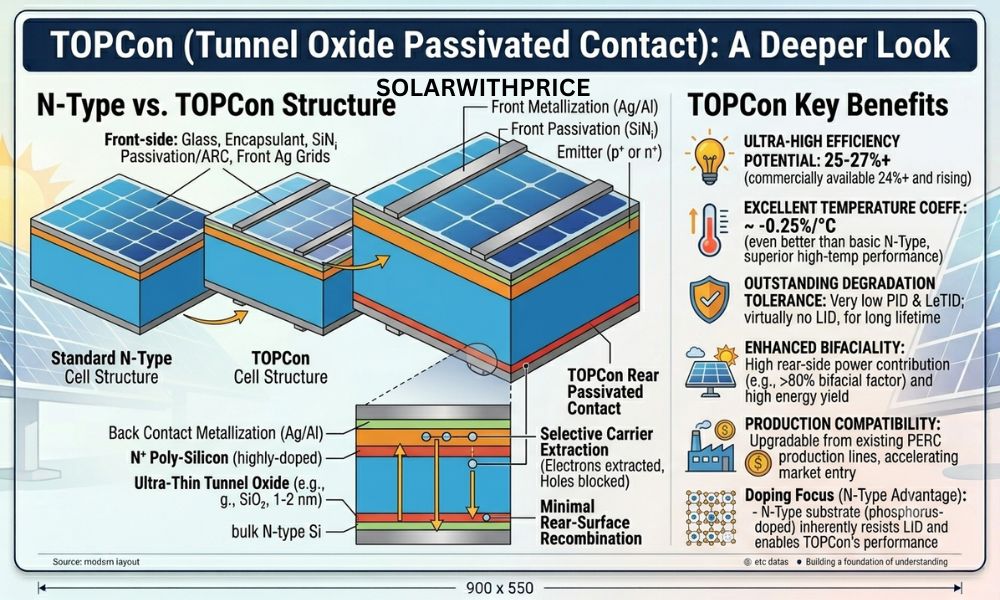
- Efficiency: 21% to 23%
- Good balance of price and performance
- Available from major distributors in Lahore, Karachi, and Islamabad
- Best for residential and commercial rooftop systems
HJT (Heterojunction Technology)
HJT is even more advanced. It layers amorphous silicon on crystalline silicon for the best efficiency possible.
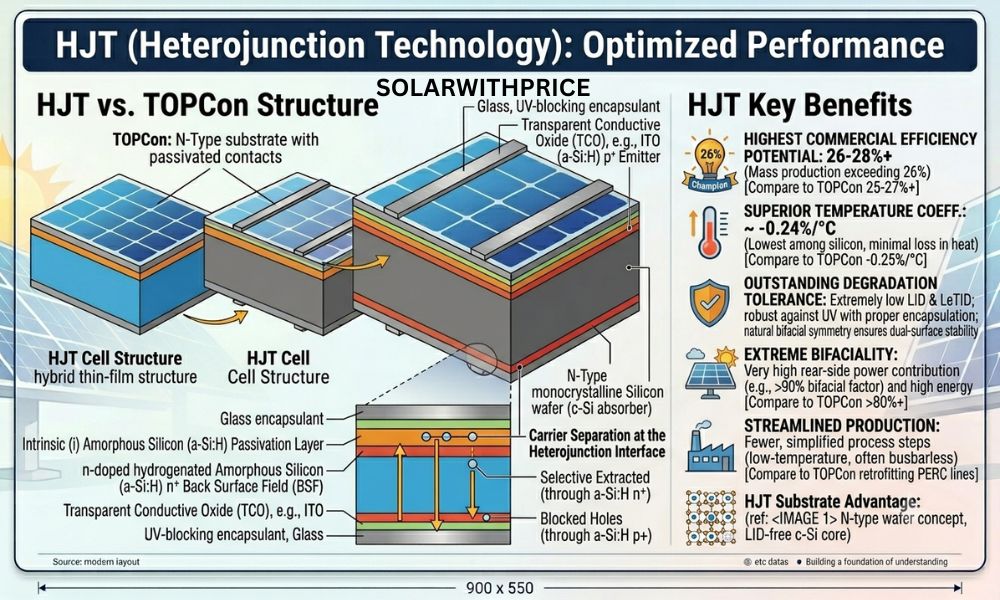
- Efficiency: up to 24%+
- More expensive than TOPCon
- Less commonly available in Pakistan
- Best for limited rooftop space where maximum output is needed
My personal experience: For most Pakistani buyers, TOPCon N-Type is the sweet spot right now.
Popular N-Type and P-Type Brands in Pakistan 2026
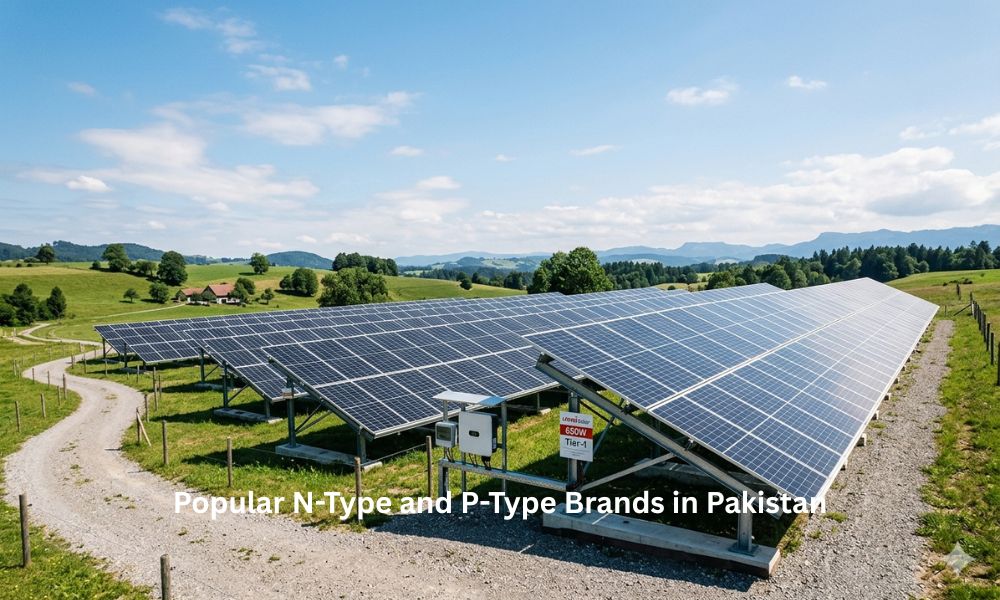
N-Type Brands Available in Pakistan
LONGi Hi-MO 10 / Hi-MO X10. One of the most popular N-Type panels in Pakistan. LONGi is a trusted name with good warranty support and wide availability.
Jinko Tiger Neo Jinko is another top-tier brand. Their Tiger Neo series uses TOPCon N-Type cells and is widely imported into Pakistan.
Trina Vertex N Trina Solar’s N-Type line offers excellent efficiency with a competitive price. Astronergy (a Trina-related brand) is also actively marketing N-Type TOPCon in Pakistan.
JA Solar Deep Blue 4.0 JA Solar’s latest N-Type series is gaining popularity in Pakistan for its reliability and warranty terms.
P-Type Brands Still Available in Pakistan
Canadian Solar (HiKu series) is still widely used for budget-conscious installations. Good reliability and wide availability.
Inverex and Crown (local brands). These local brands mostly use P-Type PERC technology. Affordable and useful for smaller systems.
Which One Should You Buy in Pakistan?
There, we will discuss completely Which One Should You Buy in Pakistan nowadays, like features as follows
Buy N-Type (TOPCon) if:
- You have a medium to large roof (10 panels or more)
- You plan to use the system for 15 to 25 years
- You want maximum electricity production in hot summer months
- You are applying for net metering and want the best returns
- Your budget allows Rs. 33 to Rs. 37 per watt
Buy P-Type (PERC) if:
- Your budget is tight, and you need to keep costs low
- You are installing a small system (3kW to 5kW)
- You plan to upgrade or replace panels within 10 years
- You are in a mild-climate area with less heat stress on panels
What About Warranty?
It is also important to note that N-Type panels often offer slightly better performance guarantees. For example, some LONGi and Jinko N-Type panels guarantee 87% to 90% output after 25 years, while many P-Type panels guarantee 80% to 83%.
- 10 to 12 years product warranty (against defects)
- 25 to 30 years performance warranty (guaranteeing output level)
My pro tip: Always ask your dealer for the warranty certificate before buying in Pakistan, because there are also many wrong sellers.
Real Example – A Home in Lahore
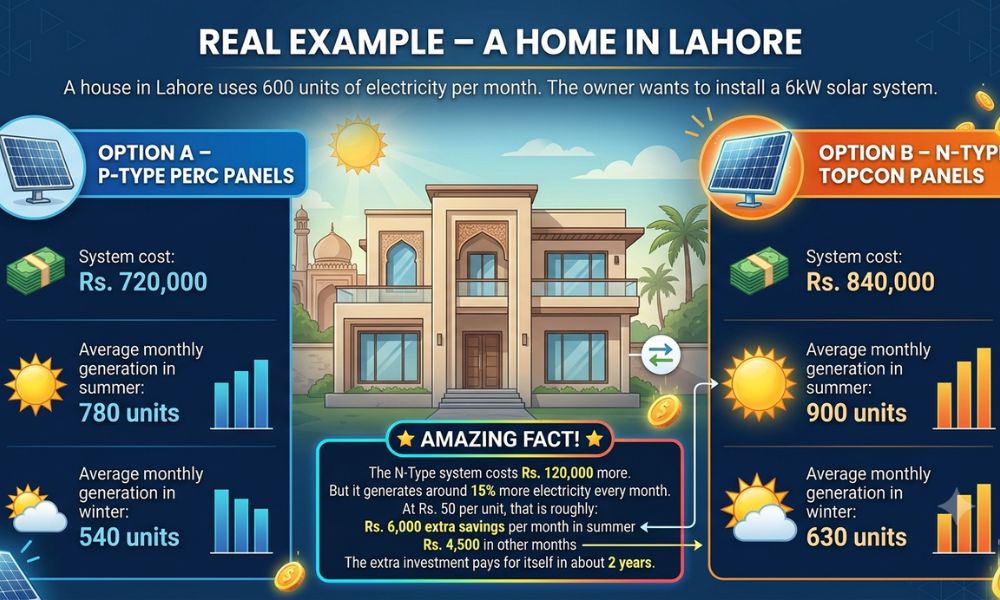
A house in Lahore uses 600 units of electricity per month. The owner wants to install a 6kW solar system.
Option A – P-Type PERC panels:
- System cost: Rs. 720,000
- Average monthly generation in summer: 780 units
- Average monthly generation in winter: 540 units
Option B – N-Type TOPCon panels:
- System cost: Rs. 840,000
- Average monthly generation in summer: 900 units
- Average monthly generation in winter: 630 units
Amazing Fact: The N-Type system costs Rs. 120,000 more. But it generates around 15% more electricity every month. At Rs. 50 per unit, that is roughly Rs. 6,000 extra savings per month in summer and Rs. 4,500 in other months.
The extra investment pays for itself in about 2 years.
Final words
N-type solar panels are an excellent choice for Pakistan’s hot climate to generate more electricity.
They are highly recommended because they handle high temperatures better than older models and are more efficient, converting 22% to 25% of sunlight into usable electricity.
It is also important to note that they suffer from almost no power loss over time, ensuring consistent performance for years in 2026.
On the other side, “P-type” solar panels may be cheaper to purchase initially, but n-type panels provide better value in Pakistan.
They are slightly less efficient than n-type panels. They are also more sensitive to heat and gradually lose power over time, making them a standard, cost-effective entry-level choice.
FAQs
Are N-Type panels available in small cities in Pakistan?
Yes, availability has improved a lot. Major distributors in Lahore, Karachi, and Islamabad stock N-Type panels from leading brands. In smaller cities, you may need to contact regional dealers or order from city distributors.
Is N-Type better than P-Type in Pakistan?
Yes, for Pakistan’s hot climate, N-Type panels perform better. They handle high temperatures more efficiently and do not suffer from light-induced degradation. They are a better long-term investment.
What is TOPCon in solar panels?
TOPCon stands for Tunnel Oxide Passivated Contact. It is the most popular N-Type solar cell technology right now. It is used by LONGi, Jinko, Trina, and JA Solar in their latest panels.
How much more do N-Type panels cost in Pakistan?
N-Type TOPCon panels typically cost Rs. 43 to Rs. 48 per watt compared to Rs. 40 to Rs. 43 per watt for standard P-Type panels. This is roughly 8% to 15% more.
Do P-Type panels still make sense in Pakistan?
Yes, for buyers on a tight budget, P-Type PERC panels are still a solid choice. They are cheaper, widely available, and work reliably. If you want to upgrade later, you can always add N-Type panels to your system.
What is LID (Light-Induced Degradation)?
LID is when a solar panel loses some power output in the first few days of sunlight exposure. P-Type panels suffer from LID (1% to 3% loss). N-Type panels have almost zero LID, meaning you get the full rated output from day one.
Which brands offer N-Type panels in Pakistan?
LONGi, Jinko Solar, Trina Solar, Astronergy, and JA Solar all offer N-Type panels in Pakistan. These are available through authorised distributors in major cities.
Will N-Type panels become cheaper in Pakistan?
Yes. As global N-Type production increases, prices are coming down. N-Type market share has grown from less than 5% globally in 2020 to around 15% in 2025, and production will continue to expand.

I AM CH SAMI ULLAH, THE TOP SOLAR PANEL SELLER AND INSTALLER IN PAKISTAN, WITH CHEAPEST RATES, OF TOP QUALITY. GET THE LATEST RATES ON SOLAR PANELS, FANS, ACs, TUBE WELLS, SOLAR FRIDGES, AND SOLAR ATTA CHAKKIS. WHATSAPP (03461320821)