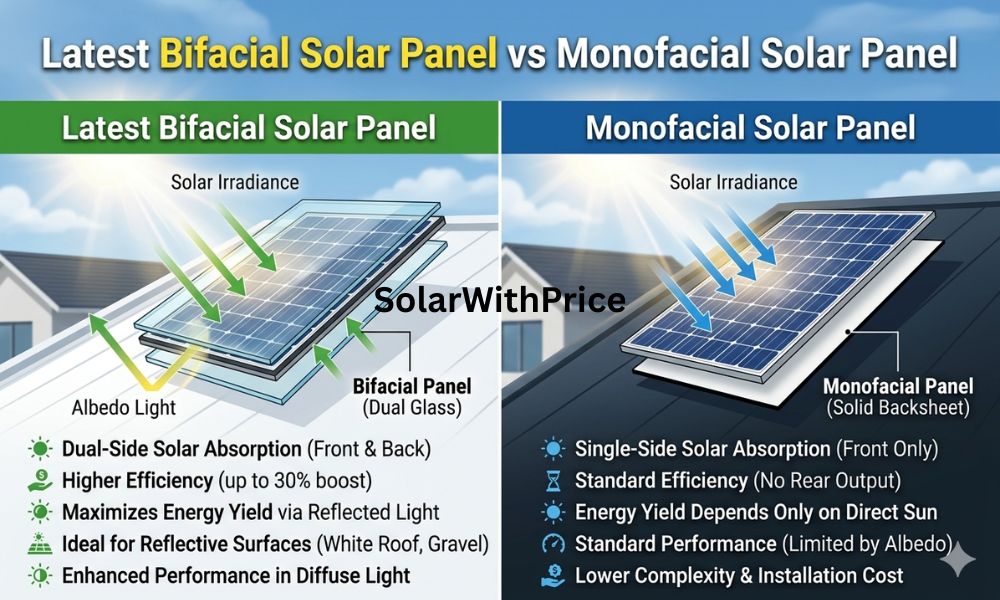
The Bifacial Solar Panels can generate electricity from both sides, the front side as well as the back side, which is why trending in the world, especially in Pakistan. They have the highest efficiency rate to generate a large amount of electricity because they absorb sunlight from two surfaces. The bifacial solar panels also have a longer life span, which is a bonus point.
The Monofacial solar panels have only one side, the front side, to generate electricity. These are also known as Single-glass solar panels because their front side absorbs sunlight. They have a slightly lower efficiency rate as well as life to generate electricity. Monofacial solar panels are a little bit cheaper than bifacial solar panels in Pakistan.
The Bifacial solar panel prices are 46 to 50 rupees per-watt and 24,000 to 33,000 rupees per solar panel in Pakistan nowadays. On the other hand, monofacial solar panel prices range from 42 to 44 rupees per-watt and 22,00 to 27,000 rupees per solar panel in Pakistan.
If you are planning to install a solar system in Pakistan, one of the biggest decisions you will face is choosing between a bifacial solar panel vs monofacial solar panel. Both types have their own strengths, costs, and best use cases.
My Pro Tip: But many buyers in Pakistan do not fully understand the difference, and that confusion can cost them money or efficiency in the long run.
What is a Bifacial Solar Panel?
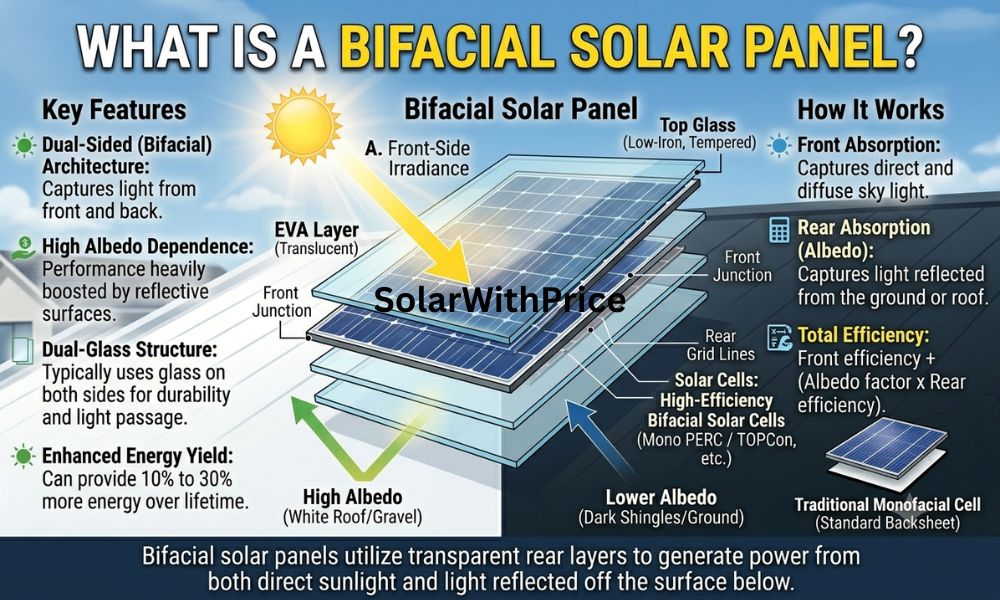
A bifacial solar panel is a type of solar panel that can generate electricity from both the front and the back surface during the day. The front side absorbs direct sunlight, just like a regular solar panel. But the rear side also captures sunlight that bounces off the ground, rooftop, or nearby surfaces; this reflected light is called albedo light.
Important Notice: Because of this dual-sided energy capture, bifacial solar panels can produce significantly more power than traditional single-sided panels under the right conditions.
I have verified that this Bifacial technology became commercially popular around 2015–2017, but by 2026, it had captured over 60% of the global solar panel market in Pakistan. Leading brands like Jinko Solar, LONGi, Canadian Solar, JA Solar, and Trina Solar all offer bifacial modules.
In Pakistan, these solar panels are now widely available through importers and distributors in Lahore, Karachi, Islamabad, and Faisalabad in 2026. It is also important to note that these Prices in mid-2026 range from approximately Rs. 24,000 to Rs. 33,000 per panel, depending on wattage (400W–700W) and brand in Pakistan.
The most common bifacial panel design uses a transparent backsheet or glass-glass (dual glass) structure. The glass-glass design is more durable, more resistant to humidity and UV degradation, and typically carries a 30-year linear performance warranty from top manufacturers.
This makes bifacial panels a strong long-term investment, especially in hot climates like Pakistan, where panel degradation is a real concern over a 25-year system lifespan.
How Much Extra Power Does a Bifacial Panel Produce in 2026?
The extra energy gain from the rear side of a bifacial panel is called the bifacial gain or bifaciality factor. Most quality bifacial panels have a bifaciality coefficient of 70%–85%, meaning the rear side can produce up to 70–85% as much power as the front side per unit of irradiance.
My personal experience: In practical real-world installations in Pakistan, this typically results in a 5% to 20% increase in total energy output compared to a similar monofacial panel.
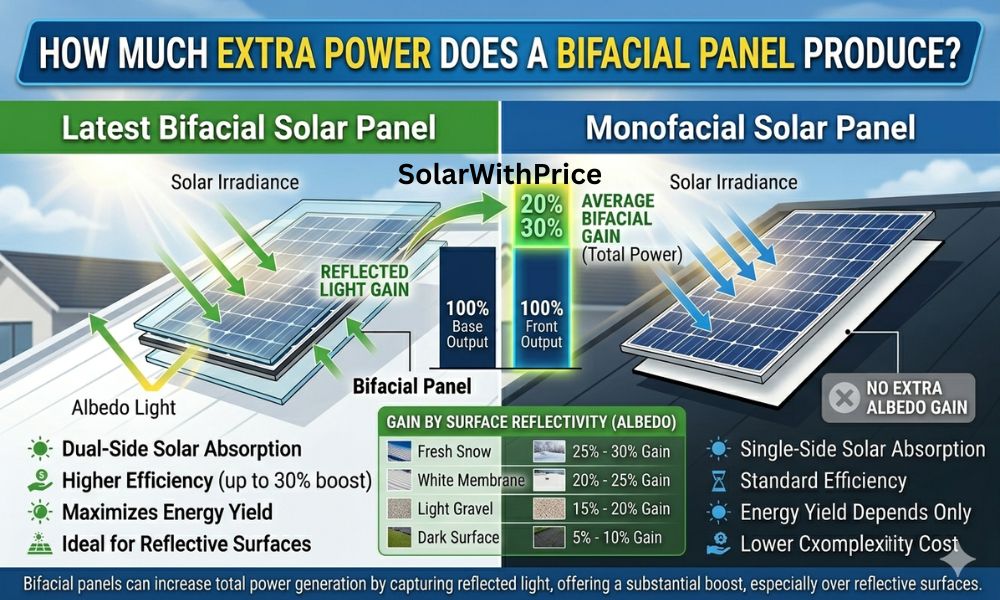
However, this gain depends heavily on the installation setup. For example, if a bifacial panel is installed directly on a dark black roof with no space underneath, the rear side gets very little reflected light, and the bifacial gain drops to near zero.
On the other hand, if panels are installed on white-painted rooftops, light-colored concrete, gravel, or grass, which is common in Pakistani commercial and agricultural setups, the gain can reach 15–20%.
According to independent energy studies, bifacial panels on elevated ground-mount systems with a light-colored surface beneath them show the highest performance gains.
In Pakistan’s agricultural sector, bifacial panels on tube well solar systems (solar pumping systems) mounted at a tilt of 25–30 degrees over sandy or whitewashed concrete surfaces have shown consistent real-world gains of 10–15% in districts like Multan, Bahawalpur, and Rahim Yar Khan, where solar irradiance is among the highest in Asia.
Bifacial Solar Panel Efficiency and Wattage in Pakistan 2026
| Brand | Wattage Range | Peak Efficiency | Technology |
| LONGi | 585W – 650W | 22.5% – 23.6% | N-type TOPCon / HPBC 2.0 |
| Jinko Solar | 585W – 725W | 22.8% – 23.2% | N-type TOPCon |
| Canadian Solar | 585W – 720W | 22.5% – 23.3% | N-type TOPCon / HJT |
| Trina Solar | 580W – 740W | 22.5% – 23.2% | N-type Vertex N (TOPCon) |
| JA Solar | 585W – 710W | 22.4% – 22.8% | N-type TOPCon |
| Astronergy | 585W – 720W | 22.0% – 23.0% | N-type TOPCon |
Latest Bifacial Solar Panel Prices in Pakistan 2026
Bifacial solar panels are generally 10% to 25% more expensive than equivalent monofacial panels in Pakistan nowadays.
| Panel Type | Wattage | Verified Price (PKR) |
|---|---|---|
| Bifacial TOPCon (Tier 1) | 580W–600W | Rs. 26,500 – Rs. 29,000 |
| Bifacial PERC (Tier 1) | 545W–560W | Rs. 24,000 – Rs. 26,000 |
| Bifacial TOPCon (Tier 2) | 580W–620W | Rs. 25,000 – Rs. 27,000 |
| Monofacial PERC (Tier 1) | 400W–550W | Rs. 20,000 – Rs. 26,000 |
| Monofacial PERC (Tier 2) | 380W–540W | Rs. 16,000 – Rs. 25,000 |
These prices are per solar panel, including import duty and local distributor margin in Pakistan in 2026. Installation costs, inverter, mounting structure, wiring, and net metering charges are separate.
My pro tip: When calculating the per-watt cost, Tier 1 bifacial panels typically come out to Rs. 45 to Rs. 49 per watt in the Pakistani market.
Bifacial Solar Panel Installation Requirements in Pakistan 2026
It is very important to note that installing bifacial panels correctly in Pakistan requires some extra planning compared to standard monofacial setups. Because bifacial panels depend on reflected light from the rear side, the installation height, tilt angle, and surface beneath the panels all affect performance.
Raised Mounting Structures: Bifacial panels must be elevated to allow light to reflect onto the rear side. Standard low-profile or flush mounts are generally ineffective, as they block the necessary light. For optimal performance, aim for at least 25 cm to 1 meter of clearance between the panel and the roof or ground surface.
High-Albedo Surface Preparation: The area directly beneath the panels should be light-colored to maximize the reflection of sunlight (the “albedo effect”). In Pakistan, where flat cement rooftops are common, painting the roof area under the panels white or using light-colored gravel can significantly increase energy gain.
Professional System Design: Because bifacial installation is more complex, you should engage AEDB-certified installers to ensure structural stability and compliance with local safety regulations. Proper design helps account for local wind speeds and ensures the mounting hardware does not cast shadows on the rear of the panels.
Strategic Row Spacing: If installing multiple rows, provide adequate space (at least 2.5 meters) between them. This prevents shadows from one row of panels from falling onto the next, which would otherwise decrease the rear-side energy yield.
Careful Electrical & Cable Management: Cables should be routed along the sides or secured using light-colored, non-metallic ties to avoid casting shadows on the rear of the modules. Ensure that junction boxes and electrical connections are properly waterproofed (IP65 or higher) to withstand Pakistan’s weather conditions.
Maintenance for Reflectivity: Regular cleaning is essential. Dust and debris on the panels or on the reflective surface beneath them will reduce the albedo effect and overall system efficiency.
Bifacial Solar Panel Brands Available in Pakistan 2026
Several international and local brands offer bifacial solar panels in the Pakistani market. Here is a quick overview of the most commonly available options:
| Brand | Notable Technology |
| LONGi solar panel | HPBC 2.0 / N-type TOPCon |
| Jinko Solar | N-type TOPCon |
| Canadian Solar | HJT / N-type TOPCon |
| Trina Solar | Vertex N (TOPCon) |
| JA Solar | N-type TOPCon |
| Astronergy | N-type TOPCon |
These brands are preferred for their reliability, high-efficiency N-type TOPCon technology, and suitability for Pakistan’s climate.
What Is a Monofacial Solar Panel 2026?
A monofacial solar panel is the traditional, single-sided solar panel that most people in Pakistan are familiar with. It generates electricity only from the front surface, which faces the sun. The rear side is covered by a white or black opaque backsheet, which does not contribute to power generation.
Monofacial solar panels have been the industry standard since the early days of residential solar installations in the 1990s and 2000s, and they still make up a significant portion of solar panel sales worldwide and in Pakistan.
Monofacial panels are simpler in design, lighter in weight, and generally less expensive than bifacial panels. They work well in the vast majority of residential rooftop installations and are the go-to choice for budget-conscious buyers.
My pro tip: In Pakistan, almost every solar installer is comfortable with monofacial panel installation, making it easier to find qualified technicians and replacement parts if needed.
Monofacial Solar Panel Efficiency and Performance
Standard Tier 1 monocrystalline monofacial PERC panels available in Pakistan today offer efficiency ratings of 19% to 21.5%, which is solid performance for most residential and commercial applications.
Wattage range is typically 400W to 545W per panel for the most common sizes in the Pakistani market. For a standard 5kW home system using 450W monofacial panels, you would need approximately 11–12 panels.
Monofacial panels perform very predictably because their output depends only on direct front-side irradiance. This makes energy yield calculations easier and more reliable during the design phase of your solar project.
Additionally, because there is no rear-side irradiance component, monofacial panel performance is less affected by installation factors like rooftop color or panel height. A monofacial panel installed on a black roof will perform almost identically to the same panel on a white roof, which makes them simpler to plan and install.
However, monofacial panels do still experience efficiency losses in high temperatures. Pakistan’s summer temperatures are extreme, and rooftops can reach 65°C or higher.
At these temperatures, even the best monofacial PERC panels will show a power output reduction of 20–25% compared to their rated output at Standard Test Conditions (STC, which is 25°C).
Latest Monofacial Solar Panel Price and Value in Pakistan 2026
Monofacial solar panels are the more affordable option in Pakistan. Tier 1 brands like LONGi, Jinko, JA Solar, and Trina offer monofacial PERC panels at approximately Rs. 22,000 to Rs. 35,000 per panel in the 400W–545W range.
| Brand | Recommended Series / Model | Technology |
| LONGi | Hi-MO X10 / Hi-MO 10 | N-Type TOPCon / HPBC |
| Jinko Solar | Tiger Neo Series | N-Type TOPCon |
| JA Solar | DeepBlue 4.0 Series | N-Type TOPCon |
| Trina Solar | Vertex N / Vertex S+ | N-Type TOPCon |
| Canadian Solar | HiKu / HiHero Series | N-Type TOPCon / HJT |
| Astronergy | N-Type Bifacial Series | N-Type TOPCon |
| AIKO | ABC Series | All Back Contact (ABC) |
| Risen Energy | Titan Series | Half-Cut / Bifacial |
| Suntech | Ultra V Series | Mono PERC |
| ZnShine | Graphene-Coated Series | Graphene-Coated PERC |
My personal experience: Local Pakistani brands and Tier 2 Chinese brands offer panels in the Rs. 23,000 to Rs. 28,000 range. On a per-watt basis, monofacial panels typically cost Rs. 43 to Rs. 45 per watt installed.
When to Choose Monofacial Over Bifacial
Monofacial panels are the better choice in several specific situations common in Pakistan. If your rooftop has a dark surface (e.g., black or dark grey tiles or waterproofing) and painting it white is not practical, the bifacial advantage largely disappears.
Similarly, if your solar panels will be mounted flush against the rooftop with no clearance underneath, the rear side of a bifacial panel gets little to no reflected light, making the price premium unjustified.
Additionally, monofacial panels are better for installations where budget is a primary constraint and maximum ROI speed is the goal. For example, a small business owner in Multan who wants to reduce their electricity bill as quickly as possible and has limited capital will often find that a larger monofacial system.
Bifacial Solar Panel vs Monofacial Solar Panel
| Feature | Monofacial Solar Panels | Bifacial Solar Panels |
| Energy Capture | Front side only | Front and rear (reflected light) |
| Rear Structure | Opaque backsheet | Transparent backsheet or dual-glass |
| Typical Efficiency | Standard | Higher (potential for 5–30% boost) |
| Ideal Installation | Standard rooftops, limited space | Ground-mounts, open areas, reflective surfaces |
| Cost | More affordable (lower upfront) | Higher upfront cost |
| Weight | Generally lighter | Heavier (due to dual-glass design) |
| Best For | Budget-conscious residential users | Commercial/industrial or high-yield goals |
Durability and Lifespan Comparison: Bifacial vs. Monofacial
| Feature | Monofacial Panels | Bifacial (Glass-Glass) Panels |
| Product Warranty | Typically 10+ years | Typically 10+ years |
| Performance Warranty | 25–30 years (Linear) | 25–30 years (Linear) |
| Annual Degradation Rate | 0.5% – 0.7% per year | 0.3% – 0.4% per year |
| Primary Durability Edge | Standard | Superior resistance to PID, moisture, and UV |
| Weight | 22 – 25 kg | 28 – 35 kg |
| Structural Requirement | Standard | May require rooftop assessment |
Which Is Better for Pakistan: Bifacial or Monofacial?
The honest answer is: it depends on your specific situation. Here is a practical guide for Pakistani buyers:
Choose Bifacial if:
- You have a white or light-colored rooftop (or can paint it white)
- Your panels will be elevated at least 30 cm above the roof
- You have a ground-mount system, agricultural pump system, or elevated rooftop system
- You want maximum long-term energy production and are willing to pay a higher upfront cost
- Your system is 10kW or larger (where bifacial’s higher per-panel wattage reduces the total panel count needed)
Choose Monofacial if:
- Your budget is limited, and you want maximum wattage per rupee
- Your rooftop is dark-colored and cannot be painted
- Panels will be flush-mounted with little clearance underneath
- You need a straightforward, simple installation
- You are buying from a local or Tier 2 brand, where bifacial options may have less reliable quality control
Comparison Table: Bifacial vs Monofacial Solar Panels (Pakistan)
| Feature | Bifacial Solar Panel | Monofacial Solar Panel |
|---|---|---|
| Power Generation | Both sides (front + rear) | Front side only |
| Typical Efficiency | 20%–23.5% | 19%–21.5% |
| Common Wattage (Pakistan) | 545W–700W | 380W–545W |
| Price Per Panel (PKR) | Rs. 28,000–55,000 | Rs. 16,000–35,000 |
| Price Per Watt (PKR) | Rs. 65–90/W | Rs. 50–75/W |
| Bifacial Gain | 5%–20% extra | N/A |
| Weight | 28–35 kg | 22–25 kg |
| Durability | Glass-glass (superior) | Standard framed backsheet |
| Degradation Rate | 0.3–0.4% per year | 0.5–0.7% per year |
| Performance Warranty | 25–30 years | 25 years |
| Best For | White rooftops, ground mounts, commercial | Budget installs, dark rooftops, flush mounts |
| Top Brands (Pakistan) | LONGi, Jinko, JA Solar, Trina | LONGi, Jinko, Canadian Solar, Inverex |
| Installation Complexity | Moderate–High | Low–Moderate |
FAQs: Bifacial Solar Panel vs Monofacial Solar Panel
Q1: Which is better for a home solar system in Pakistan — bifacial or monofacial?
For most Pakistani homes with a standard concrete rooftop, a Tier 1 bifacial TOPCon panel is the better long-term investment if the rooftop can be painted white and panels can be elevated properly. If the budget is tight or the roof cannot be prepared for bifacial gain, a quality Tier 1 monofacial PERC panel is still an excellent choice. The right decision depends on your roof type, budget, and system size.
Q2: How much more expensive are bifacial solar panels in Pakistan?
Bifacial panels are typically 10–25% more expensive than equivalent monofacial panels in Pakistan. For example, a 580W bifacial TOPCon panel from a Tier 1 brand may cost Rs. 40,000–50,000, while a 545W Tier 1 monofacial PERC panel may cost Rs. 28,000–35,000.
Q3: Do bifacial solar panels work on dark or black rooftops in Pakistan?
Bifacial panels perform significantly worse on dark rooftops because the rear side needs reflected light (albedo) to generate extra power. On a dark rooftop with no surface preparation, the bifacial gain can drop to near zero, making the price premium unjustified.
Q4: Which solar panel brands in Pakistan offer bifacial panels with local warranty support?
LONGi, Jinko Solar, JA Solar, Trina Solar, and Canadian Solar all offer bifacial panels in Pakistan, primarily through authorized local distributors. Pakistan’s own Inverex brand also offers bifacial panels with local warranty support.
Q5: What is the lifespan difference between bifacial and monofacial solar panels?
Both bifacial and monofacial panels from Tier 1 brands are designed to last 25–30 years. However, glass-glass bifacial panels typically degrade more slowly (0.3–0.4% per year) compared to standard monofacial panels (0.5–0.7% per year).
Conclusion
The Bifacial Solar Panels can generate electricity from both sides, the front side as well as the back side, which is why trending in the world, especially in Pakistan.
They have the highest efficiency rate to generate a large amount of electricity because they absorb sunlight from two surfaces. The bifacial solar panels also have a longer life span, which is a bonus point.
The Monofacial solar panels have only one side, the front side, to generate electricity. These are also known as Single-glass solar panels because their front side absorbs sunlight.
They have a slightly lower efficiency rate as well as life to generate electricity. Monofacial solar panels are a little bit cheaper than bifacial solar panels in Pakistan.
The Bifacial solar panel prices are 46 to 50 rupees per-watt and 24,000 to 33,000 rupees per solar panel in Pakistan nowadays.
On the other hand, monofacial solar panel prices range from 42 to 44 rupees per-watt and 22,00 to 27,000 rupees per solar panel in Pakistan.

I AM CH SAMI ULLAH, THE TOP SOLAR PANEL SELLER AND INSTALLER IN PAKISTAN, WITH CHEAPEST RATES, OF TOP QUALITY. GET THE LATEST RATES ON SOLAR PANELS, FANS, ACs, TUBE WELLS, SOLAR FRIDGES, AND SOLAR ATTA CHAKKIS. WHATSAPP (03461320821)